

Yesterday’s Sunday Serenade, “Here Now, Gently Here,” was created as a grounding-focused song — a gentle invitation back into the present moment. Today’s Meditation Monday reflection explores why that matters. Grounding is not just a calming trick. Repeated over time, it becomes a way of reconditioning the nervous system.
One of the most important ideas in trauma recovery is also one of the most compassionate: Your nervous system can learn to fear, to shut down, to stay vigilant, and to expect rejection, danger, criticism, abandonment, or overwhelm.
But it can also learn safety: presence, steadiness, and pausing before reacting. It can learn to come back after being triggered and to recognize that the present moment is not the past.
That is why meditation, guided imagery, breathwork, prayer, grounding, and gentle body awareness can be so powerful. They are not just relaxation exercises. When done consistently, they become a way to recondition the nervous system.
Not by force.
By repetition.
By safety.
By returning, again and again, to the present moment.
The Window of Tolerance
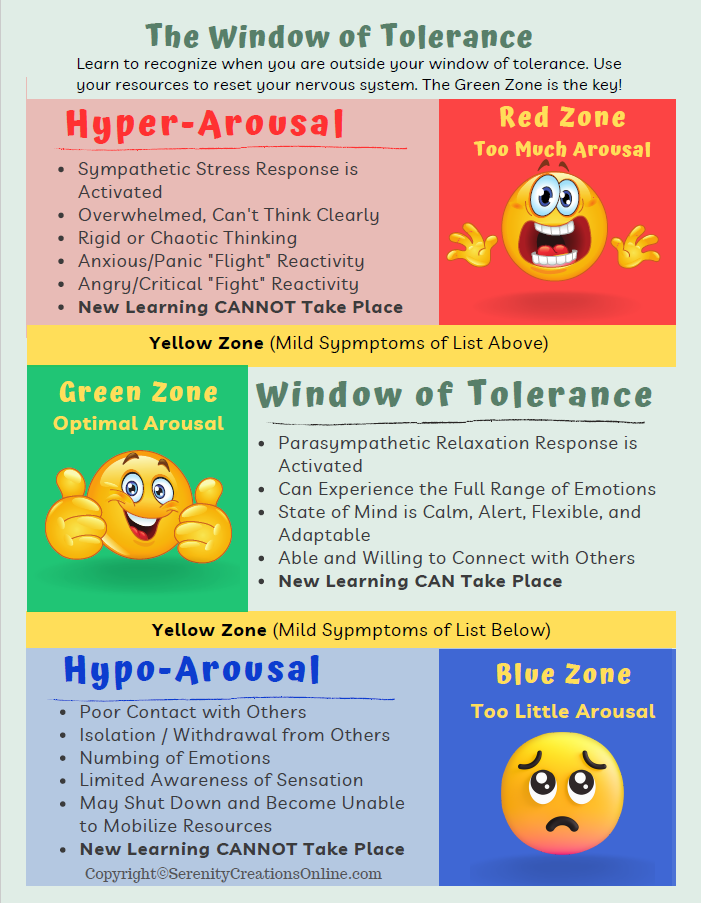
The Window of Tolerance is the range where your nervous system can feel, think, connect, and respond without becoming overwhelmed or shutting down. Inside the window, you may still feel emotion. You may feel sadness, anger, grief, fear, or vulnerability. But you can stay present enough to notice what is happening.
You can say:
Something is happening inside me.
A part of me is activated.
My body is responding.
I can slow this down.
I can come back.
Outside the window, the survival system takes over.
Above the window, we may move into hyperarousal: anxiety, panic, anger, urgency, racing thoughts, over-explaining, controlling, scanning, fixing, or bracing.
Below the window, we may move into hypoarousal: numbness, fog, collapse, shutdown, helplessness, disconnection, fatigue, or “I can’t do this.”
These are not character flaws. They are nervous-system states. And nervous-system states can be reconditioned over time.
The Autonomic Ladder
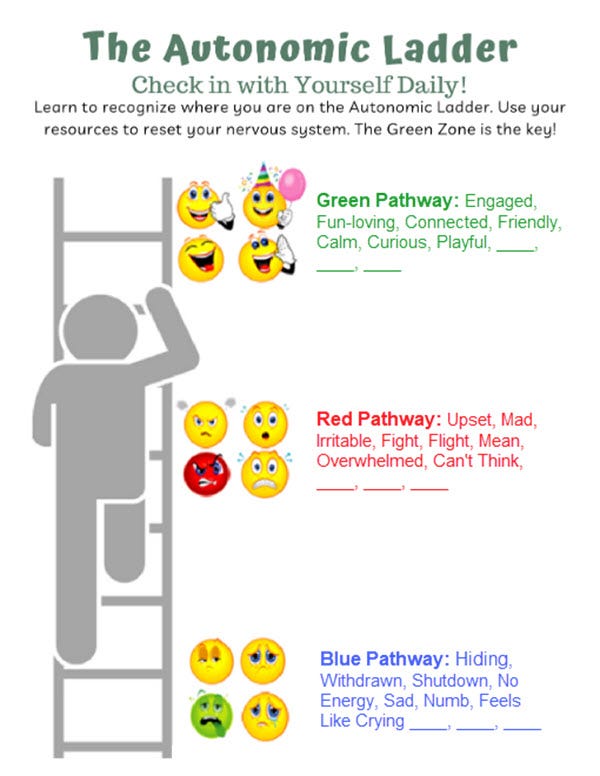
Another helpful image is the Autonomic Ladder. At the top of the ladder, we are more regulated, connected, open, and present. We can think and feel at the same time. We can listen, reflect, repair, create, pray, learn, and connect.
In the middle of the ladder, we are mobilized for survival. This is the fight-or-flight zone. We may become anxious, defensive, urgent, restless, perfectionistic, controlling, or driven to fix something immediately.
At the bottom of the ladder, we enter shutdown survival. The system conserves energy. We may feel numb, heavy, far away, hopeless, frozen, or disconnected.
Meditation Monday is not about pretending we live at the top of the ladder all the time. No one does. The practice is learning to notice where we are — and gently help the body find its way back.
Meditation as Nervous-System Reconditioning
Many people think meditation is supposed to make them feel calm. Sometimes it does. But the deeper purpose is not simply to “feel relaxed.” The deeper purpose is to build a new relationship with activation.
A thought appears
A feeling rises
A body sensation gets loud
A memory flashes
A protector part wants to react
A critic starts talking
The mind wanders
And then, instead of judging yourself, you return:
To the breath
To the body
To the room
To a prayer
To an image of safety
To a compassionate phrase
To the present moment
That return is the practice. Every gentle return is a small act of reconditioning.
The nervous system begins to learn:
I can notice discomfort without being swallowed by it.
I can feel activation and still have choices.
I can come back to myself.
I do not have to obey every alarm.
The present moment can become safer than my old expectations.
This is one reason I love guided meditation, hypnosis, and imagery work. They give the nervous system something specific to practice. Not just an idea, but an experience. And experience is what teaches the deeper brain.
From Survival Practice to Safety Practice
Trauma, chronic stress, and painful attachment experiences often train the nervous system through repetition.
If someone repeatedly experienced criticism, their system may learn to brace.
If they repeatedly experienced abandonment, their system may learn to cling, collapse, or disconnect before anyone else can leave.
If they repeatedly experienced chaos, their system may learn to scan constantly for danger.
If they repeatedly had to perform, please, achieve, or stay invisible to feel safe, those patterns may become automatic.
In LSPM language, these patterns become part of a person’s Default-Mode Loop.
A trigger activates an old belief
The belief activates an emotional memory
A protector part responds
The nervous system moves up or down the ladder
Then familiar coping strategies take over
The loop repeats because the system has practiced it thousands of times.
So healing also needs practice.
Not harsh practice
Not perfectionistic practice
Not “I should be over this by now” practice
Gentle, repeated, emotionally safe practice. That is how we begin shifting from survival practice to safety practice.
The Role of Capacity
Before deep trauma work, we need capacity. Capacity means the ability to stay present with some emotional activation without becoming flooded or collapsed. This is why nervous-system work is not a side issue. It is foundational.
Before we challenge old beliefs, revisit painful memories, work directly with vulnerable parts, or install new emotional learning, we need enough room inside. Meditation helps create that room. Each time you practice, you are not just “relaxing.” You are strengthening the pathway back to presence.
You are teaching your body:
This breath is available.
This room is here.
This moment is different.
I can observe without reacting immediately.
I can feel something without becoming it.
I can come back.
That is the beginning of nervous-system capacity.
A Simple Meditation Monday Practice
Here is a short reflection you can use today.
Take a moment and ask:
Where am I on the ladder right now?
Am I closer to connection and presence?
Am I mobilized — anxious, tense, hurried, irritated, driven, or braced?
Am I lower on the ladder — numb, foggy, tired, discouraged, or shut down?
No judgment.
Just notice.
Then gently ask:
What would help my nervous system move one small step toward safety?
Not all the way to perfect calm.
Just one small step.
Maybe that means feeling your feet on the floor.
Maybe it means taking a slower breath.
Maybe it means looking around the room and naming what you see.
Maybe it means placing a hand over your heart.
Maybe it means praying a simple prayer.
Maybe it means imagining a safe place.
Maybe it means saying:
I am here now
This is this moment
My body is trying to protect me
I can move one small step toward safety
That is enough.
What I Would Add Now
When I first shared this teaching years ago, I emphasized the Window of Tolerance as a trauma-recovery concept. I still believe that.
But today I would add this:
The Window of Tolerance is not only something we understand. It is something we practice.
Every time we notice activation and return to the present, we are widening the window.
Every time we pause before reacting, we are widening the window. Every time we meet a frightened part with compassion instead of criticism, we are widening the window.
Every time we let the body experience even a few seconds of safety, we are widening the window.
That is reconditioning. Not instant transformation. A gradual reshaping of what the nervous system expects.
How This Fits LSPM
In the Life Scripts & Parts Matrix, or LSPM, we map the patterns that keep repeating. We look at the triggers, beliefs, parts, emotions, body states, and coping strategies that form a person’s Default-Mode Loops.
But the goal is not just to analyze the loop.
The goal is to create new experiences that teach the system something different.
A protector can learn it does not have to work so hard
A critic can learn that pressure is not the only path to change
A younger part can learn that the adult self is present now
The body can learn that not every reminder of the past is a current threat
The mind can learn that safety can be practiced.
Meditation Monday is one small way of practicing that new learning. Not as a replacement for therapy when therapy is needed. Not as a way to bypass pain. But as a steady rhythm of returning.
Closing Thought
Your nervous system was shaped by experience.
That means it can also be reshaped by experience.
Small moments count.
A breath counts
A pause counts
A compassionate phrase counts
A hand on the heart counts
A walk outside counts
A few minutes of guided imagery counts
A moment of prayer counts
Noticing “I am activated” instead of becoming the activation counts.
The goal is not to be calm all the time. The goal is to build a more reliable way back.
Back to presence
Back to choice
Back to connection
Back to the adult self
Back to the present moment
That is where healing begins. Not with pressure. With practice. Not with perfection. With returning.
Meditation Monday Reflection
Today, try journaling on these three questions:
When I leave my Window of Tolerance, do I usually go upward, downward, or both?
What are the first signs that my nervous system is becoming activated?
What is one gentle practice that helps me return one step toward safety?
For this week, choose one small practice and repeat it daily. Not to force yourself into calm. To teach your nervous system the way back.


