

Every once in a while, a news story appears that seems to be about one thing on the surface while pointing to something much larger beneath the surface. The recent controversy involving Anthropic’s Claude Mythos, Project Glasswing, cybersecurity capabilities, government intervention, and national security concerns is one such story.
The Controversy in Plain Language
Before we go deeper, here is the basic outline.
Anthropic’s Project Glasswing was presented as a cyberdefense initiative: a way to use advanced AI models to help trusted organizations find serious software vulnerabilities before malicious actors can exploit them.
That is the promise side.
But the same capability that helps defenders find vulnerabilities can also raise serious concerns if it is misused, jailbroken, leaked, deployed too broadly, or accessed by foreign adversaries. Reports surrounding Claude Mythos and related frontier models have raised questions about national security, export controls, government intervention, corporate control, and who should decide when an AI system is too powerful to release widely.
That is the danger side.
The deeper issue is not simply whether one company, one model, or one government made the right call. The deeper issue is this:
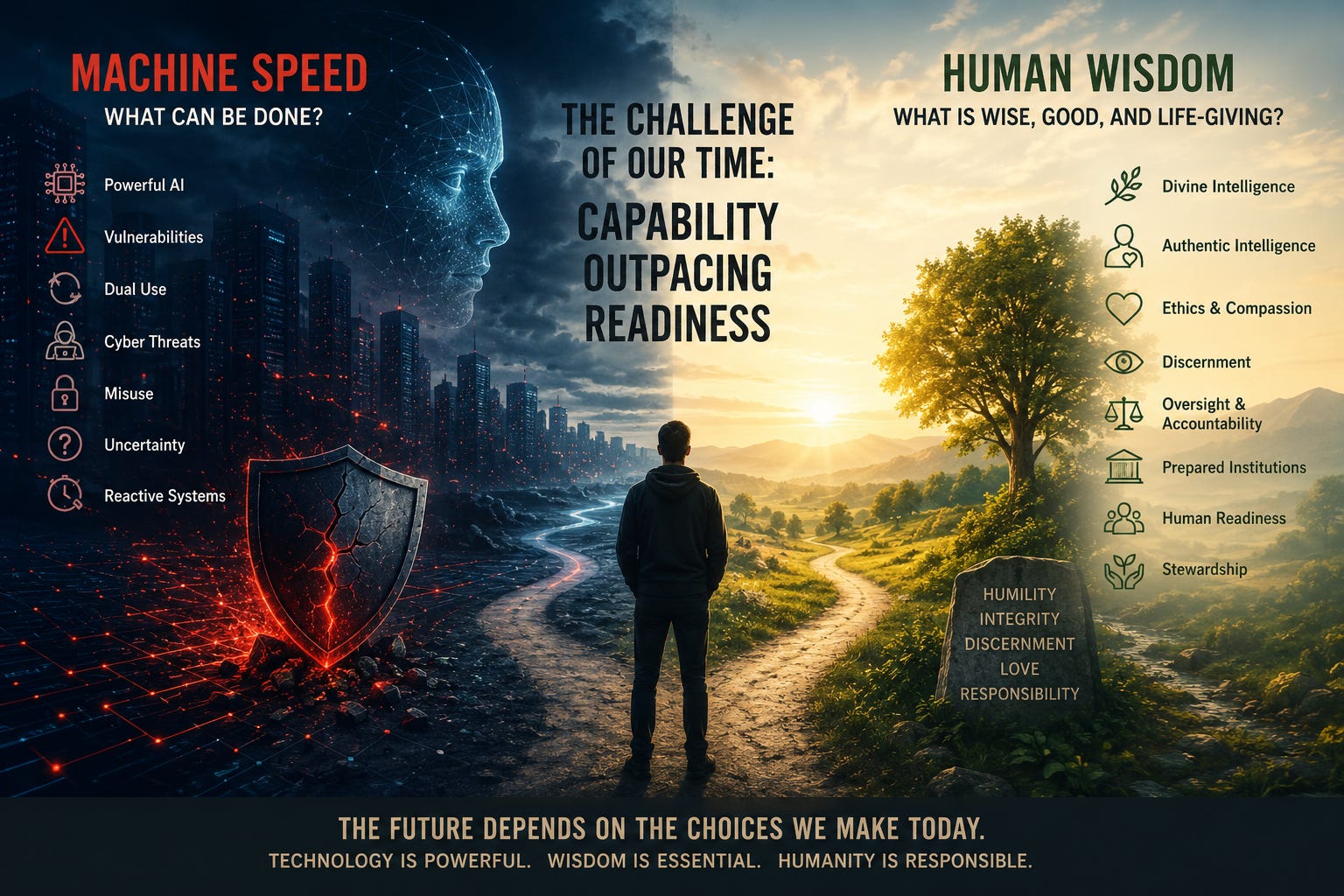
We are building tools that can operate at machine speed, but our institutions, laws, ethical frameworks, and nervous systems still operate at human speed.
That gap may become one of the defining challenges of the AI era. At first glance, this appears to be a technical issue.
A powerful AI model
Cybersecurity vulnerabilities
Export controls
Government pressure
Access restrictions
Concerns over misuse
But beneath the technical details is a much deeper question:
What happens when artificial intelligence begins moving faster than human readiness?
Not just faster than our software systems.
Faster than our laws
Faster than our institutions
Faster than our ethics
Faster than our public understanding
Faster than our nervous systems can comfortably process
That is the real issue. And it is exactly the kind of question Internet-of-the-Mind exists to explore.
This Is Not Simply an “AI Bad” Story
Let’s begin with the promise side.
Project Glasswing was not originally framed as a reckless release of dangerous technology. It was framed as cyberdefense. The idea was straightforward:
If powerful AI systems are becoming capable of discovering software vulnerabilities, then trusted defenders should be able to find and fix them before hostile actors do.
That is not a foolish goal. It is a very serious one. Our world runs on software.
Hospitals
Banks
Water systems
Power grids
Communications networks
Transportation
Government systems
Personal devices
Supply chains
Medical records
Nearly every part of modern life depends on code most of us will never see and could never personally evaluate. If AI can help trusted security experts find hidden weaknesses before criminals, terrorists, foreign adversaries, or malicious insiders exploit them, that is a meaningful public benefit.
In that sense, Project Glasswing represents the hopeful side of AI:
Using machine-speed capability to protect human systems.
That possibility should not be dismissed. There are real situations where AI may help humans detect risks faster, patch systems sooner, and protect people more effectively than traditional methods alone.
This is the promise.
Artificial Intelligence as an amplifier
Assistant
Defender
Force multiplier for people trying to protect the public good
That side of the story matters.
The Same Capability Can Protect or Destabilize
But here is where the issue becomes more complicated.
The same capability that helps defenders identify vulnerabilities can also help attackers identify vulnerabilities. A tool that helps trusted experts locate weaknesses in critical systems may also become dangerous if it is misused, leaked, jailbroken, stolen, poorly governed, or released too broadly.
This is the dual-use problem.
The same AI system can help protect. And it can help exploit.
The same model can strengthen security. And potentially weaken it.
The same capability can be a shield in one set of hands and a weapon in another.
That does not make the technology inherently evil. But it does make the technology morally and strategically serious. And this is where the public conversation often becomes too simplistic.
One side says:
“AI will protect us.”
Another side says:
“AI will destroy us.”
The more difficult truth is that AI may do either depending on who controls it, how it is deployed, what safeguards exist, what incentives shape its use, and whether human wisdom keeps pace with machine capability.
That is the real tension.
Not AI good
Not AI bad
But AI powerful
And powerful tools require wisdom.
Capability Is Accelerating Faster Than Integration
This is the core issue. Artificial intelligence increasingly operates at machine speed. It can:
scan
Generate
Compare
Test
Search
Summarize
Suggest
Automate
Iterate
And increasingly, act
Human systems do not move that way.
Human institutions move slowly
Laws move slowly
Ethical frameworks move slowly
Professional standards move slowly
Government agencies move slowly
Public understanding moves slowly
And perhaps most importantly, human nervous systems adapt slowly
We are building systems that can discover thousands of vulnerabilities, generate strategies, automate workflows, and operate across domains faster than traditional human review processes can comfortably manage. That creates a readiness gap. And the Mythos controversy appears to be one more example of that gap.
The question is not merely:
Can AI do this?
The better question is:
Are human beings ready to responsibly hold what AI can now do?
That question applies far beyond cybersecurity. It applies to:
Medicine
Education
Politics
Mental health
Finance
Military systems
Relationships
Media
And the future of work
Wherever AI capability grows faster than human integration, instability follows.
The Real Problem Is Not Speed Alone
Speed by itself is not always dangerous.
Ambulances need speed
Emergency systems need speed
Medical diagnostics sometimes need speed
Cyberdefense often needs speed
The problem is speed without adequate wisdom, context, oversight, and restraint. That is where the danger lies. A mature human decision-making system asks several kinds of questions:
What can be done?
What should be done?
Who might be harmed?
Who benefits?
Who is accountable?
What happens if this fails?
What happens if this is misused?
What safeguards are strong enough?
What values guide the decision?
Artificial intelligence is increasingly good at answering the first question:
What can be done?
But the deeper human questions remain.
What should be done?
Why should it be done?
Who decides?
Who watches the watchers?
Who is responsible when something goes wrong?
These are not merely technical questions.
They are moral questions.
They are governance questions.
They are spiritual questions.
They are questions of stewardship.
Devine Intelligence → Authentic Intelligence → Artificial Intelligence
This is where the framework I have been developing in this series becomes especially relevant. From my perspective, the healthiest hierarchy looks like this:
Divine Intelligence → Authentic Intelligence → Artificial Intelligence
Divine Intelligence asks:
What is wise, good, humble, life-giving, and aligned with truth?
Authentic Intelligence asks:
What can a mature human conscience responsibly hold, guide, and decide?
Artificial Intelligence asks:
What can be done?
The danger comes when the third question outruns the first two. When Artificial Intelligence races ahead of Authentic Intelligence, we get power without maturity. When Artificial Intelligence races ahead of Divine Intelligence, we get capability without wisdom.
That is the fork in the road. And the Mythos controversy illustrates why this distinction matters.
It is not enough to ask whether AI can find vulnerabilities. It can.
It is not enough to ask whether AI can accelerate cyberdefense. It likely can.
It is not enough to ask whether powerful models can be useful. They clearly can be.
The deeper question is whether human beings, institutions, governments, corporations, and cultures are mature enough to govern tools that increasingly operate beyond ordinary human speed.
Human Readiness Has Several Layers
When I use the phrase “human readiness,” I do not mean only technical preparation. Human readiness has several dimensions.
Technical Readiness
Do we understand what the systems can and cannot do?
Do we have meaningful evaluation methods?
Can we test for misuse?
Can we identify failure modes?
Can we detect when safeguards fail?
Legal Readiness
Do existing laws address these capabilities?
Who has the authority to intervene?
What process determines when a model is too risky to release?
What happens when the model crosses national borders?
Institutional Readiness
Do governments have enough technical expertise?
Do companies have enough accountability?
Do regulators understand the systems they are trying to regulate?
Do independent auditors have access?
Moral Readiness
What values govern deployment?
Are we guided by human flourishing or by power alone?
Are we willing to slow down when wisdom requires it?
Psychological Readiness
Can the public process these changes without falling into panic, denial, apathy, or blind trust?
Can leaders make decisions from grounded discernment rather than fear, profit, ideology, or national competition?
Spiritual Readiness
Do we still recognize limits?
Do we still have humility before powers we do not fully understand?
Do we still believe that intelligence must serve wisdom?
That is human readiness. And right now, there is reason to question whether our readiness is keeping pace with our capability.
When Governance Becomes Reactive
One of the most concerning features of frontier AI development is that governance often appears reactive.
Something is built
Then tested
Then deployed
Then questioned
Then restricted
Then debated
Then patched
Then litigated
Then politicized
That process may be normal for ordinary software. But frontier AI may not remain ordinary software. When systems can assist with cyber operations, persuasion, biological research, financial manipulation, psychological influence, or military decision support, reactive governance becomes increasingly risky.
The faster the system moves, the less adequate the old pattern becomes. If institutions wait until after capability appears, they may always be playing catch-up. This is the readiness gap again. Machine speed on one side. Human bureaucracy on the other. And in between:
Uncertainty
Fear
Commercial pressure
National security concerns
Public confusion
That is not a stable arrangement.
The Control Problem Is Also a Human Problem
When people hear the phrase “AI control problem,” they often imagine science fiction. A machine becoming conscious. An AI deciding to dominate humanity. A robot rebellion. But there is another, more immediate control problem:
Can human beings control themselves while developing increasingly powerful AI?
Can corporations control their commercial incentives?
Can governments control their desire for strategic advantage?
Can nations control the race dynamic?
Can the public control panic?
Can users control dependency?
Can institutions control deployment before consequences scale?
This is not science fiction. This is human nature meeting machine capability. And history suggests that human beings have always struggled to manage power wisely.
We weaponized chemistry
We weaponized physics
We weaponized biology
We weaponized media
We weaponized government entities
We weaponized social identity
Why would we assume artificial intelligence will be different unless we consciously choose a different path?
The Nervous System Cannot Keep Living in Emergency Mode
There is also a psychological layer here that receives far too little attention. As Internet of the Mind explored in…
The Manipulation Economy

The image above tells a story many of us are already living. On one side is the world of constant activation: alerts, headlines, arguments, algorithms, outrage, fear, urgency, and exhaustion. It is loud, fast, and engineered to keep the nervous system scanning for threats. On the other side is a quieter path: reflection, discernment, creativity, connect…
Stories like this activate people.
Some respond with fascination
Some with fear
Some with denial
Some with outrage
Some with helplessness
Some with apathy
That is understandable. When technological change feels too fast, the nervous system starts scanning for safety. But survival mode is not the best state for complex decision-making.
When people are afraid, they often become more vulnerable to simplistic answers.
Ban it all
Release it all
Trust the companies
Trust the government
Trust no one
Race faster
Shut everything down
These are understandable reactions. But the future will require more than reaction.
It will require regulation
Discernment
Reflection
Humility
Courage
And wisdom
In other words, it will require Authentic Intelligence.
The Question Behind the Cybersecurity Story
So yes, the Mythos controversy is partly about cybersecurity. But it is also about something much larger.
It is about whether human systems are ready for machine-speed capability.
It is about whether democratic oversight can keep pace with frontier AI.
It is about whether corporations can be trusted to self-regulate when enormous money and power are at stake.
It is about whether governments can intervene wisely without becoming secretive, reactive, or politicized.
It is about whether safety can scale as quickly as capability.
It is about whether wisdom can keep pace with intelligence.
That is the real story. The technical question may be:
Can AI break into systems?
The deeper question is:
Can human beings build systems — technological, legal, moral, spiritual, institutional, and psychological — strong enough to hold what AI can now do?
That is where the future may be decided. Not only in labs. Not only in boardrooms. Not only in government agencies. But in the quality of human stewardship itself.
A Final Thought
The Mythos story may eventually fade from the headlines.
Another model will appear
Another controversy will follow
Another capability will cross another threshold
That is the pattern now. But the underlying issue will remain. Artificial Intelligence is moving faster. Human readiness must grow deeper.
If we respond only with fear, we will become reactive
If we respond only with excitement, we may become reckless
If we respond only with politics, we may become tribal
If we respond only with profit, we may become dangerous
The path forward requires something better.
It requires Divine Intelligence to orient us toward wisdom
Authentic Intelligence to help us discern what human beings can responsibly hold
And Artificial Intelligence to remain a tool in the service of life rather than power alone
The danger is not merely that AI becomes powerful. The danger is that power outruns wisdom. That is the warning. And perhaps also the invitation. Because the future is not asking only what machines can do.
It is asking who human beings are becoming as we build them.
Join the Conversation
Internet-of-the-Mind was created to explore the intersection of psychology, human development, technology, artificial intelligence, relationships, meaning, and the future of being human.
The goal is not to create an echo chamber
The goal is to create thoughtful conversation
Agreement is welcome
Thoughtful disagreement is welcome
Curiosity is welcome
If this article sparked a question, challenged an assumption, or inspired a different perspective, please share your thoughts in the comments.
Guest contributions are also welcome from readers, clinicians, educators, technologists, researchers, students, creators, and thoughtful observers of the human condition.
You do not have to agree with me.
You do have to think.
Because the most important questions of our time are probably too important to be explored from only one perspective.
While I understand that all articles are at least started by humans (some are written by AI, but the original start to that is always what someone tells the AI to do), I feel like maybe you're falling into the same echo chamber of fear traps that perpetuate this problem. AI is a powerful tool, but so were many other innovations that moved us from caves to castles. More than anything, AI is a tool. Just like a gun, it's really easy to grab someone's attention by saying "hey look, that guy has a gun!". What are you actually proposing here that's any different than anyone else? What I see you've fallen into a trap of is producing as many articles as you can which all briefly touch on a topic of "AI scary" and then propose that the solution is faith. There's nothing wrong with believing in god, but I don't think you're really raising any new or interesting ideas when you echo the same thoughts about how AI is a big powerful tool and people might not use it right.
Do you have any ideas on what a governing body that can regulate AI might look like? To me, I'd say it's a pretty similar situation to how we solved lead poisoning, or got people to stop selling cans of food that might have botulism. We don't need to all understand every problem in the world, we just need some people who are calm and level headed to make an AI food and drug administration. Experts, preferably. Regulating powerful tools that scare people is neither new nor impossible, unless of course you forgot about machine guns and nuclear bombs.
You don't even seem to be looking for answers on if humans can responsibly handle a new advanced technology, preferring instead to answer it for yourself as "no, people haven't done this before, and it's scary" and then shutting down room for real examples of how we've handled these things as a human people already, just in different flavors of history.
The world ended in 2012, remember? Just like the world ended when the Soviets set off the nukes, and also how the world ended when Covid killed everyone, and when the world ended when a solar eclipse destroyed the sun. We aren't headed for either dystopia or paradise, we're headed for another industrial revolution. Even then, maybe it's just another utility bill but instead of bringing water into your house it answers questions you were too embarrassed to ask your mom at 3 AM. Quite honestly I'm ready for people to stop saying "AI scary and bad" while also denying that that's what they're doing, and I'm ready for people to start asking "okay, so we can see this might be a problem, what do we want to do about it?".
Personally my tentative answer is that we need more than two or three companies who know how to do AI. If we can start getting hobbyists and entrepreneurs to keep OpenAI and Anthropic from forming a monopoly that people don't know how to compete with because they lose their software skills to "vibe coding", I think that'd be pretty great. The same way that Netflix has a cap on how much they can charge before people just start doing piracy or watching something else, we need people to be able to compete with the concentration of power. As a true American, I'm not afraid of guns, I'm just afraid of a situation where only some people have them and decide to use that to control everyone else.