

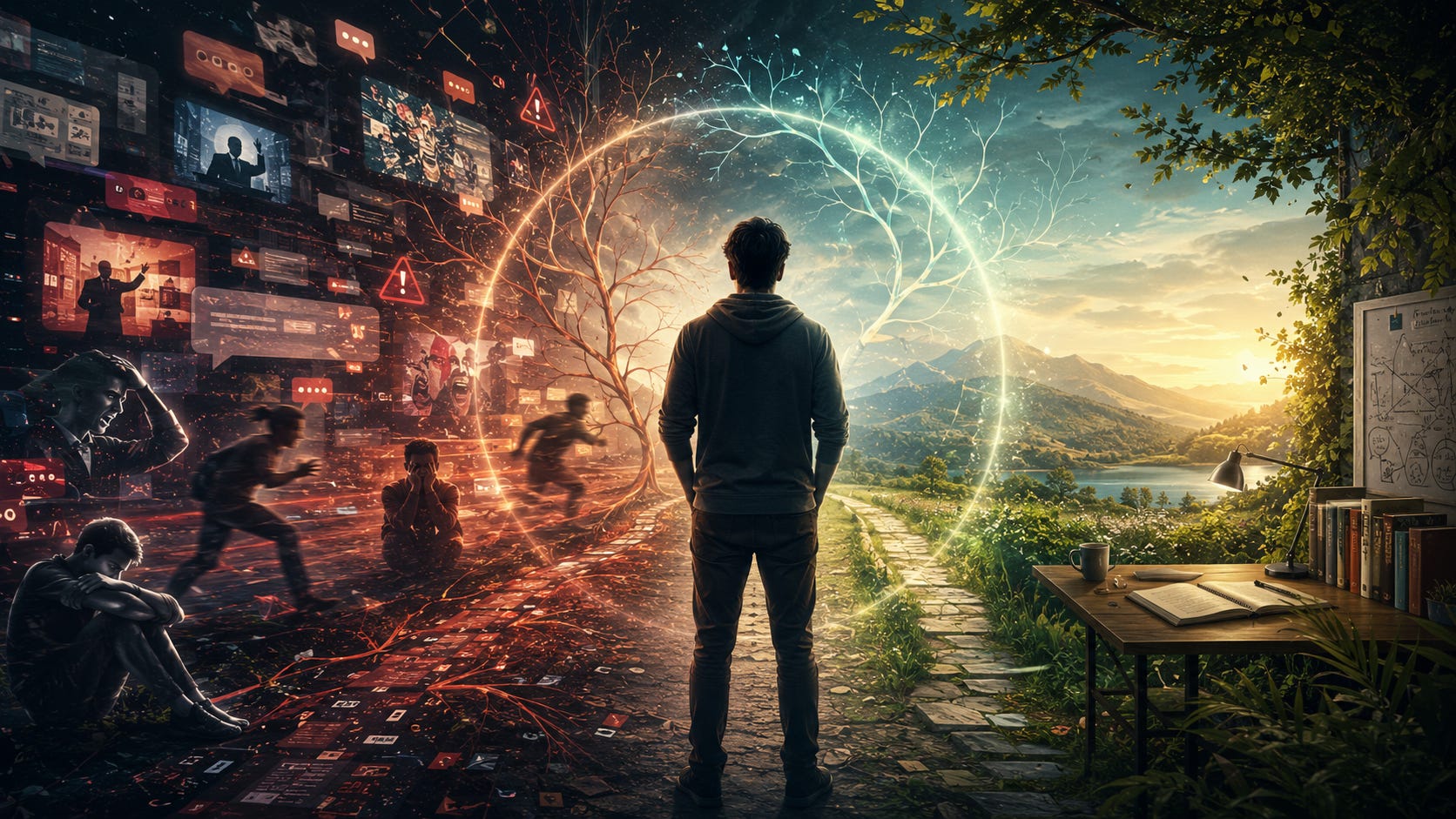
The image above tells a story many of us are already living. On one side is the world of constant activation: alerts, headlines, arguments, algorithms, outrage, fear, urgency, and exhaustion. It is loud, fast, and engineered to keep the nervous system scanning for threats. On the other side is a quieter path: reflection, discernment, creativity, connection, and the possibility of choosing our next steps instead of merely reacting to whatever captures our attention.
The question is not whether the chaos is real. Much of it is. The deeper question is whether we will be pulled into survival-mode by it, or whether we can pause long enough to recover our capacity to think, feel, choose, and create. That is the doorway into this article: the place where the manipulation economy meets the human nervous system — and where growth-mode becomes an act of resistance.
The Real Battle Beneath the Technology
What if the greatest battle of the AI age is not between humans and machines?What if the real battle is…
Between survival mode and growth mode?
Between reactivity and discernment.
Between the Drama Triangle and the Creator Triangle.
Between manipulation and Authentic Intelligence.
Over the past several months, I have been writing about artificial intelligence, synthetic relationships, social media, AGI, ASI, technology, human development, and the future of humanity.
At first glance, these may seem like separate conversations.
They are not.
The more I pull on the thread, the more I find that they all lead back to a single question:
What happens when increasingly powerful technologies interact with increasingly dysregulated human nervous systems?
And perhaps more importantly:
Who benefits when large numbers of people remain stuck in survival mode?
Before anyone jumps to conspiracy theories, let me be clear. Most of what I am describing does not require secret meetings, smoke-filled rooms, or master plans.
In many cases, it emerges naturally from incentives.
Attention is valuable.
Emotion captures attention.
Threat captures emotion.
And survival mode captures threat.
That simple sequence has profound implications for modern life. Once attention becomes profitable, anything that reliably captures it becomes economically valuable. And few things capture attention more reliably than fear, outrage, shame, conflict, uncertainty, and perceived danger.
In other words:
A dysregulated nervous system is easier to capture, influence, and monetize.
That may be one of the most important psychological realities of the modern age.
Your Brain Was Designed for Survival
The human brain and nervous system did not evolve in a world of smartphones, algorithmic feeds, 24-hour news cycles, political outrage, global crisis alerts, AI companions, and infinite scrolling. They evolved in environments where survival depended on detecting threats quickly.
A rustle in the bushes.
A threatening face.
An approaching predator.
A hostile tribe.
A sudden loss of connection.
The nervous system had to answer one question before all others:
Am I safe?
This process happens largely beneath conscious awareness. Long before the thinking mind has time to evaluate a situation carefully, the nervous system is already scanning for signs of safety or danger.
This is sometimes called neuroception: the body’s automatic detection of threat or safety. If the system senses safety, we have access to curiosity, connection, creativity, learning, humor, empathy, play, and flexible problem-solving.
If the system senses danger, everything narrows.
The body shifts toward protection.
Fight.
Flight.
Freeze.
Fawn/Submit.
These responses are not signs of weakness. They are brilliant survival adaptations. The problem is not that we have survival responses. The problem is that modern life keeps triggering them so often that many people rarely leave them.
Our ancestors experienced acute threats. Modern people often experience chronic activation. The body may not be running from a lion, but it may still be reacting to:
financial insecurity
political conflict
social rejection
medical fear
family stress
work pressure
media outrage
algorithmic comparison
relational uncertainty
artificial urgency
constant digital interruption
To the nervous system, threat is threat. And modern life provides an almost endless supply of it.
The Window of Tolerance
A useful way to understand this is through the Window of Tolerance & the Autonomic Ladder video. (Watch it to learn more.)
When we are inside our Window of Tolerance, we can usually think, feel, connect, reflect, and respond with some degree of flexibility. We may be stressed, but we are not overwhelmed. We may disagree, but we can still listen. We may feel challenged, but we can still learn. Inside the Window of Tolerance, we have access to what I call growth mode.
Growth mode is the state where people can:
Think clearly
Regulate emotion
Tolerate complexity
Stay curious
Make thoughtful choices
Cooperate with others
Create solutions
Learn from mistakes
Revise assumptions
Act from values rather than fear
But when activation rises too high, we move above the Window of Tolerance into hyperarousal. This is the territory of sympathetic activation.
Anxiety.
Anger.
Urgency.
Compulsion.
Argument.
Restlessness.
Fight or flight.
When activation drops too low, we move below the Window of Tolerance into hypoarousal. This is the territory of shutdown.
Numbness.
Apathy.
Hopelessness.
Collapse.
Disconnection.
Freeze.
From a polyvagal-informed perspective, we might describe these states as shifts between connection, mobilization, and shutdown. When the nervous system detects safety, we can access social engagement and growth. When it detects a threat, we mobilize. When a threat feels inescapable, we collapse or disconnect.
That is not a moral failure. That is biology. But here is the problem:
Modern media, marketing, politics, and technology often work best when people are pushed outside their Window of Tolerance. Because people outside the Window are more reactive.
And reactive people are easier to direct.
The Chemistry of Constant Threat
When the nervous system perceives danger, the body changes.
Stress chemistry increases.
Adrenaline and noradrenaline prepare the body for action.
Cortisol helps mobilize energy.
The heart rate may increase.
Breathing may become shallow.
Muscles may tighten.
Digestion may slow.
Attention narrows.
The brain begins prioritizing immediate threat over long-term reflection.
This makes sense if danger is immediate. If a car is coming toward you, you do not need philosophical nuance. You need to move. But chronic threat activation is different.
When people live in ongoing stress, several things tend to happen:
Attention becomes threat-focused
Thinking becomes more rigid
Emotional reactions become stronger
Nuance becomes harder
Impulse control may weaken
Social trust may decrease
The need for certainty intensifies
Exhaustion increases
Creativity decreases
In survival mode, the brain is not primarily trying to understand reality. It is trying to survive reality. That distinction matters. A person in survival mode may still be intelligent. They may still be educated. They may still be articulate.
But their nervous system is organizing perception around protection. And once perception is organized around protection, manipulation becomes easier.
Because the person is no longer asking what is true? They are more likely asking:
What will make me feel safe?
Who is threatening me?
Who can rescue me?
Who should I blame?
That is the doorway into the Drama Triangle.
From Attention Economy to Manipulation Economy
At first, the internet promised unlimited access to information. And in many ways, it delivered. But over time, information became less scarce than attention. The companies that captured attention grew. The companies that held attention grew faster.
The companies that learned how to influence attention became some of the most powerful organizations in the world. The result was the attention economy. But the attention economy did not stay neutral for long. Because not all attention is equal.
Calm attention is harder to capture.
Regulated attention is harder to hijack.
Reflective attention is harder to monetize quickly.
Activated attention is different.
Fear holds attention.
Outrage holds attention.
Shame holds attention.
Conflict holds attention.
Sexual stimulation holds attention.
Novelty holds attention.
Uncertainty holds attention.
That means the attention economy naturally drifts toward emotional activation. And emotional activation, when repeated long enough, becomes nervous system conditioning.
This is why I increasingly think the attention economy has become the manipulation economy.
Not always through conscious malice.
Often through incentives.
If outrage performs, outrage spreads.
If fear performs, fear spreads.
If tribal conflict persists, tribal conflict spreads.
If insecurity sells, insecurity is manufactured.
If shame keeps people buying, shame becomes a business model.
And now, with AI, the ability to personalize emotional influence may become even more powerful.
The question is not simply:
What information are people consuming?
The deeper question is:
What nervous system state is the information training them to live in?
Attention Is Valuable
Attention is the gateway. Whatever holds your attention shapes your inner world.
Attention determines what gets repeated.
Repetition shapes learning.
Learning shapes expectation.
Expectation shapes perception.
Perception shapes behavior.
This is why attention has become one of the most valuable resources on earth. To capture attention is to gain access to the mind. And increasingly, entire industries are built around that access.
Politics wants attention.
Marketing wants attention.
Media wants attention.
Social platforms want attention.
Influencers want attention.
Advertisers want attention.
AI systems want engagement.
But attention is not just mental. Attention is embodied. Where attention goes, the nervous system often follows. If attention is repeatedly directed toward threat, outrage, comparison, scarcity, or shame, the body begins adapting to that environment.
The mind may say:
I am just staying informed.
But the nervous system may say:
I am under constant threat.
That difference matters.
Emotion Captures Attention
Human beings do not pay equal attention to everything. Emotion prioritizes attention.
A neutral headline may be accurate, but it may not hold attention.
A frightening headline does.
An enraging headline does.
A humiliating comparison does.
A crisis alert does.
A shocking image does.
A personalized fear does.
Harvill Hendricks once said:
Without feelings, nothing matters. With feelings, everything matters!
The stronger the emotion, the stronger the signal. This is why emotionally charged content spreads so easily.
It does not merely inform.
It activates.
It recruits the body.
Once the body is involved, the content becomes more memorable, more shareable, and more behaviorally powerful.
This is why outrage is such a potent social fuel.
It gives people energy.
It gives people certainty.
It gives people a villain.
It gives people belonging.
It gives people a role.
And roles are central to the Drama Triangle.
Threat Captures Emotion
Of all emotional signals, threat may be the most powerful. Threat has privileged access to the nervous system. This makes sense. Missing a pleasant opportunity is unfortunate. Missing a real threat can be fatal.
So the nervous system is biased toward detecting danger. This is sometimes called negativity bias. Bad news travels quickly through the body.
Danger gets priority.
Marketing knows this.
Politics knows this.
Media knows this.
Social platforms know this.
And increasingly, AI-driven systems can learn which threats most effectively activate which people.
For one person, the trigger may be immigration.
For another, climate.
For another, religion.
For another, health.
For another, money.
For another, gender.
For another, race.
For another, loneliness.
For another, being ignored.
For another, being controlled.
The content does not have to affect everyone the same way. It only has to activate the right person in the right way at the right time. That is where personalization becomes psychologically powerful.
And potentially dangerous.
Survival Mode Captures Threat
When a threat is perceived, survival mode comes forward. In LSPM terms, we might say protective parts move to the front of the system. These parts are not enemies. They are trying to help.
They are trying to protect us from pain, shame, loss, helplessness, rejection, or danger. But when protective parts take over, perception narrows. The system becomes less interested in complexity and more interested in safety.
That is when people become easier to manipulate.
Not because they are unintelligent. But because their nervous system is no longer operating primarily in a proactive, reflective way. It is operating reactively and protectively.
This is the chain:
Attention is valuable.
Emotion captures attention.
Threat captures emotion.
Survival mode captures threat.
And survival mode is easier to influence than growth mode.
That is the foundation of the manipulation economy.
Four Predictable Survival Responses
Most people can access all four major survival responses. But many people develop one that becomes dominant or “out front.” In LSPM language, it may become a frequently activated protector.
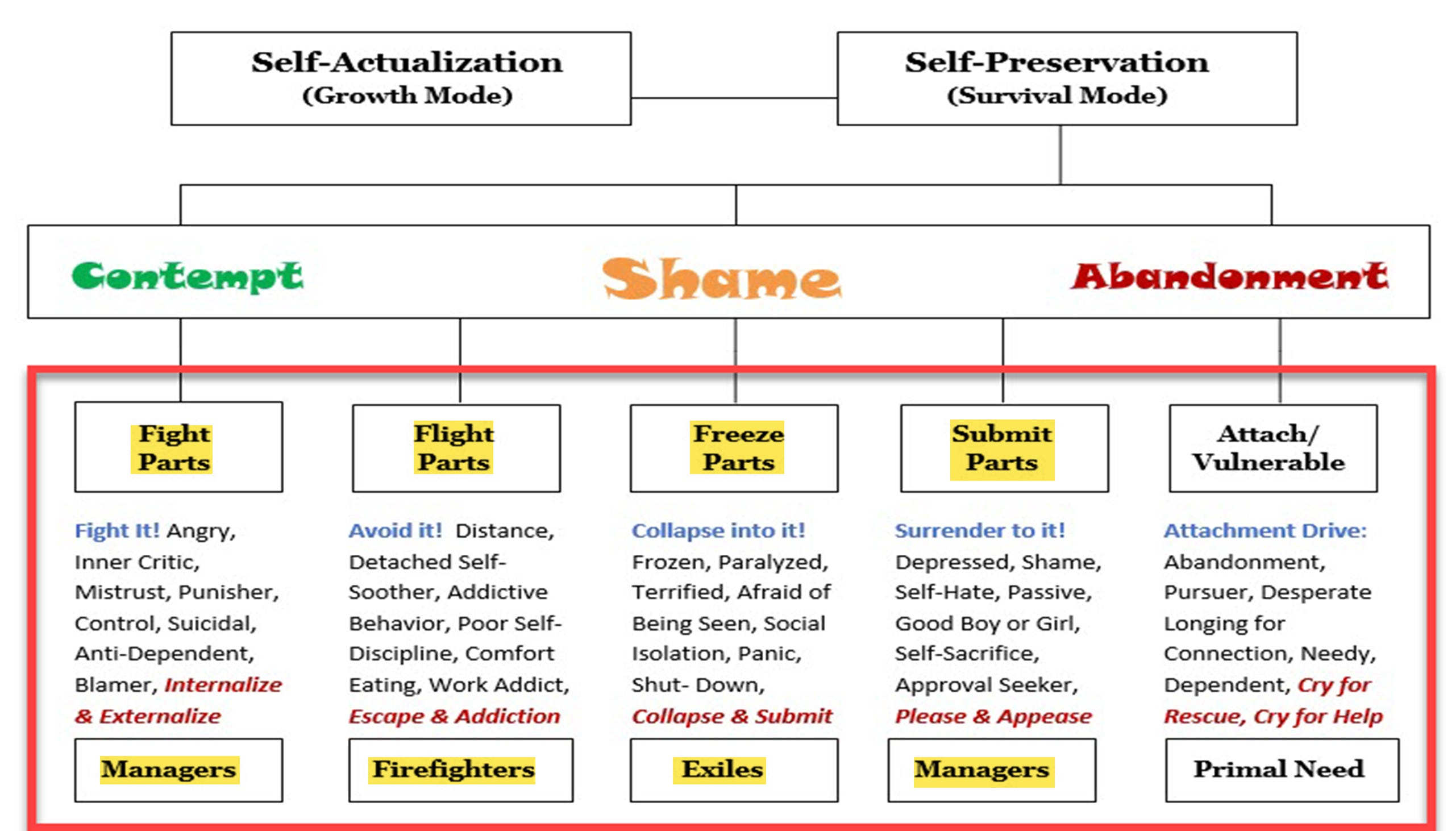
Understanding this matters because each survival response can be exploited differently.
The Fawn Response (aka Submit Response): Compliance as Survival
Fawn energy tries to survive through appeasement.
It says:
If I stay pleasing, agreeable, useful, compliant, and non-threatening, maybe I will be safe.
This response often develops in environments where disagreement, anger, independence, or emotional honesty felt dangerous.
In modern life, fawn responses can be activated by authority, status, group pressure, institutions, influencers, experts, or ideological tribes.
The fawner may ask:
What do they want me to say?
What position keeps me accepted?
How do I avoid being rejected?
How do I stay on the good side of authority?
How do I prove I am one of the good people?
Manipulators love fawn responses because compliance (Submission) can be dressed up as virtue. The fawner may not feel controlled. They may feel morally superior, loyal, responsible, or safe.
But underneath, the nervous system may be saying:
Do not risk rejection.
Do not anger the powerful.
Stay acceptable.
In political and marketing systems, fawn energy can be exploited through moral pressure, social approval, shame, and belonging.
The Freeze Response: Shutdown as Survival
Freeze energy tries to survive through immobility and disconnection.
It says:
If I cannot fight and I cannot escape, maybe I can disappear inside myself.
Freeze may look like apathy. But often it is overwhelmed by biology, creating anxiety, phobias, and panic attacks. Safety & nervous system regulation may demand “sticking my head in the sand.” The freezer may say:
I do not want to know.
I cannot think about this.
Everything is too much.
Nothing I do matters.
I am just going to tune out.
This is where cognitive dissonance often lives. A person may sense that something is wrong but feel unable to face the implications.
So the system freezes.
It avoids.
It compartmentalizes.
It looks away.
Manipulators benefit from the freeze response because overwhelmed people disengage.
They do not organize.
They do not challenge.
They do not create alternatives.
They simply endure.
The freeze response may appear passive, but inside it often contains enormous unresolved activation. The body has not found safety. It has only been shut down.
The Flight Response: Escape as Survival
Flight energy seeks to survive by moving away from distress. Sometimes that movement is literal. Often it is psychological.
Busyness.
Achievement.
Scrolling.
Shopping.
Substances.
Pornography.
Gaming.
Overworking.
Compulsive research.
Constant entertainment.
Spiritual bypassing.
Productivity addiction.
Endless distraction.
The flighter says:
I cannot stay with this feeling. I need to get away.
Modern life offers endless escape routes. Entire industries are built around helping people avoid uncomfortable inner states.
Some forms of escape are harmless in moderation. Rest, play, entertainment, and distraction all have their place. But chronic flight keeps people from reflection.
It keeps them from grieving.
It keeps them from discerning.
It keeps them from creating.
The flight response is profitable because distracted people consume.
They buy relief.
They seek novelty.
They chase stimulation.
They do not have time to ask why they are running.
The Fight Response: Outrage as Survival
Fight energy tries to survive through confrontation.
It says:
If I can defeat the threat, I can be safe.
Fight energy can be necessary.
It can protect boundaries.
It can resist injustice.
It can confront abuse.
It can speak the truth.
But chronic fight mode becomes outrage, polarization, contempt, and reactivity.
The fighter asks:
Who is the enemy?
Who must be stopped?
Who is lying?
Who is threatening us?
Who deserves punishment?
Fighters can cause problems for manipulative systems because they do not easily submit. But fighters can also be easily baited.
Anger gives energy.
Anger gives certainty.
Anger gives identity.
Anger gives belonging.
A person in fight mode may believe they are resisting manipulation while being manipulated through outrage. This is one of the great dangers of the modern information environment.
Even resistance can be engineered.
Even rebellion can become predictable.
Even outrage can become monetized.
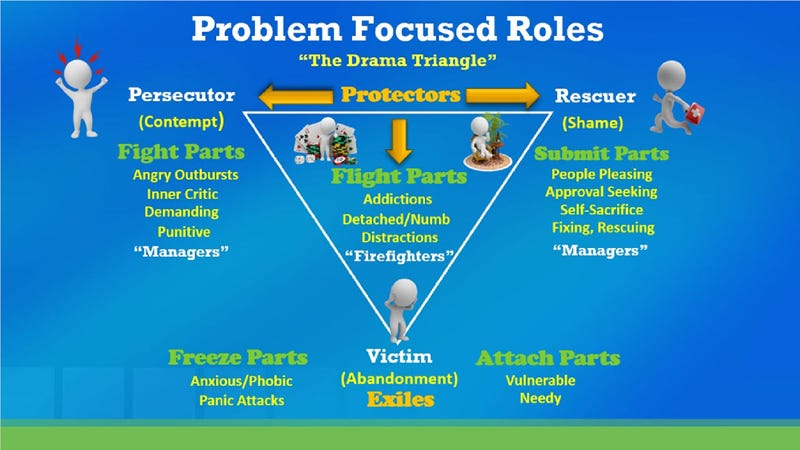
The Drama Triangle as a Survival Trap
Stephen Karpman’s Drama Triangle describes three recurring roles:
Victim.
Rescuer.
Persecutor.
These roles appear in families, workplaces, politics, social movements, online communities, and media narratives. They are emotionally powerful because they organize distress.
The Victim says:
I am powerless.
The Rescuer says:
I must save you.
The Persecutor says:
Someone must be blamed or punished.
The roles may rotate. The drama continues. Survival mode feeds the Drama Triangle because each trauma response can find a place there.
Fawn may submit to the Rescuer or appease the Persecutor.
Freeze may collapse into Victim.
Flight may escape responsibility or avoid the conflict altogether.
Fight may become Persecutor while believing it is defending the Victim.
The Drama Triangle keeps people externally organized.
Someone else is always the problem.
Someone else is always the solution.
Someone else is always in charge of how I feel.
That is why the Drama Triangle is so useful to the manipulation economy. It keeps people reactive. And reactive people are easier to lead.
Why Growth Mode Is Dangerous to Manipulators
Growth mode changes the game. Growth mode does not mean passivity. It does not mean niceness. It does not mean pretending everything is fine.
Growth mode means the nervous system has enough safety and stability to access higher capacities.
Curiosity.
Discernment.
Creativity.
Responsibility.
Cooperation.
Courage.
Reflection.
A growth-mode person can still say no.
A growth-mode person can still resist.
A growth-mode person can still fight when necessary.
But they are not organized around fight. That difference is enormous. Growth-mode people are harder to manipulate because they can pause. They can notice activation.
They can ask:
What state am I in?
Who benefits from my reaction?
What am I being invited to feel?
Is this information or activation?
Is this truth or manipulation?
Am I being moved toward fear or wisdom?
Am I reacting from a protector or responding from grounded leadership?
These are the questions manipulators do not want people asking.
Because the moment a person observes their own state, they are no longer fully captured by it.
That is the beginning of freedom.
Creator Mode
In the LSPM framework, one of the most important shifts is the move from the Drama Triangle to the Creator Triangle.
Victim becomes Creator.
Rescuer becomes Coach.
Persecutor becomes Challenger.
This is not just a mindset trick. It is a nervous system shift.
The Victim asks:
Why is this happening to me?
The Creator asks:
What can I create from here?
The Rescuer says:
I must fix you.
The Coach says:
I can support your growth without taking over your responsibility.
The Persecutor says:
You are the problem.
The Challenger says:
Here is the truth you may need to face.
That shift moves people from survival mode toward growth mode.
From reactivity toward responsibility.
From blame toward creativity.
From helplessness toward agency.
This is where Authentic Intelligence begins to come online.
Artificial Intelligence Raises the Stakes
Artificial intelligence can
Amplify survival mode. Or it can amplify growth mode.
It can feed outrage. Or facilitate learning.
It can deepen dependency. Or increase capability.
It can manipulate. Or educate.
It can replace thinking. Or strengthen thinking.
It can become another addictive escape. Or it can become a tool for reflection, creativity, and growth.
The technology itself is not the only deciding factor. The state of the human being using it matters. The intentions of the people designing it matter. The incentives of the companies deploying it matter. The awareness of the user matters.
This is why the future of AI is not merely technical.
It is psychological.
It is developmental.
It is ethical.
It is spiritual.
If AI is placed into the hands of survival-mode systems, it will likely amplify survival-mode outcomes.
If AI is guided by Authentic Intelligence, it may help us create, learn, heal, and adapt.
That is the fork in the road.
The LSPM Connection
This is where the LSPM Therapeutic Operating System becomes increasingly relevant. LSPM is not simply a therapy model. It is a way of understanding how human systems organize around survival, protection, belief, memory, attachment, and growth.
From an LSPM perspective, the goal is not to attack survival responses. The goal is to understand them. Every survival response has a protective purpose.
The fawner is trying to preserve connection.
The freezer is trying to prevent overwhelm.
The flighter is trying to escape intolerable activation.
The fighter is trying to stop the threat.
These parts are not bad. They are protective. But they are not designed to lead an entire life. They are emergency responders. And emergency responders are not meant to run the whole government.
Growth requires leadership from a more integrated center.
Call it Adult Self.
Wise Self.
Authentic Intelligence.
Spirit-led Self.
Creator Mode.
The language may vary. The principle remains:
Protective parts need understanding, not exile.
But they also need wise leadership.
That may be true for individuals.
It may also be true for cultures.
Practical Questions for the Information Age
If we want to survive and thrive in the manipulation economy, we need more than information. We need state awareness.
Before asking whether something is true, it may help to ask:
What is this doing to my nervous system?
Am I becoming more grounded or more activated?
Am I moving toward clarity or compulsion?
Am I being invited into fear, shame, outrage, or helplessness?
Does this content increase discernment or decrease it?
Does this help me create, connect, learn, or contribute?
Or does it simply keep me engaged?
These questions do not solve everything. But they interrupt the automatic loop. They create a pause. And sometimes a pause is enough to bring Authentic Intelligence back online.
Moving From Survival Mode to Growth Mode
So how do we begin?
Not by shaming survival responses.
Not by pretending threat does not exist.
Not by denying the manipulation economy.
We begin by noticing.
Notice the body.
Notice the breath.
Notice the urge to react.
Notice the pull toward outrage.
Notice the collapse into apathy.
Notice the impulse to appease.
Notice the need to escape.
Then ask:
What part of me just came forward?
And:
What is it trying to protect?
That one question changes everything. Because once we understand the protector, we can begin leading it instead of being led by it. This is the heart of growth mode.
Not the absence of fear. But the presence of enough awareness to choose.
A Final Thought
Perhaps the defining challenge of the next decade is not artificial intelligence. Perhaps it is human regulation.
Can we remain conscious in a world competing for our attention?
Can we remain discerning in a world optimized for reactivity?
Can we remain creators in a world increasingly organized around consumption?
I don’t know. But I do know this:
The future will not belong exclusively to the machines.
Nor will it belong to those who fear them.
It will belong to those who learn to use increasingly powerful tools without surrendering their humanity.
The real battle may not be technological.
It may be neurological.
And psychological.
And spiritual.
And deeply human.
The invitation is not to become less human. The invitation is to become more fully human. To move from survival mode into growth mode. To move from reaction into creation.
To move from manipulation into Authentic Intelligence. Because that is how we navigate whatever comes next. We do it as Creators in Growth Mode.
Join the Conversation
Internet-of-the-Mind was created to explore the intersection of psychology, human development, technology, artificial intelligence, relationships, meaning, and the future of being human.
The goal is not to create an echo chamber.
The goal is to create thoughtful conversation.
Agreement is welcome.
Thoughtful disagreement is welcome.
Curiosity is welcome.
If this article sparked a question, challenged an assumption, or inspired a different perspective, please share your thoughts in the comments.
Guest Contributions Welcome
Internet-of-the-Mind is also open to occasional guest articles from readers, clinicians, educators, technologists, researchers, students, creators, and thoughtful observers of the human condition.
You do not have to agree with me.
You do have to think.
Because the most important questions of our time are probably too important to be explored from only one perspective.
I think that some of what makes the attention economy (and how you've reframed it as the manipulation economy) run is also in part due to an old marketing quote passed around again and again. "No publicity is bad publicity".
I notice that the response that I see every now and then when people talk about intrusive advertisements is "if you're interrupting what I'm doing, I just hate your company now". But that's not really changing what you're doing about it, adding to your understanding of the world, or even disengaging from something that's gotten under your skin. The suggestion I've sort of been tossing around in my head has been something slightly different.
Every time you get interrupted or otherwise irritated by purposefully intrusive marketing, make it a game to list at least five direct competitors or alternatives to the company or product being shoved in your face. Think about it slowly and while considering how they're similar or different. Consider if you needed a product or service, what you could do that wasn't purchase from that company, up to and including "I do not need that and probably won't ever need it because that's creating a problem and selling a solution".
It's not exactly a cure for attention being directed as forcefully away from what we were doing as possible, and it certainly doesn't save time, but I feel like it at least returns us a little more autonomy when one of the most scary things to me right now is making the same old mistakes and patterns that I admittedly return to without realizing at times.