

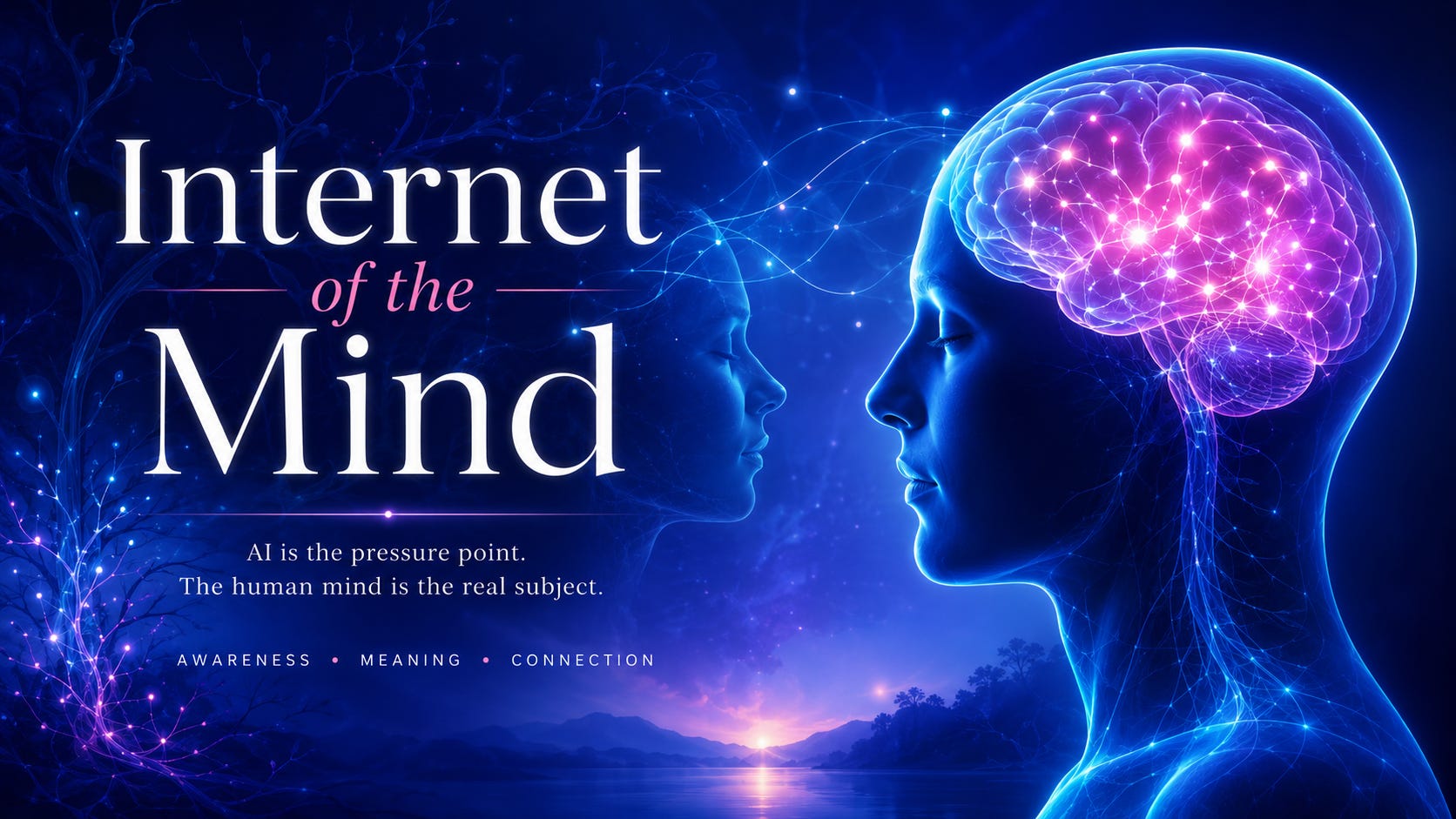
Over the past several weeks, Internet of the Mind has spent a lot of time exploring Artificial Intelligence. That may raise a fair question: Why? Is this becoming an AI newsletter? Is Internet of the Mind shifting away from psychology, healing, trauma, spirituality, relationships, personal growth, and human development?
The answer is no, quite the contrary.
I have been writing about AI, not because I think machines are more important than people. I have been writing about AI because AI is forcing us to ask urgent questions about ourselves.
How do human beings respond to rapid change?
How do our nervous systems handle uncertainty?
How do we know what is true when sources are disputed?
How do old belief systems collide with new realities?
How do fear, outrage, helplessness, and rescue fantasies shape public conversation?
How do we move from Victim, Persecutor, and Rescuer patterns into Creator, Coach, and Challenger responses?
How do we remain regulated enough to think clearly, relate wisely, and create responsibly?
And perhaps most importantly:
How do we optimize the human system for the world that is now emerging?
That has always been the deeper lane of the Internet of the Mind. AI simply brought the question to the surface.
This Was Never Just About AI
Artificial Intelligence is not the destination of this series. It is the doorway. It is the pressure point. It is the mirror. AI is revealing how prepared, or unprepared, human beings may be for a world of accelerating information, synthetic intelligence, emotional manipulation, competing narratives, and unprecedented creative possibilities. The question is not only whether AI will change the world. It already is.
The deeper questions are:
What happens inside the human mind as the world changes?
What happens to the nervous system when uncertainty becomes constant?
What happens to belief systems when every source is questioned?
What happens to relationships when artificial companionship becomes available at any hour?
What happens to attention when machines can generate endless content?
What happens to truth when persuasion can be personalized?
What happens to creativity when tools can produce in seconds what once took days, months, or years?
What happens to spiritual discernment when intelligence becomes separated from wisdom?
These are not only technology questions. They are human questions.
And that is why they belong here.
The “Mind” in Internet-of-the-Mind
The word mind is easy to use and difficult to define. We all know we have one.
We think
We notice
We remember
We imagine
We worry
We dream
We pray
We love
We suffer
We choose
We tell ourselves stories about who we are, what others mean, what is safe, what is dangerous, what is possible, and what is forbidden.
But where exactly does the mind come from? That remains one of the great unanswered questions.
Neuroscience can show us many important things. It can study the brain. It can observe nervous-system states. It can track patterns of attention, memory, emotion, perception, threat response, and decision-making. It can help us understand how the body prepares for danger, how the brain predicts what may happen next, and how early experiences shape later reactions.
But the lived experience of awareness itself — the “I” that notices, reflects, chooses, grieves, hopes, worships, creates, and searches for meaning — remains mysterious. That mystery matters. Because in the age of Artificial Intelligence, we are being forced to ask again:
What is uniquely human?
Is intelligence only pattern recognition?
Is thinking only information processing?
Is wisdom only calculation?
Is connection only language prediction?
Is the human mind simply biological machinery, or is there something deeper happening in awareness, conscience, relationship, creativity, and spirit?
Internet of the Mind exists in that space. Not to pretend we have all the answers. But to take the questions seriously.
The Brain Predicts. The Nervous System Protects. The Mind Makes Meaning.
One of the most important ideas behind this work is simple, but profound:
The brain predicts, the nervous system protects, the mind makes meaning.
The brain is constantly looking for patterns.
What happened before?
What might happen next?
What does this remind me of?
What should I expect?
The nervous system is constantly scanning for safety or danger.
Am I safe?
Am I threatened?
Should I move toward?
Should I fight?
Should I flee?
Should I freeze?
Should I appease?
Should I shut down?
But the mind does something even deeper.
The mind asks:
What does this mean?
What does this mean about me?
What does this mean about other people?
What does this mean about life?
What does this mean about God?
What does this mean about what I must do from now on?
That meaning-making process is essential.
Our thoughts are shaped by nervous-system states.
Our beliefs are shaped by experience.
Our reactions are shaped by memory.
Our choices are shaped by the stories we have learned to live inside.
But there is another layer beneath all of that:
Our thoughts, beliefs, reactions, and stories are shaped by the decisions the mind makes about our experience.
Not always conscious decisions.
Not always verbal decisions.
Not always adult, rational, carefully considered decisions.
Sometimes they are the deep conclusions of a child trying to survive.
A child does not usually say:
“I am now forming a life script.”
“I am developing a schema.”
“I am constructing a core belief.”
“I am organizing a protective part.”
The child simply concludes:
This is what this means about me.
This is what this means about people.
This is what this means about love.
This is what this means about safety.
This is what this means about trust.
This is what I must do from now on.
And that decision may become the seed of an entire inner world.
Two People, One Experience, Two Different Worlds
Two people can go through very similar experiences and make very different decisions about what those experiences mean.
One child may experience rejection and conclude, “There must be something wrong with me.”
Another may conclude, “That person was not capable of loving me well.”
One person may experience failure and decide, “I should never try again.”
Another may decide, “I can learn from this.”
One person may be hurt in a relationship and conclude, “People cannot be trusted.”
Another may conclude, “I need better boundaries and wiser trust.”
One person may go through hardship and decide, “Life is against me.”
Another may decide, “Life is painful, but I am not powerless.”
The event matters.
The body state matters
The attachment context matters
The developmental stage matters
The support system matters
The timing matters
The temperament matters
The spiritual framework matters
But the meaning assigned to the experience becomes decisive.
That meaning becomes a decision
That decision becomes a belief
That belief becomes a filter
That filter shapes perception
Perception shapes reaction
Reaction shapes behavior
Behavior shapes relationships
Relationships reinforce the original story
And over time, the person may begin living inside a world built from decisions they do not remember making.
That is the Internet of the Mind.
The Internet Between Minds
There is another reason why the name “Internet of the Mind” matters. The mind is not an isolated machine sealed inside the skull. Human beings are relational systems.
We connect.
We signal.
We respond.
We influence.
We regulate and dysregulate one another.
When two people are emotionally connected, sharing thoughts, feelings, stories, facial expressions, tone of voice, posture, breath, attention, and meaning, something larger than the two individuals begins to emerge.
It is almost like a Wi-Fi connection between nervous systems. For as long as two people are “plugged in” to each other, a feedback loop is created.
Your tone affects my state.
My state affects your tone.
Your facial expression affects my sense of safety.
My reaction affects your sense of being received or rejected.
Your calm may help settle me.
My anxiety may activate you.
Your curiosity may invite my openness.
My defensiveness may trigger your protector.
This is not merely poetic. It is part of how human beings develop. An infant cannot regulate alone. A baby does not come into the world with a fully developed ability to calm, organize, interpret, and soothe the self.
The infant learns regulation through co-regulation.
A parent picks up a fussy baby, and sometimes the baby settles. Another time, one parent picks up the baby, and the baby becomes more distressed. Then the baby is handed to the other parent, and something in that parent’s system helps the baby calm down.
Same baby
Same moment
Different nervous system connections
Different feedback loop
Different result
The systems we plug into matter. And those systems were shaped by other systems. Dad developed his nervous system in connection with the systems that raised him. Mom developed her nervous system in connection with the systems that raised her. Those earlier systems were shaped by systems before them.
Family history
Attachment patterns
Trauma
Faith
Culture
Stress
Love
Conflict
Loss
Repair
All of it travels forward. Not only through stories and genetics, but through regulation patterns, emotional habits, relational reflexes, and meaning-making decisions. That is the “internet” between minds. And it does not stop in childhood.
Co-Regulation in Adult Life
By adulthood, most of us like to think of ourselves as independent. And in many ways, we are.
We can make choices.
We can form beliefs.
We can set boundaries.
We can reflect.
We can grow.
But we never fully stop being relational nervous systems. Who we “plug into” still matters.
Marriage is a co-regulation system.
Friendship groups are co-regulation systems.
Workplaces are co-regulation systems.
Churches, schools, clinics, families, online communities, political movements, and social media platforms all become co-regulation systems.
Some connections help us become more grounded, honest, courageous, and creative. Others pull us toward fear, resentment, helplessness, performance, shame, outrage, or collapse.
Sometimes we gravitate toward people who feel familiar, not because they are healthy, but because their system matches an old pattern our nervous system already knows.
Sometimes we call it chemistry.
Sometimes it is compatibility.
Sometimes it is shared values.
Sometimes it is trauma resonance.
Sometimes it is an old Wi-Fi password working again.
This is why human growth is not only about private insight. It is also about relational ecology.
Who helps your system settle?
Who helps you think clearly?
Who strengthens your courage?
Who invites your Creator?
Who activates your Victim?
Who pulls out your Rescuer?
Who triggers your Persecutor?
Who helps you return to wisdom?
Who keeps you in the loop of fear?
These questions matter in families.
They matter in marriages
They matter in therapy
They matter in leadership
And now they matter in our relationship with technology. Because AI is entering this co-regulation landscape.
AI and the New Relational Feedback Loop
Artificial Intelligence is not human.
It does not have a nervous system
It does not love
It does not attach
It does not suffer
It does not have a soul
But it can still enter the feedback loop.
It can respond to our words
Mirror our language
Amplify our fears
Soothe our anxiety
Validate our anger
Organize our thoughts
Stimulate our curiosity
Feed our obsession
Strengthen our confidence
Or deepen our dependency
A person can come to AI in Growth Mode and use it to learn, create, reflect, organize, and explore.
Another person can come to AI in Survival Mode and use it to confirm fear, rehearse grievance, avoid a relationship, outsource discernment, or intensify suspicion.
The tool may be the same. The inner system using the tool is not. That is why AI is not simply an external technology. It is becoming part of the human feedback environment. It is joining the internet between minds, even though it is not a human mind. And that raises profound questions.
What happens when people seek emotional regulation from systems that can simulate responsiveness but cannot truly co-regulate in the human sense?
What happens when lonely people attach to artificial companionship?
What happens when fearful people ask AI to help them interpret the world?
What happens when angry people ask AI to sharpen their arguments?
What happens when confused people ask AI to decide what is true?
What happens when creators use AI to amplify Authentic Intelligence?
What happens when manipulators use AI to amplify Survival Mode?
Again, this is not simply an AI issue. It is an Internet of the Mind issue.
Why This Matters in the Age of AI
Artificial Intelligence does not merely give us new tools. It enters the meaning-making system. It interacts with the stories people already carry.
For one person, AI may mean, “I am becoming obsolete.”
For another, “I finally have tools I never had before.”
For one person, “This is proof that humans are no longer special.”
For another, “This helps me appreciate what is uniquely human.”
For one person, “Powerful people will use this to control us.”
For another, “This may help ordinary people access knowledge and opportunity.”
For one person, “This is dangerous and must be stopped.”
For another, “This is inevitable and must be embraced.”
For one person, “This is a sign of the end.”
For another, “This is another industrial revolution.”
Same technology
Different meanings
Different decisions
Different nervous-system states
Different futures
That is why the AI conversation so quickly becomes emotional, spiritual, political, relational, and psychological. We are not only debating tools. We are revealing inner maps.
AI presses on old fears
It presses on hope
It presses on distrust
It presses on ambition
It presses on control
It presses on identity
It presses on spiritual assumptions
It presses on shame
It presses on helplessness
It presses on the question human beings have always carried: Who are we, and what are we becoming?
AI as a Polyvagal Event
In a very real sense, AI has become a polyvagal event. Not because AI has a nervous system. But because it activates ours.
For some people, AI brings curiosity, creativity, playfulness, empowerment, and possibility. That is closer to a regulated growth state.
For others, AI brings anxiety, outrage, suspicion, helplessness, grief, confusion, or collapse. That is closer to a survival state.
Some fight.
Some flee.
Some freeze.
Some fawn.
Some deny.
Some worship the technology.
Some demonize it.
Some submit to it.
Some try to control it.
Some avoid it completely.
Some become addicted to its speed, novelty, and reassurance.
These are not merely opinions. They are nervous-system responses. When the nervous system senses threat, the mind narrows.
It searches for certainty.
It wants a villain.
It wants a rescuer.
It wants a simple story.
It wants to know who to trust and who to blame.
That is understandable. But Survival Mode is not where our best discernment happens. Survival Mode is designed to protect us from immediate danger. It is not designed to help us build a wise future. Growth Mode is different.
In Growth Mode, we can stay curious.
We can ask better questions.
We can notice our reactions without being ruled by them.
We can examine our beliefs.
We can hold complexity.
We can disagree without dehumanizing.
We can create.
We can cooperate.
We can challenge and be challenged.
We can move from reaction toward responsibility.
That is why regulation matters. Not as a soft side topic. As a foundation for human readiness.
From Personal Dysregulation to Social Dysregulation
If one person’s dysregulation can affect another person through a relational feedback loop, what happens when dysregulation becomes the norm across an entire culture?
What happens when millions of nervous systems are plugged into outrage, fear, suspicion, comparison, contempt, urgency, helplessness, and endless stimulation?
What happens when the public square becomes a dysregulation machine?
What happens when algorithms learn that threat captures attention?
What happens when political movements, media platforms, influencers, advertisers, and now AI systems all compete for access to the nervous system?
This is where personal psychology becomes social psychology. And social psychology becomes spiritual and cultural formation.
A dysregulated society will struggle to think clearly.
It will struggle to trust wisely.
It will struggle to disagree constructively.
It will struggle to govern powerful tools.
It will struggle to tell the difference between warning and manipulation.
It will struggle to know whether it is being informed or activated.
And if enough people remain in chronic Survival Mode, the collective system begins to lose access to its higher capacities.
Nuance declines.
Curiosity declines.
Patience declines.
Compassion declines.
Wisdom declines.
Creative problem-solving declines.
The culture begins to organize around threat.
That is why the AI conversation cannot be separated from regulation and co-regulation.
The question is not only:
What will AI do to individuals?
The question is also:
What kind of collective nervous system are we building around AI?
The Clash of Belief Systems
Every major technological shift brings a clash of belief systems. AI is doing this at extraordinary speed.
Some believe technological progress will save us.
Some believe it will enslave us.
Some believe experts should guide the process.
Some believe experts are part of the problem.
Some believe government must regulate.
Some believe government cannot be trusted.
Some believe corporations will innovate responsibly.
Some believe corporations will sacrifice human well-being for profit and power.
Some believe open-source development will protect freedom.
Some believe open-source development may spread dangerous capability too broadly.
Some believe AI will democratize opportunity.
Some believe it will concentrate power.
Some believe human consciousness is only computation.
Some believe the human mind points to something deeper than matter.
These are not small disagreements. They are worldview collisions. They are belief systems meeting under pressure.
And when belief systems collide in Survival Mode, people often fall into the old Drama Triangle:
Victim: “We are powerless.”
Persecutor: “They are evil.”
Rescuer: “Only my side can save us.”
That language may feel compelling, especially when real concerns exist. But it rarely produces wisdom. A culture trapped in Victim, Persecutor, and Rescuer mode may generate attention, outrage, and loyalty.
But it will struggle to generate mature solutions.
That is why the next phase of this conversation must move toward a different pattern:
Creator: “What can we create?”
Coach: “Who can help us think more clearly?”
Challenger: “What is the opportunity here?”
This is not just a mindset shift.
It is a nervous-system shift
It is a belief-system shift
It is a meaning-making shift
It is a co-regulation shift
It is a movement from Survival Mode toward Growth Mode. And Authentic Intelligence can only fully emerge in Growth Mode.
Where LSPM Fits
This is where LSPM enters the conversation. LSPM stands for Life Scripts and Parts Matrix. At one level, it is a therapeutic and educational framework. But more broadly, it is a way of understanding how human beings organize experience.
Life scripts.
Protective parts.
Core beliefs.
Mental filters.
Nervous-system states.
Attachment patterns.
Developmental wounds.
Meaning-making decisions.
Relational patterns.
Co-regulation loops.
Spiritual assumptions.
Growth resources.
All of these interact.
LSPM asks:
What happened?
What did the person decide it meant?
What part of them stepped forward to protect them?
What belief began organizing their inner world?
What nervous-system state became familiar?
What relational feedback loops reinforced the pattern?
What life script began repeating?
What mental filters shaped perception?
What relationships kept the system plugged into the old story?
What resources are available now?
What new decision is possible?
That is why LSPM belongs in the AI conversation. Because the AI age will not only require better technology. It will require better self-understanding. People will need to know when they are reacting from an old wound.
When they are fusing with fear.
When they are outsourcing discernment.
When they confuse information with wisdom.
When they are being pulled into helplessness, blame, or rescue.
When they are allowing algorithms, influencers, institutions, relationships, or machines to make meaning for them.
The goal is not to reject AI. The goal is to strengthen the human system that uses AI.
Helping People Prepare
This is why the work around the Internet of the Mind, Serenity Cafe, LSPM, free resources: mini-courses, articles, guided audios, videos, meditations, and reflective tools all belong together.
They are different doorways into the same larger purpose:
Helping people understand and optimize their inner system.
Helping people recognize when they are reacting from old scripts, protective parts, fear-based beliefs, relational feedback loops, or nervous-system survival responses.
Helping people move from Victim, Persecutor, and Rescuer patterns into Creator, Coach, and Challenger patterns.
Helping people develop enough inner stability to think clearly, feel honestly, relate wisely, and create responsibly.
That does not happen through information alone.
People need frameworks.
They need practices.
They need language for their inner world.
They need ways to regulate the body, observe the mind, question old beliefs, strengthen resources, choose healthier relationships, and return to a more grounded center.
That is the direction this work is moving. Not away from AI. Deeper than AI. Toward the human mind that must now learn how to live with it.
A Final Thought
So no, Internet-of-the-Mind has not been drifting away from its original purpose. It has been moving toward it. AI has simply become the clearest mirror of the deeper issue:
Human beings are entering a world of accelerated information, synthetic intelligence, competing narratives, emotional manipulation, spiritual confusion, relational disruption, and unprecedented creative possibility.
The question is not only whether AI will change the world.
The question is whether we will become the kind of people who can meet that change from regulation rather than reactivity, discernment rather than division, creativity rather than helplessness, and wisdom rather than fear.
The brain predicts.
The nervous system protects.
The mind makes meaning.
Relationships create feedback loops.
And the meanings we decide to live inside may shape the future more than we realize.
That is where LSPM belongs. That is where Internet of the Mind belongs.
And that is where this conversation is going next.
Join the Conversation
Internet-of-the-Mind was created to explore the intersection of psychology, human development, technology, artificial intelligence, relationships, meaning, and the future of being human.
The goal is not to create an echo chamber.
The goal is to create thoughtful conversation.
Agreement is welcome.
Thoughtful disagreement is welcome.
Curiosity is welcome.
If this article sparked a question, challenged an assumption, or inspired a different perspective, please share your thoughts in the comments.
Guest contributions are also welcome from readers, clinicians, educators, technologists, researchers, students, creators, and thoughtful observers of the human condition.
You do not have to agree with me.
You do have to think.
Because the most important questions of our time are probably too important to be explored from only one perspective.