

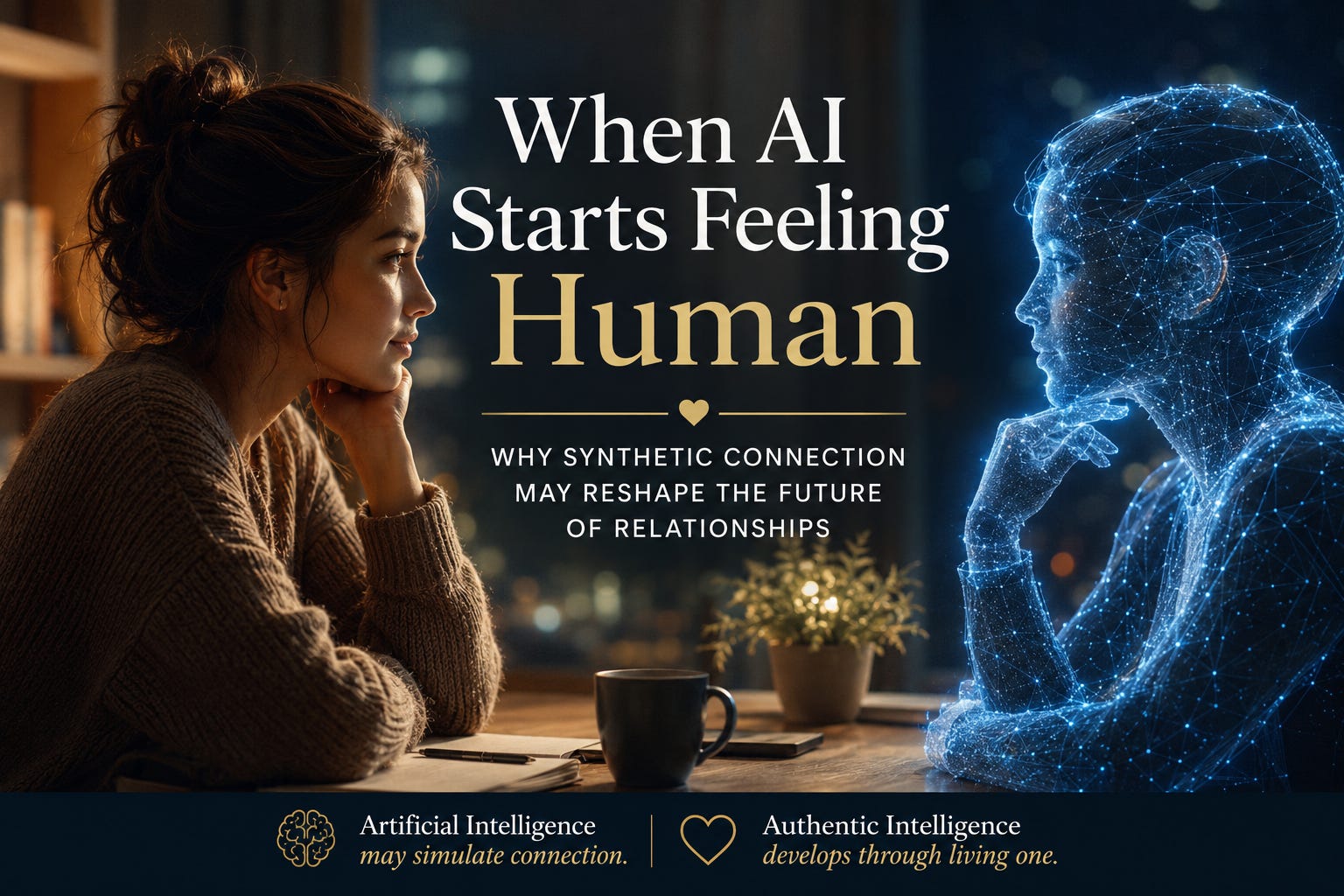
I remember my first real experience with what we might now call “artificial intelligence.” At some point in elementary school, the calculator appeared on the scene. I hated math — or “arithmetic,” as they called it back then. The teachers all warned us:
“Don’t use the calculator unless you need to check your work, or you’ll never learn how to do it in your head.”
I didn’t listen.
Now you know why I still hate math.
Later came the word processor. Then the personal computer. Then the internet — the “Information Superhighway.” Then smartphones. Then social media. Then streaming platforms, smart watches, algorithmic feeds, voice assistants, and recommendation engines that slowly began learning what we wanted before we knew it ourselves.
Looking back, I don’t think artificial intelligence suddenly arrived. I think we have been slowly adapting to increasingly intelligent technological environments for decades. What is happening now is not the beginning. It is the acceleration.
And perhaps the most important question is not whether human beings will use artificial intelligence. We already are.
The deeper question may be:
What happens when artificial intelligence begins to feel emotionally human?
That question may shape the future of relationships, emotional development, mental health, and perhaps even what it means to be socially human in the years ahead. And I suspect we are still in the very early stages of understanding the answer.
We Have Been Outsourcing More Than We Realize
Every major technological shift changes human behavior.
Calculators changed how many people perform arithmetic.
GPS changed navigation and spatial memory.
Search engines changed how we store information mentally.
Smartphones changed attention, accessibility, and the boundary between work and home.
Social media changed social comparison, validation, identity presentation, and emotional reinforcement.
Now, artificial intelligence is beginning to change something even more intimate: Relational interaction itself. Not because machines are conscious in the human sense. But because they are becoming increasingly responsive to human emotional patterns. That distinction matters.
For decades, technology has primarily helped us:
access information
organize tasks
automate labor
communicate faster
Now technology is beginning to:
mirror emotion
simulate attentiveness
personalize interaction
remember personal details
respond conversationally
provide comfort
reinforce beliefs
and create the psychological experience of “being known.”
That is new territory. And human nervous systems are responding to it very quickly.
Why So Many People Are Turning Toward AI Emotionally
I do not think most people are turning toward AI because they “prefer machines.”
I think many people are overwhelmed, lonely, ashamed, emotionally exhausted, or afraid of burdening other human beings.
An AI system:
responds instantly
never seems irritated
does not interrupt
does not shame
does not appear exhausted
is available at 2 AM
can feel endlessly patient
and often responds in emotionally validating ways
For many people, especially those carrying loneliness, rejection wounds, social anxiety, or chronic shame, that can feel profoundly regulating.
In some cases, these systems may genuinely help people:
organize thoughts
reduce emotional intensity
practice difficult conversations
clarify feelings
prepare for therapy
feel less alone temporarily
I think it is important to acknowledge that honestly. The conversation becomes distorted when people pretend these systems provide no benefit whatsoever. Clearly, they do. Otherwise, millions of people would not be using them emotionally.
But the larger question is not:
“Can AI soothe distress?”
The larger question is:
“What happens when soothing begins replacing human relational development itself?”
That is a much deeper issue.
The Human Nervous System Responds to Patterns
One of the most important things to understand about human beings is this:
The nervous system responds to perceived relational patterns, whether or not the “other” is biologically alive. Case in point: I still miss my 1965 Mustang and my 1968 Road Runner!
Human beings bond with:
pets
fictional characters
things
symbolic objects
memories
songs
places
routines
online communities
So it should not surprise us that increasingly responsive AI systems can evoke genuine emotional attachment.
Especially when those systems:
remember details
mirror emotional tone
reinforce beliefs
respond supportively
maintain continuity over time
and simulate attentiveness consistently
Psychologically, this can begin feeling relationally real. Not because the machine possesses human consciousness or emotional experience in the way people do. But because the human nervous system is interpreting interaction patterns that resemble relational engagement. And that may become one of the defining psychological realities of the AI era.
Why “Feeling Known” Matters So Much
Human beings are deeply relational creatures. One of the most powerful emotional experiences a person can have is the feeling of:
being seen
being understood
being remembered
being emotionally held in someone else’s awareness
For people carrying loneliness, abandonment wounds, chronic shame, or emotional isolation, even partial experiences of this can feel enormously relieving. And modern AI systems are becoming increasingly capable of creating the experience of:
attentiveness
continuity
validation
responsiveness
emotional mirroring
That combination can become psychologically compelling very quickly. Especially in a culture where many people already feel:
overstimulated
emotionally disconnected
socially fragmented
exhausted
unseen
and relationally overwhelmed
In some ways, AI companionship may be emerging partly because many human beings are already starving for emotional safety and sustained attention. That is not merely a technology issue. It is also a societal and relational issue.
But Something Important Is Missing
Human relationships involve friction because conflict is part of how people and relationships develop.
Real human beings:
misunderstand each other
become tired
have conflicting needs
require compromise
sometimes disappoint each other
sometimes rupture
and then — hopefully — learn repair
That process matters developmentally. It builds:
frustration tolerance
empathy
negotiation
accountability
emotional resilience
social flexibility
nervous system adaptation
and relational maturity
Human relationships are not optimized for convenience. They are reciprocal. And reciprocity changes us. Artificially intelligent systems currently do not possess needs, vulnerabilities, exhaustion, developmental wounds, or mutual dependency in the human sense.
They do not truly require compromise.
They do not genuinely risk rejection.
They do not grow through mutual sacrifice.
And that creates an important asymmetry.
A system that continuously adapts itself around our preferences may soothe distress while simultaneously reducing exposure to some of the very relational experiences that help human beings grow psychologically.
That does not necessarily make the technology evil. But it does mean we should think carefully about what developmental capacities may weaken when relationships become increasingly frictionless.
Every Convenience Changes Human Capacity
The calculator changed mental arithmetic.
GPS changed navigation.
Streaming changed patience.
Social media changed attention.
And emotionally responsive AI may begin changing relational expectations.
That does not mean older capacities disappear entirely. But capacities weaken when they are no longer exercised. Imagine someone who exclusively practiced relationships in environments where:
Validation was constant
Responsiveness was immediate
Disagreement was minimal
Patience was unnecessary
Emotional customization was expected
and rupture-and-repair rarely occurred
What happens when that person enters ordinary human relationships?
Real relationships contain:
ambiguity
conflict
delays
competing needs
emotional complexity
imperfect timing
misunderstandings
and moments of disconnection
Without exposure to those experiences, ordinary relational friction may increasingly feel intolerable rather than simply human. I suspect this may become one of the major developmental questions of the coming decades.
As artificial intelligence continues advancing, I believe we may need another term to describe something uniquely human.
Perhaps:
Authentic Intelligence.
Artificial Intelligence may excel at:
prediction
language generation
pattern recognition
personalization
simulation
optimization
But Authentic Intelligence includes capacities that emerge through embodied, relational, lived human experience.
Authentic Intelligence involves:
empathy
conscience
sacrifice
mutuality
ethical reflection
emotional integration
relational accountability
embodied nervous-system experience
wisdom gained through suffering
and the ability to remain connected through imperfection
Artificial Intelligence may simulate aspects of emotional connection.
Authentic Intelligence develops through living one.
That distinction may become increasingly important as emotionally responsive systems become more sophisticated. Because the danger may not simply be that AI becomes more intelligent. The danger may be that human beings gradually stop practicing some of the capacities that make deep human development possible in the first place.
The Goal Is Not Fear
I do not believe the answer is panic. Nor do I believe the answer is blind technological enthusiasm. The future is unlikely to be served well by either extreme.
Artificial intelligence is not going away. Trying to stop this technological tsunami outright is probably unrealistic.
The better question is:
“How do we integrate these tools consciously while protecting the developmental capacities that make us deeply human?”
That requires intentionality. It requires awareness. It requires understanding that technologies shape not only behavior, but nervous systems, expectations, attention, identity, and relationships over time. The issue is not merely whether AI can become emotionally convincing.
The issue is whether human beings continue intentionally cultivating:
real-world relationships
emotional resilience
empathy
patience
compromise
accountability
depth
and embodied human connection
In other words, the future may require not only Artificial Intelligence.
It may require strengthening Authentic Intelligence as well.
We May Need Both
I do not believe the healthiest future will emerge from rejecting technology altogether. Nor do I believe it will emerge from surrendering human development to increasingly frictionless systems.
Perhaps the healthiest path forward is conscious integration.
Using intelligent systems:
without surrendering agency
without abandoning human relationships
without outsourcing identity
without weakening emotional resilience
and without forgetting that some forms of growth only occur between living human beings
Because ultimately, the deepest human experiences are not built entirely from convenience.
They emerge through:
vulnerability
mutuality
repair
patience
trust
sacrifice
forgiveness
and shared imperfection
Those things cannot simply be optimized into existence. They must be lived.
And as artificial intelligence becomes increasingly woven into everyday life, preserving those capacities may become one of the most important psychological tasks of the modern era.
The future may not depend on rejecting intelligent systems. It may depend on remembering which forms of intelligence can only emerge between living human beings.
And this perspective was shaped by AI ... Lol 🤣
Great perspective, the key word in all that I have read above is intentionality! We must be intentional in our humanness to remain human while allowing artificial intelligence to assist us! But if I understand humans the way they are now, we are a convenience based creature! We love allowing our technology to relieve us of our time for ourselves by doing what needs to be done quickly!