

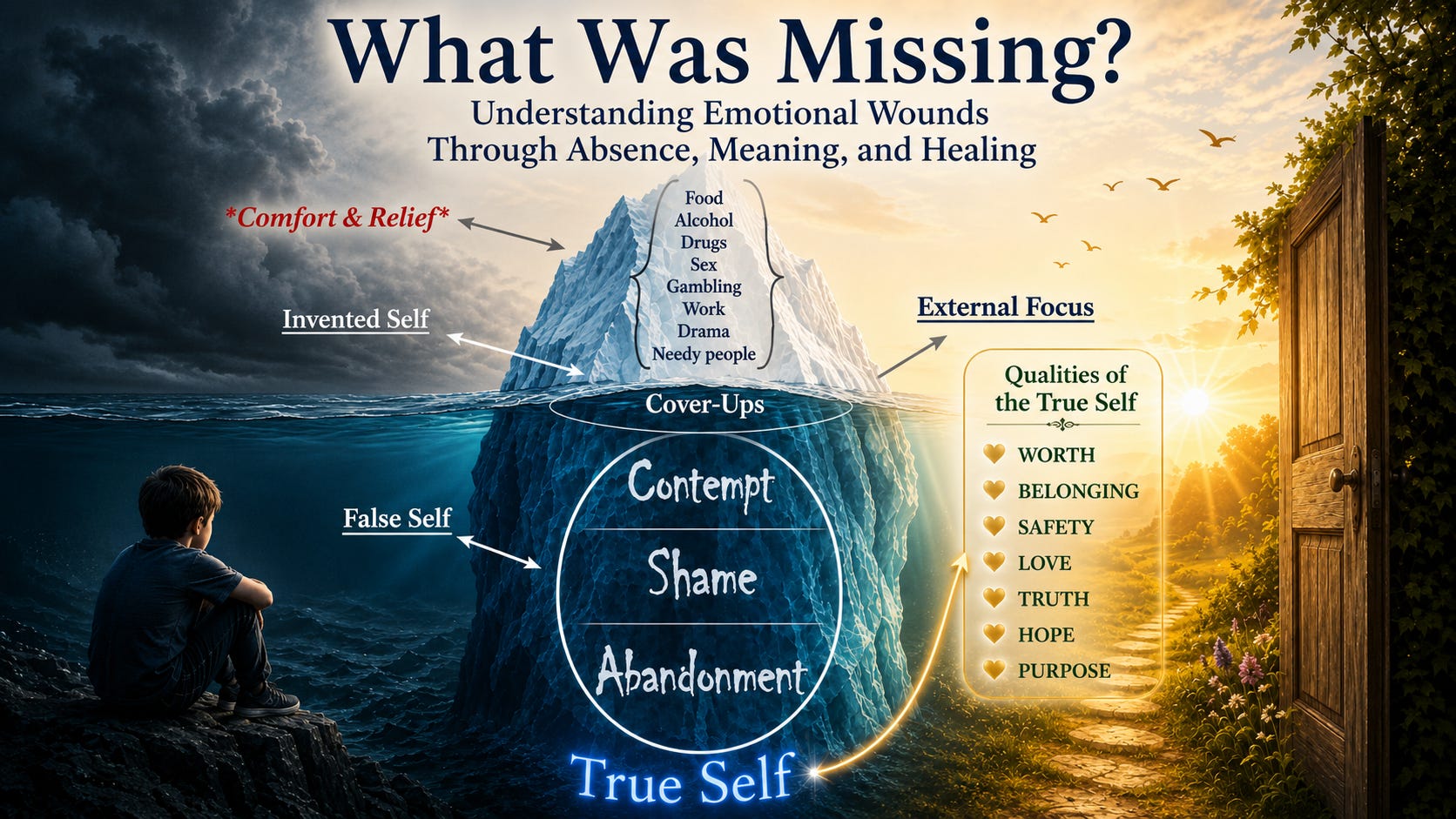
The Dark Room
I crossed the office and sat across from a man who had spent years describing the same feeling in different ways.
“Empty,” he said that afternoon. “Like there’s a black hole inside me.”
He had tried filling it with relationships, work, alcohol, achievement, and constant noise. Each one helped for a while. But when the relationship ended, the workday stopped, or the room became quiet, the emptiness returned—often larger than before.
As he spoke, a storm moved across the sky outside my window. The room slowly darkened. Without thinking, I reached over and turned on a lamp. The darkness did not have to be removed, defeated, or pushed away. It disappeared when something that had been absent became present.
I looked back at him and wondered whether we had been asking the wrong question. What if the emptiness inside him was not a thing he needed to fight? What if it was the absence of something he had needed to receive?
Protection
Connection
Safety
Joy
Meaning
Love
Perhaps the void was not his identity. Perhaps it was not evidence that something dark lived at the center of him. Perhaps it was the place where something essential had never been given—or had once been taken away.
Outside, the clouds shifted. A narrow beam of sunlight crossed the floor between us.
The sun had been there the entire time.
We Usually Ask What Is Wrong
When people struggle emotionally, we tend to begin with questions such as:
“What is wrong with me?”
“Why am I like this?”
“Why can’t I just get over it?”
“Why do I keep doing things I know are hurting me?”
Those questions assume that something negative exists inside the person—some defect, darkness, weakness, disorder, or broken part that must be identified and removed.
Sometimes there are genuine biological or medical conditions that deserve careful assessment and treatment. But many emotional struggles are not best understood as evidence that a person was born defective.
A different question may bring us closer to the source:
What was missing?
When a child was abused, protection was missing.
When a child was neglected, attunement was missing.
When love depended on performance, secure belonging was missing.
When feelings were mocked, emotional safety was missing.
When a caregiver was unpredictable, stability was missing.
When a child was repeatedly blamed, fairness and accurate responsibility were missing.
When grief was dismissed, companionship in sorrow was missing.
The harmful thing that happened matters. But so does the life-giving thing that should have been present and was not.
Saying that darkness is the absence of light does not mean darkness has no effect. A child left alone in a dark room may still become frightened, disoriented, and desperate.
An absence is not experienced as nothing. The nervous system experiences it as pain.
The Child Must Decide What It Means
There is an old teaching story about two little boys who were placed in very different rooms.
One boy was taken into a room filled from wall to wall with toys. When the adults later returned, they found him sitting in the middle of the room crying.
“What is wrong?” they asked.
“I can’t decide what to play with first,” he said. “I might choose the wrong one!”
The other boy was placed in a room filled with horse manure. When the adults returned, they found him whistling and shoveling as fast as he could.
“What are you doing?” they asked.
The boy looked up and said:
“With all this manure, there has to be a pony in here somewhere!”
The difference was not only what was in the rooms. It was what the boys had learned to expect from life.
Perhaps the second child had…
a grandfather who delighted in him.
A teacher who noticed his strengths.
An aunt who listened when he was discouraged.
A coach who taught him that mistakes were part of learning.
Someone had added hope. Someone had added confidence. Someone had helped him believe that difficulty might contain possibility.
The first boy may have received plenty of material things while something less visible remained missing:
Permission to choose.
Confidence that mistakes could be survived.
Freedom from perfectionism.
Trust in his own judgment.
A stable sense that he would still be acceptable if he chose poorly.
Children do not merely experience events. They interpret them. They decide what those events mean. And because they are children, they make those decisions with limited information, limited perspective, and very little power.
A young child cannot usually say: “My mother is overwhelmed and emotionally unavailable.”
The child concludes: “I am not important enough for her to notice.”
A child cannot say: “My father ridicules emotion because he is uncomfortable with his own vulnerability.”
The child concludes: “My feelings are weak, shameful, or dangerous.”
A child cannot say: “The adults failed to protect me.”
The child concludes: “I am unsafe.”
Or worse: “There must be something wrong with me.”
The absence creates pain. The child’s conclusion gives that pain a meaning.
When the God-Like People Cannot Be Wrong
During what sociologist Morris Massey called the Imprint Period, young children take in far more than words and rules. They absorb emotional meanings about safety, love, worth, belonging, and what they must do to remain connected.
To a small child, parents are not experienced as ordinary, imperfect adults. They are the providers of food, shelter, comfort, protection, explanation, and belonging. They know how the world works. They decide what is safe, what is dangerous, what is good, and what is bad. In the child’s limited world, they can seem almost god-like, 10 feet tall and bulletproof.
These are the people who are supposed to keep the child safe and provide the experiences through which security, value, and identity gradually become internalized. Early caregiving relationships play a foundational role in emotional development because children depend upon caregivers for both survival and regulation.
But what happens when those god-like figures do not protect the child? What happens when they ridicule feelings, withdraw love, become frightening, remain emotionally absent, or fail to notice that the child is hurting?
The young child often cannot safely conclude:
“The people responsible for me are limited, wounded, unavailable, or failing me.”
That realization would mean the child’s source of safety cannot be trusted—and the child has nowhere else to go.
So the mind reaches for an explanation that preserves attachment and offers at least the illusion of control:
“It must be me.”
If Dad is angry, I must have caused it.
If Mom withdraws, I must be too needy.
If no one protects me, perhaps I am not worth protecting.
If love disappears when I struggle, I must learn how to earn it.
If I am the problem, then perhaps I can fix the problem. I can become quieter, tougher, more helpful, less emotional, less needy, more successful, or nearly perfect. Self-blame is painful, but it allows the child to preserve the belief that the god-like people are still dependable—and that safety might be restored if the child can only become someone different.
John Bradshaw once said that the young child must idealize their parents and see them as perfect god-like creatures because,
“If I am protected by a god-like creature, then nothing can get to me.”
Research has linked childhood neglect with self-blaming emotional responses and later internalizing difficulties. That is how an absence in the environment becomes an emptiness within the child.
Protection was missing, so the child concludes: “I am not worth protecting.”
Attunement was missing, so the child concludes: “I do not matter.”
Secure love was missing, so the child concludes: “I must perform to be loved.”
The wound begins with what the child did not receive. But it continues through what the child decided that absence meant about who they were.
What Was Missing Around Me Became Something Missing Within Me
This may be one of the most painful transformations in human development:
What was missing around the child becomes experienced as something missing within the child.
Protection was missing, so the child feels weak.
Attunement was missing, so the child feels invisible.
Consistent love was missing, so the child feels unlovable.
Guidance was missing, so the child feels incapable.
Belonging was missing, so the child feels like an outsider.
Permission was missing, so the child feels wrong for having needs.
The child takes an external absence and turns it into an internal identity.
The conclusion may sound like:
“I don’t matter.”
“I’m not enough.”
“I’m too much.”
“I’m on my own.”
“I have to earn love.”
“I cannot trust anyone.”
“If people really know me, they will leave.”
“My feelings make me weak.”
“I must never make a mistake.”
These are not objective discoveries about the child’s identity. They are attempts to explain painful conditions. But when those explanations are repeated often enough, they begin to feel like truth. That’s when they become core beliefs and mental filters.
The Free-Floating Mass of Pain
When I show people the Iceberg Model, I often ask them to describe what the deeper, beneath-the-surface emotional pain feels like.
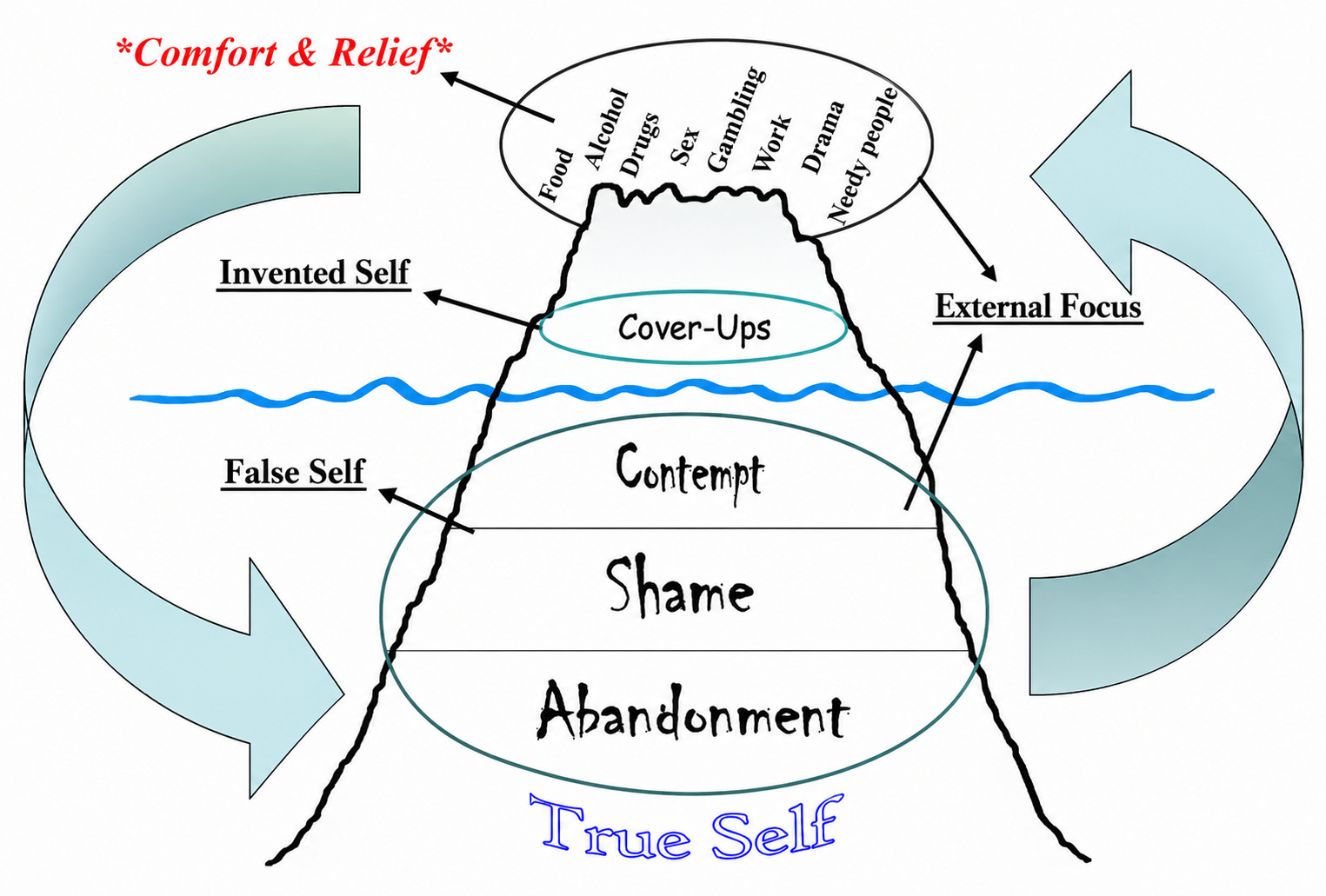
They rarely describe it as a clearly defined object.
They use words such as:
“An ache.”
“A Longing.”
“An Emptiness.”
“A void.”
“A vacuum.”
“A black hole.”
“A hollow place.”
“Something I can never fill.”
That language is revealing. The pain feels intensely present, yet people describe it in terms of absence. The emptiness may be the accumulated experience of what was needed but never sufficiently received:
Safety
Protection
Affection
Attunement
Validation
Permission
Guidance
Belonging
Meaning
Secure identity
Spiritual connection
I have called this the Free-Floating Mass of Pain because people may feel its weight long before they understand where it came from. A child may experience hundreds of moments of fear, shame, loneliness, rejection, or unmet need.
But those experiences may never be named.
Never explained.
Never comforted.
Never connected to their true source.
The pain remains, but the child’s explanation becomes distorted.
Instead of: “Something important was missing,”
the child concludes: “Something is missing in me.”
Instead of: “I was not adequately protected,”
the child concludes: “I am weak.”
Instead of: “I was not treated as valuable,”
the child concludes: “I have no value.”
As already mentioned: The wound begins with what was missing. It continues through what the child concluded the absence meant.
Mental Filters Keep the Old Conclusion Alive
Once a child reaches a conclusion, the mind begins organizing around it.
If the conclusion is: “People leave,”
the child becomes highly alert to distance, disappointment, and withdrawal.
If the conclusion is: “I am not enough,”
the child notices mistakes more readily than successes.
If the conclusion is: “My needs are a burden,”
the child becomes sensitive to sighs, irritation, or signs that someone is inconvenienced.
If the conclusion is: “I am only valuable when I perform,”
achievement becomes more than something enjoyable. It becomes proof of existence.
These conclusions become mental filters. They shape what the person notices, remembers, expects, and believes.
Evidence that supports the old conclusion stands out.
Evidence that challenges it may be overlooked, minimized, distrusted, or quickly forgotten.
A person may receive ten compliments and spend the night thinking about the one criticism.
A loving partner may offer years of consistency, yet one moment of distance activates the old certainty: “I knew it. I am going to be abandoned.”
A person may succeed repeatedly, yet one mistake reactivates: “I’m a failure.”
The filter does not merely describe reality. It helps recreate the emotional world in which the original conclusion continues to feel true.
The Survival Self Develops Around the Conclusion
When something essential is missing, and the child reaches a painful conclusion, the system adapts.
A child who lacks protection may become controlling.
A child who lacks approval may become a performer.
A child who lacks emotional safety may become numb.
A child who lacks dependable care may become fiercely independent.
A child who lacks belonging may become a people-pleaser.
A child who lacks secure worth may become perfectionistic.
A child who lacks comfort may discover substances, food, fantasy, work, or constant distraction.
These patterns are not random. They are attempts to solve the problem of absence.
The Survival Self may say:
“If I control everything, maybe I can finally feel safe.”
“If everyone approves of me, maybe I can feel valuable.”
“If I never need anyone, no one can abandon me.”
“If I remain numb, I cannot be overwhelmed.”
“If I achieve enough, I will finally be enough.”
“If I stay busy, the emptiness will not catch up with me.”
The strategy may later become costly. It may damage relationships, create exhaustion, intensify anxiety, or lead to addiction. But beneath the strategy is usually a legitimate need.
This is why shame rarely produces lasting healing. Shaming the behavior ignores and usually reinforces the deprivation and conclusion that gave it birth.
The more useful question is:
What is this pattern trying to supply, prevent, or replace?
Why We Keep Looking Outside Ourselves
A child’s external focus is not a flaw. It is necessary. Children begin by borrowing regulation, safety, language, and identity from the people around them.
A child learns:
“I am safe because you protect me.”
“I matter because you notice me.”
“My feelings make sense because you help me understand them.”
“I can survive distress because you stay with me.”
“I am lovable because your care does not disappear when I struggle.”
When these experiences are sufficiently present, they gradually become internalized.
External protection becomes an inner sense of safety.
External compassion becomes self-compassion.
External guidance becomes inner wisdom.
Being accurately seen helps the child develop a stable sense of self.
But when those experiences are missing, the developmental task remains unfinished. The person may continue looking outward for the identity, reassurance, regulation, and fullness that never became securely established within.
The search may take many forms:
Relationships
Approval
Achievement
Work
Money
Sex
Substances
Food
Status
Control
Helping
Perfectionism
Constant activity
Each carries a hidden promise:
“Perhaps this will finally make me feel whole.”
Counterfeit Fullness
External experiences can provide genuine pleasure and real relief.
Being admired may quiet shame.
Being desired may temporarily answer the fear of being unlovable.
Achievement may replace inadequacy with pride for a while.
Alcohol may soften self-consciousness.
Work may silence the inner void.
A new relationship may create a powerful sense of being alive, seen, and complete.
The relief is real. But relief is not always restoration. The outside experience may temporarily fill awareness without healing the original absence or changing the childhood conclusion. When the experience fades, the emptiness returns.
Sometimes the person concludes:
“I need more.”
More reassurance.
More success.
More intensity.
More pleasure.
More control.
More distraction.
But the deeper truth may be:
I do not need more of the substitute. I need something different.
Creature comforts are not the enemy. There is nothing wrong with enjoying good food, a comfortable home, financial security, recreation, affection, pleasure, accomplishment, or rest.
These are gifts. They can nourish and enrich life. But they cannot create identity or permanently fill developmental and spiritual emptiness.
Comfort received as a gift enriches the True Self’s experience of life. Comfort used as a substitute attempts to fill the absence of connection with the True Self.
Or, in more explicitly spiritual language:
There is nothing wrong with enjoying the gifts of creation. Trouble begins when we ask the gifts to replace the Giver.
What Someone Added May Have Changed Everything
The two boys in the story remind us of something hopeful. A child does not need a perfect childhood to develop resilience. Sometimes one trustworthy person adds something that is missing elsewhere.
A teacher communicates:
“You are capable.”
A coach communicates:
“You can struggle without being a failure.”
A grandparent communicates:
“I delight in who you are.”
An aunt communicates:
“Your feelings matter.”
A neighbor communicates:
“You are safe here.”
A sponsor communicates:
“You do not have to do this alone.”
A counselor communicates:
“What happened was not your fault.”
These messages do more than provide temporary encouragement. When they are repeated and received, they begin to become internal resources.
The child gradually learns:
“Maybe I do matter.”
“Maybe mistakes are survivable.”
“Maybe difficulty does not mean disaster.”
“Maybe I can trust myself.”
“Maybe there is still a pony in here somewhere.”
This is why two people may live through similar conditions and carry away very different beliefs.
It does not mean one was stronger, better, more spiritual, or more deserving.
One may have had someone who added hope, truthful reflection, belonging, agency, or protection before the absence became the whole story.
The Emptiness Is Not the Self
When emptiness has been present for a long time, people often assume it reveals something essential about who they are.
“Maybe there is nothing inside me.”
“Maybe I am incapable of love.”
“Maybe I am fundamentally broken.”
“Maybe I am just an empty person.”
But the dark room offers another possibility. The darkness is not the room’s identity. It is not a substance embedded in the walls. It tells us something about the room’s present condition:
Light is not reaching it.
In the same way, inner emptiness may not prove that there is no True Self. It may reveal that access to safety, belonging, meaning, love, and authentic identity has become obscured - like the sun shining behind the clouds.
The LSPM framework begins with the premise that the True Self is not destroyed by emotional injury. It becomes hidden beneath wounds, conclusions, mental filters, protective parts, and Survival-Self adaptations. Hidden behind the clouds, which may be very dark and ominous.
Healing is not the construction of a replacement person. It is the gradual uncovering, discovering, and recovering of the person who remained beneath those adaptations.
The sun had been there the entire time.
Healing Requires More Than Identifying What Was Missing
Recognizing the absence is important, but it is not enough.
We must also ask:
What did the child decide that the absence meant?
If protection was missing, did the child conclude: “I am helpless”?
If attunement was missing, did the child conclude: “My feelings do not matter”?
If love was inconsistent, did the child conclude: “I have to earn closeness”?
If guidance was missing, did the child conclude: “I must figure everything out alone”?
If approval depended on achievement, did the child conclude: “My worth rises and falls with my performance”?
Healing involves both the missing experience and the old conclusion.
The person may need protection now.
But the belief “I am permanently helpless” also needs to be updated.
The person may need safe connection now.
But the belief “I am fundamentally unlovable” also needs to be challenged.
The person may need permission to feel now.
But the belief “emotion is weakness” also needs a new understanding.
The wound began with deprivation. It became organized through meaning. Healing must address both.
We Cannot Always Replace What Was Lost
Some absences cannot be repaired in the form originally needed.
The childhood cannot be recreated.
The parent may never become capable of offering what was missing.
The person who died cannot return.
The abuse cannot be made unhappened.
This is where grief becomes essential. Healing is not pretending the loss did not matter. It is not finding a positive interpretation for deprivation. It is acknowledging:
“I needed something I did not receive.”
“That absence hurt me.”
“I deserved protection.”
“I deserved care.”
“I deserved to be believed.”
“I cannot change what happened, but I no longer have to treat the absence as evidence that I was unworthy.”
Some practical problems can be solved and closed. But emotional wounds often must be healed.
Healing may involve grieving what was missing, receiving corrective experiences in the present, releasing misplaced responsibility, updating the childhood conclusion, strengthening new internal resources, and allowing the nervous system to discover that the old conditions are no longer the only conditions available.
What Can Be Added Now?
We cannot travel backward and place a lamp in every dark room of the past. But we can begin bringing light into the places where the darkness still lives within present awareness.
What was missing then may help us identify what is needed now.
If protection was missing, healing may involve boundaries, advocacy, and discovering that the Adult Self can now act.
If attunement was missing, healing may involve being deeply heard and learning to notice one’s own inner experience.
If permission was missing, healing may involve reclaiming needs, feelings, preferences, and voice.
If belonging was missing, healing may involve safe community and relationships that do not require self-erasure.
If truth was missing, healing may involve naming what happened accurately.
If confidence was missing, healing may involve small experiences of competence and survivable mistakes.
If spiritual connection was missing or obscured, healing may involve rediscovering grace, meaning, sacred worth, and relationship with God.
The goal is not to fill every silence with noise or every ache with immediate comfort.
It is to identify the life-giving reality the wound has been pointing toward.
A More Complete Set of Questions
The next time emptiness, shame, anxiety, compulsive behavior, or relational distress appears, try pausing before asking:
“What is wrong with me?”
Consider asking:
What was missing?
What did I decide that absence meant about me?
What did I begin doing to compensate for it?
What truthful, life-giving experience needs to be added now?
Maybe safety is missing.
Connection
Rest
Truth
Protection
Permission
Meaning
Grief
Agency
A stable internal source of worth
Spiritual grounding
Then ask:
Am I trying to fill that absence with something incapable of supplying it?
And:
What is one small way I can bring what is truly needed into this moment?
Call someone safe.
Name the feeling.
Set a boundary.
Allow grief.
Sit quietly in prayer.
Rest without earning it.
Tell the truth.
Offer compassion to the part that has been trying to fill the room.
The Sun Was Still There
The man in my office had spent years trying to remove the darkness.
He fought it.
Tried to escape it.
Outworked it.
Drank over it.
Looked for someone else to make it disappear.
But perhaps the emptiness was never a dark substance at the center of him. Perhaps it was a signal. Something essential had been missing.
He had then made painful decisions about what that absence meant.
Those decisions became beliefs.
The beliefs became filters.
The filters shaped protective patterns.
And the patterns kept recreating the very emptiness they were designed to escape. The void was not his identity. The absence was not proof that there was no one inside. And the strategies he developed were not evidence that he was fundamentally defective. They were attempts to survive in a room where he had not yet learned how to find the light.
The lamp did not create the room. It revealed what had been there all along. Outside the window, the clouds had obscured the sun. They had not extinguished it.
And perhaps that is one of the deepest truths about healing:
The wound begins with what was missing, but it continues through what the child concluded the absence meant. Healing restores what can be restored, corrects the old conclusion, and helps the person recover access to the self that was never truly absent.
A Gentle Practice for the Week
When an old reaction appears, pause and complete these four sentences:
What was missing was…
I decided that meant…
I learned to protect myself by…
What I may need now is…
Do not force a positive answer.
Let the response come honestly.
The purpose is not to judge the old conclusion or criticize the protective pattern. It is to understand how the system formed—and to begin offering something different.
Join the Conversation
Has this question—“What was missing?”—changed how you understand any part of your own story?
You are welcome to share a reflection in the comments while protecting any details that feel personal. Sometimes one person’s insight gives another person language for something they have carried silently for years.
You may also consider sharing this article with someone who has spent too long believing that an absence in their childhood was proof of a defect within them.
Coming Next
In the next article, we will explore:
The False Self Is Not Another Self
The protective patterns we develop can become so familiar that they begin to feel like identity.
But the False Self is not a second person living inside us—and it is not an enemy that must be destroyed.
It is the human system organized around wounds, childhood conclusions, and attempts to find safety, belonging, identity, and relief.
Understanding that distinction changes the direction of healing.
One Last Thought
The room was dark because light was missing. The child felt empty because something necessary had not been sufficiently received, protected, or internalized.
But the darkness was never the room. And the emptiness was never the child.
What was missing may explain the wound. It does not define the person who was wounded.