

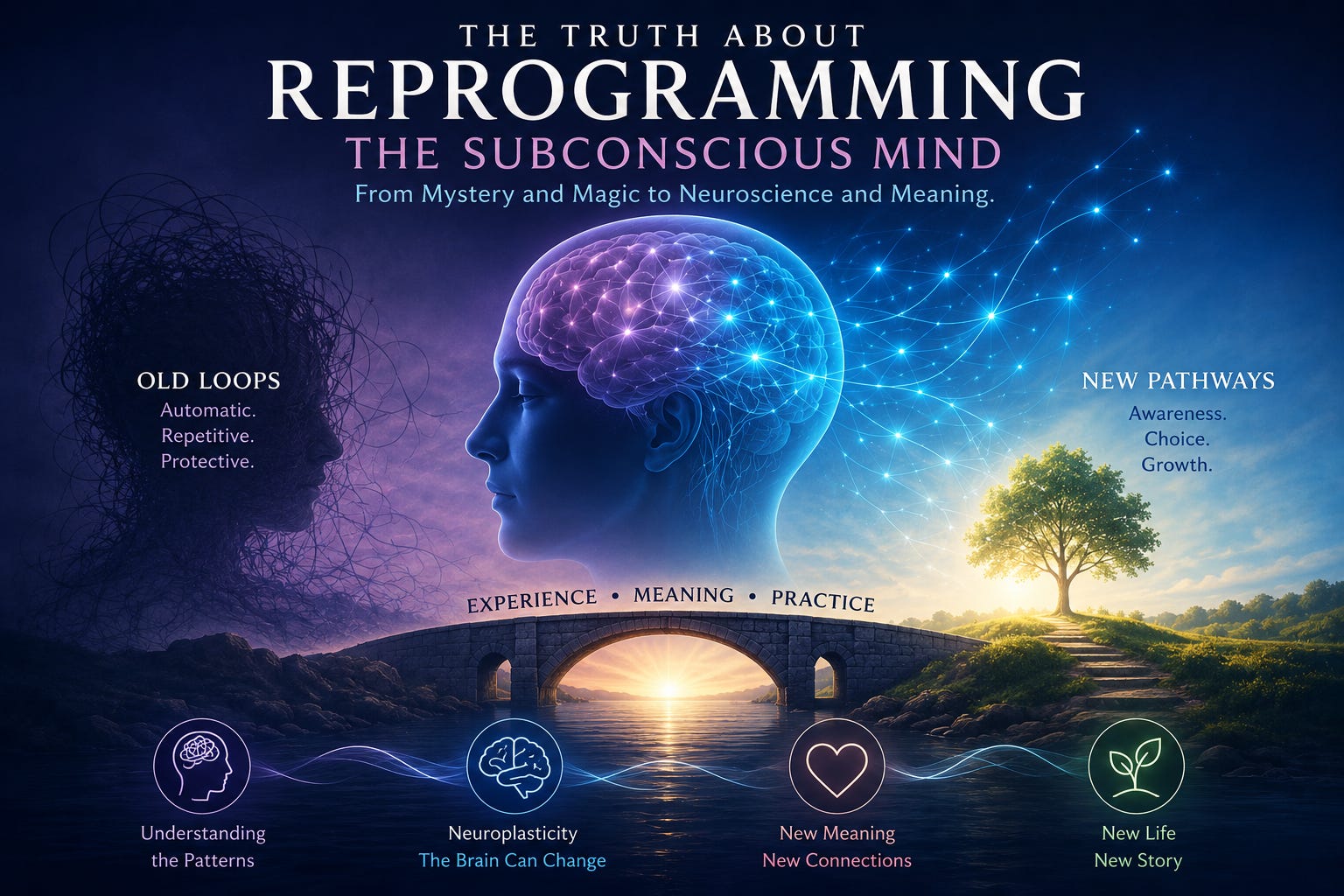
“Reprogramming the subconscious mind.” That phrase can sound mysterious. Powerful. Almost magical. It can also sound trendy, overused, and suspiciously close to internet sensationalism.
Scroll long enough, and you will find endless promises:
Reprogram your subconscious overnight.
Change your beliefs while you sleep.
Manifest a new life in seven days.
Erase trauma instantly.
Install wealth consciousness.
Unlock your hidden power.
Some of that language makes thoughtful people skeptical. And it should. Human beings are not machines. The mind is not a hard drive. Healing is not usually a matter of pushing the right button and installing a new program.
But here is the other side:
Real change can happen quickly. Sometimes very quickly. In the right conditions, with the right readiness, a person can make a meaningful shift in one session of hypnosis, EMDR, deep imagery, spiritual encounter, somatic release, or emotionally powerful insight.
A belief that has organized someone’s life for years can loosen.
A protective part can step back.
A new emotional truth can land.
A memory can feel different.
A person can experience themselves in a new way.
So the question is not whether rapid change is possible. It is.
The better question is: What is actually changing? And is “reprogramming the subconscious mind” the best way to describe it?
I think a better phrase may be:
Rewiring the brain.
Or perhaps even more accurately:
Updating the default-mode loops of the mind, brain, nervous system, and body.
That may not sound as mystical. But it may be closer to what is really happening.
The Old Language and the New Understanding
For generations, people used phrases like “the subconscious mind” to describe the hidden layers of human experience.
The patterns beneath awareness.
The beliefs we do not know we are living from.
The emotional reactions that rise before we can explain them.
The habits that repeat automatically.
The fears that feel true before we have time to question them.
The old decisions that shape our present life.
That language still has value. It points toward something real. Most of our inner life is not fully conscious in the ordinary sense. We do not wake up each morning and consciously choose every thought, reaction, belief, expectation, posture, emotional habit, and relational reflex. Much of us runs on default.
We have familiar ways of interpreting ourselves.
Familiar ways of interpreting other people.
Familiar ways of responding to stress.
Familiar ways of protecting ourselves.
Familiar ways of avoiding pain.
Familiar ways of seeking connection.
Familiar ways of expecting rejection, disappointment, danger, failure, criticism, abandonment, or shame.
Older traditions called this the subconscious. Modern neuroscience gives us additional language:
Neural pathways.
Prediction.
Neuroplasticity.
Memory reconsolidation.
Conditioning.
Hebbian learning.
Emotional learning.
Default-mode networks.
Autonomic state.
Attention.
Repetition.
Intensity.
The new language does not make the old mystery disappear. But it does help us understand why change is possible.
The brain and nervous system are not fixed.
They adapt.
They learn.
They reorganize.
They strengthen what is used.
They weaken what is no longer reinforced.
They become shaped by what we repeatedly think, feel, practice, imagine, expect, and experience.
That is good news. Because if old patterns were learned, then new patterns can be learned. And if the nervous system became organized around survival, it can gradually learn safety. If the mind made old decisions about the self, others, and life, the mind can also make new decisions.
The Brain Learns Through Intensity and Repetition
One of the simplest ways to understand brain change is this: The brain learns through intensity and repetition.
When something happens with enough emotional intensity, the brain pays attention. It says:
This matters.
Remember this.
Prepare for this next time.
That is why some events become etched into memory after one experience. Many people remember where they were when they heard about the attacks of September 11. Older generations may remember where they were when President Kennedy was assassinated. I am dating myself here, but I remember exactly what desk I was sitting at and many other details when that news came across the intercom in my first-grade classroom.
A frightening accident, a humiliating moment, a sudden betrayal, a profound spiritual experience, or a deeply moving encounter can create a strong memory because emotional intensity tells the brain, “This is important.”
Sometimes this is adaptive.
Sometimes it is painful.
Sometimes it creates wisdom.
Sometimes it creates trauma.
But the principle is similar: Intensity accelerates learning.
This is one reason hypnosis can be powerful. Hypnosis is not magic. It is a focused state of attention, imagination, responsiveness, and inner absorption. When a person is ready, safe enough, and appropriately guided, hypnosis can increase the emotional intensity of a new experience.
A person may not merely think, “I am safe now.”
They may feel it.
Imagine it.
Sense it.
Experience it.
Rehearse it.
Let it become more real to the body and nervous system.
That can matter. Because the nervous system does not change deeply through words alone. It changes through experience. If the old belief was learned through emotionally intense experience, the new belief often needs to become more than an intellectual statement.
It needs to become emotionally believable.
It needs to land.
When Intensity Is Lower, Repetition Matters More
Not all learning happens in one powerful moment. Much of life changes through repetition, practice, and rehearsal. Small experiences repeated often enough to become familiar. That is why “practice makes perfect” contains some truth.
A baseball player does not usually become skilled by taking a swing once.
The body learns through repetition.
The brain predicts better through repetition.
The nervous system becomes familiar with the motion through repetition.
But intensity still matters.
A strikeout may teach something.
A home run may teach something.
The body remembers the feel of success.
The nervous system registers the emotional charge.
The brain updates its prediction:
That worked.
Do that again.
The same principle applies emotionally and relationally. A person may need many repetitions of safety before trust becomes believable.
Many repetitions of healthy boundaries before “I can say no” becomes natural.
Many repetitions of self-compassion before “I am not defective” begins to feel true.
Many repetitions of calm before the nervous system stops expecting danger.
Many repetitions of new behavior before a life script changes.
So rapid change and gradual change are not enemies. They work together. Sometimes one powerful experience opens the door. Then repetition strengthens the new pathway. Sometimes repetition prepares the system for the one moment when the new truth finally lands.
Both matter.
Hebb’s Law in Everyday Language
There is a simple phrase often used to describe one major principle of learning:
Neurons that fire together wire together.
That is the everyday version of Hebb’s Law. In plain language, it means that when certain thoughts, emotions, body states, memories, and behaviors repeatedly happen together, the brain becomes more likely to link them.
If criticism repeatedly comes with shame, the brain links criticism and shame.
If closeness repeatedly comes with fear, the brain links closeness and danger.
If conflict repeatedly comes with abandonment, the brain links disagreement and loss.
If success repeatedly comes with pressure, the brain links achievement and anxiety.
Over time, these associations can become automatic. A person may not know why they react so strongly. They simply feel it.
The body remembers the pattern.
The mind fills in the meaning.
The nervous system prepares for what it expects.
But Hebb’s Law also points toward hope. If old patterns can wire together, new patterns can wire together too.
Safety and closeness.
Truth and compassion.
Boundaries and connection.
Mistakes and learning.
Feelings and tolerance.
Stillness and safety.
Achievement and peace.
Spiritual trust and nervous-system regulation.
These new links do not usually become strong through slogans alone. They strengthen through repeated, meaningful, emotionally believable experience. That is why effective healing work often combines insight, emotion, body awareness, imagination, repetition, and practice.
The Default-Mode Network
This is where the concept of the Default-Mode Network becomes useful. The Default-Mode Network, or DMN, is a set of brain regions often active when the mind turns inward. It is involved in self-reflection, autobiographical memory, imagining the future, thinking about others, and constructing a sense of personal story.
In simple terms, the DMN helps the mind organize the inner narrative:
Who am I?
What has happened to me?
What does this mean?
What might happen next?
How do I see myself?
How do I imagine others see me?
What kind of world do I believe I live in?
That is why I like the phrase “default-mode loops.” The brain, mind, and nervous system tend to return to familiar loops.
A familiar story.
A familiar state.
A familiar emotional expectation.
A familiar protective strategy.
A familiar interpretation of reality.
For one person, the default loop may sound like:
I am not enough.
I need to prove myself.
If I slow down, I will fall behind.
People will be disappointed.
Keep pushing.
For another:
People leave.
Do not need too much.
Stay guarded.
Do not trust the good thing.
Prepare for loss.
For another:
If I make a mistake, I will be humiliated.
Stay perfect.
Stay controlled.
Do not let them see weakness.
For another:
Nothing I do matters.
Why try?
Detach.
Numb.
Disappear.
These are not just thoughts. They are loops. They involve memory, prediction, meaning, body state, emotion, attention, and behavior. They are what older language might call subconscious programming.
But we can also understand them as learned default-mode patterns.
And that means they can be updated.
Reprogramming or Rewiring?
So is “reprogramming the subconscious mind” real?
Yes and no.
If by reprogramming we mean mechanically installing a new personality like software, then no. That is too simplistic. Human beings are not computers. And healing should never be reduced to manipulation, control, or bypassing a person’s deeper work.
But if by reprogramming we mean helping the mind, brain, body, and nervous system update old automatic patterns, then yes. That can happen.
A person can update old meanings.
They can make new decisions.
They can strengthen new neural pathways.
They can loosen old fear associations.
They can rehearse new responses.
They can form new links between safety, truth, relationship, and self-worth.
They can move from Survival Mode toward Growth Mode.
They can stop living entirely from the old conclusion:
This is what I must do to survive.
And begin living from a new one: this is what wisdom, truth, and growth now make possible. That is not magic.
But it can feel miraculous when it happens.
Why Hypnosis Can Help
Hypnosis can be useful because it works with attention, imagination, emotion, body state, and meaning. Those are the ingredients of deep learning.
In hypnosis, the person is not unconscious.
They are not under someone else’s control.
They are not being “programmed” by the hypnotist.
A better way to understand hypnosis is that the person enters a state of focused inner attention where new experiences can become more vivid, emotionally meaningful, and believable.
Instead of merely talking about safety, they may experience safety.
Instead of merely analyzing a belief, they may imagine a new possibility.
Instead of merely repeating an affirmation, they may feel the truth of a new statement in the body.
Instead of only remembering the wound, they may access resources, compassion, protection, or adult perspective.
This is why hypnosis can sometimes help create change quickly.
It can increase intensity.
It can strengthen emotional learning.
It can help the nervous system experience a new pattern rather than simply hear about one.
But hypnosis is not a shortcut around readiness.
The person’s system still matters.
Protective parts matter.
Safety matters.
Timing matters.
Trust matters.
The old pattern had a purpose. It helped the person survive something. So the goal is not to attack the old programming. The goal is to understand it, honor its protective purpose, and help the system update.
The LSPM View
In LSPM, we are not simply trying to paste positive thoughts on top of old wounds. We are looking at the whole inner system.
Life scripts.
Parts.
Core beliefs.
Mental filters.
Nervous-system states.
Relational loops.
Developmental wounds.
Spiritual assumptions.
Old decisions.
New decisions.
The question is not only:
What do you want to believe?
The deeper questions are:
What happened?
What did you decide it meant?
What part of you stepped forward to protect you?
What belief became organized around that decision?
What body state became familiar?
What mental filters began shaping perception?
What relationships reinforced the loop?
What resources are available now?
What new decision is possible?
That is where real change begins.
Not by forcing the subconscious mind to obey.
Not by pretending pain never happened.
Not by repeating positive phrases the nervous system does not believe.
But by helping the whole system update.
The mind makes meaning.
The brain wires experience.
The nervous system protects.
The body remembers.
Parts organize around survival.
Relationships reinforce loops.
And healing happens when new meaning, new experience, new regulation, and new practice begin to work together.
The LSPM Guided Intensive
This is also the larger purpose behind the upcoming LSPM Guided Intensive. The Intensive is designed to help people understand their own default-mode loops and begin preparing the inner system for deeper change. It brings together the pieces we have been exploring in this series:
Life scripts
Parts
Core beliefs
Nervous-system regulation
Meaning-making decisions
Mental filters
Protective patterns
Resource-building
Empowering beliefs
Guided meditation
Reflective exercises
The goal is not to “reprogram” people as if they are machines. The goal is to help people understand how their system became organized, what old decisions may still be running in the background, and what new beliefs, resources, and patterns can begin to form now. In other words it is:
Guided neuroplasticity.
Guided meaning-making.
Guided regulation.
Guided practice.
Guided growth.
More will be coming soon on the LSPM Guided Intensive, how it works, and how it may help people prepare for deeper healing work. For now, the main point is this: The old phrase “reprogramming the subconscious mind” may be imperfect. But it points toward something real.
The human system can change.
Old loops can update.
New pathways can form.
The mind can make new meaning.
The nervous system can learn safety.
The brain can rewire.
And a person can begin living from a new decision:
I am no longer only surviving what happened.
I am learning how to create what comes next.
Stay Tuned
In upcoming articles, I’ll continue unpacking how default-mode loops form, how they keep repeating, and how LSPM helps identify and update the deeper patterns that shape our everyday lives.
Because the real question is not whether change is possible.
It is how we create the conditions where change can actually take root.
Join the Conversation
Internet-of-the-Mind was created to explore the intersection of psychology, human development, technology, artificial intelligence, relationships, meaning, and the future of being human.
The goal is not to create an echo chamber.
The goal is to create thoughtful conversation.
Agreement is welcome.
Thoughtful disagreement is welcome.
Curiosity is welcome.
If this article sparked a question, challenged an assumption, or inspired a different perspective, please share your thoughts in the comments.
Guest contributions are also welcome from readers, clinicians, educators, technologists, researchers, students, creators, and thoughtful observers of the human condition.
You do not have to agree with me.
You do have to think.
Because the most important questions of our time are probably too important to be explored from only one perspective.
INTERNET OF THE MIND @ SERENITY CAFE, your distinction between "reprogramming" and "rewiring" matters more than it looks. The old metaphor implies a clean swap, the new one acknowledges that existing pathways don't vanish, they get outcompeted by stronger ones. I ran into a parallel problem in AI security. Everyone trains on the same corpus, so the models all share the same blind spots. The edge isn't reprogramming the model, it's curating what it never learned well in the first place. Your point and mine converge here: whether we're talking about brains or machine learning, the real work is in what you feed the system next, not in pretending you can wipe the old slate clean.
https://cyrilsimonnet.substack.com/p/everyones-ai-was-trained-on-the-same