

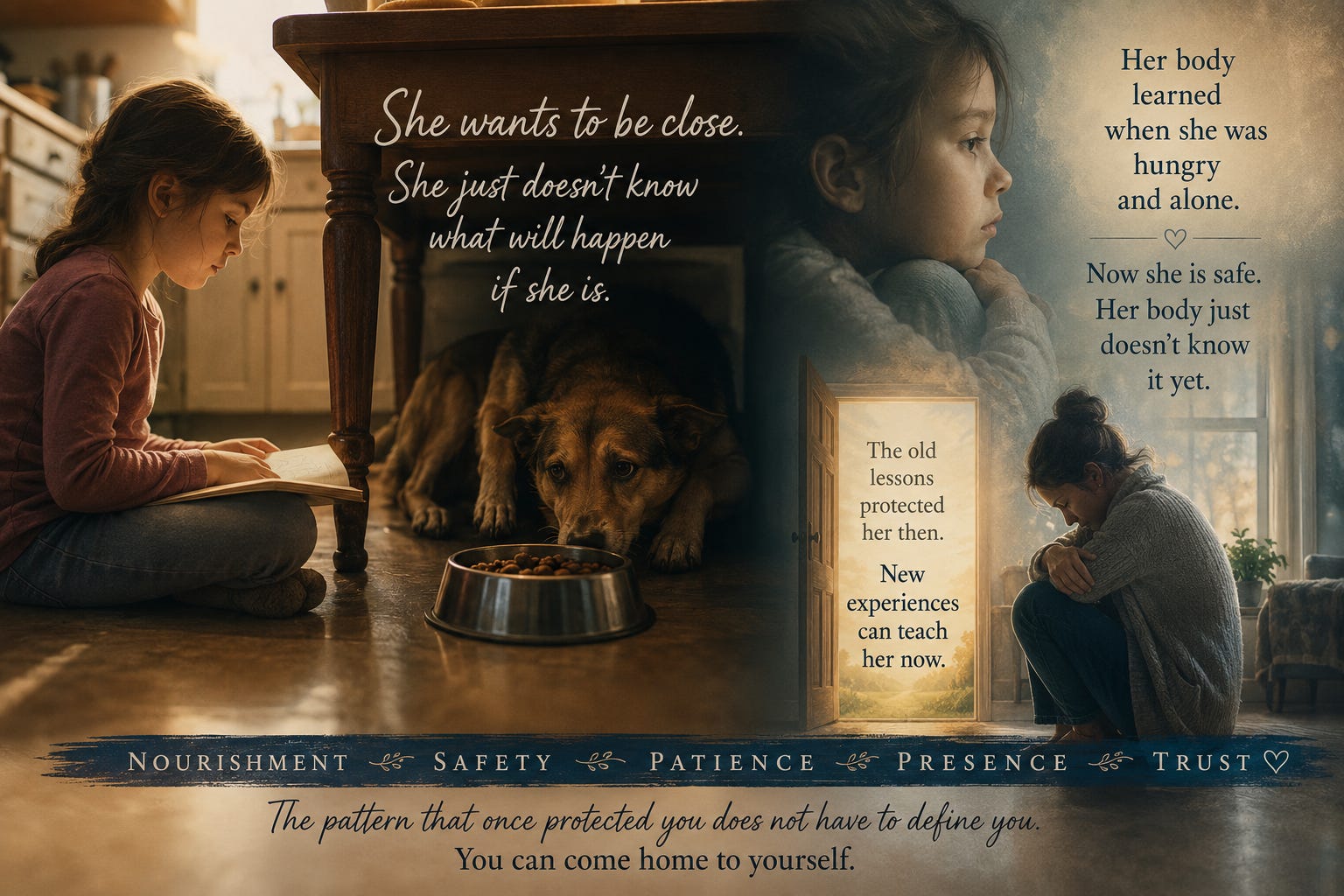
The little girl carried the dog’s food across the kitchen with both hands, careful not to spill it.
At the sound of the bowl touching the floor, the rescue dog hurried forward. She ate as though the food might disappear before she could finish—head lowered, body rigid, eyes lifting every few seconds to check the room.
When the girl took one step closer, the dog stopped eating. She stood over the bowl without moving. No growl. No bark. Just stillness.
The girl backed away.
For the three weeks the dog had lived with the family, she had behaved this way. She slept beneath a table rather than on the soft bed they had bought her. She flinched when someone reached to pet her. She rarely made a sound, even when the other dogs in the neighborhood barked.
The shelter had explained that she had been found thin and alone. No one knew how long she had gone without regular food or what had happened before she was rescued.
Now she was fed every morning and every evening. There was always water in her bowl. The house was warm. The doors were locked at night. No one shouted at her or struck her.
She was safe. But she did not behave like a dog who was safe. The adults wondered whether she would ever become affectionate. They wondered whether something in her had been permanently damaged.
The little girl did not seem worried about that.
Each evening, she sat several feet away from the dog’s hiding place. She did not call her name or try to coax her out. She simply sat on the kitchen floor, sometimes coloring, sometimes turning the pages of a book.
One evening, the dog slowly crawled from beneath the table. She stopped just beyond the girl’s reach.
The girl kept her eyes on her book.
After a while, the dog lowered herself onto the floor. Her body remained tense, ready to run, but she stayed. The girl looked toward her mother and whispered, “I think she wants to be close. She just doesn’t know what will happen if she is.”
Then she returned to her book.
The dog did not move any nearer that night. But she did not retreat beneath the table either. There was nothing inherently wrong with her. She had learned something when she was hungry and alone: food could disappear, hands could be dangerous, closeness could cost her something.
Those lessons had helped her survive. Now the conditions of her life had changed, but her body had not yet received the news.
Children can learn something similar.
In a family where emotions invite ridicule, punishment, rejection, conflict, or withdrawal, a child may discover that feeling openly is not safe. The child may stop crying, stop asking, stop protesting, stop showing fear. Eventually, the child may stop noticing what is happening inside at all.
What begins as protection can slowly become numbness.
Years later, the danger may be gone. The child may have become an adult surrounded by gentler people, greater freedom, and genuine care. But like the dog standing rigidly over a full bowl, the body may continue preparing for a deprivation that is no longer coming.
The Body Learns Before It Has Words
Children do not enter the world able to explain what is happening to them.
A young child cannot usually say:
“The adults around me are emotionally unavailable, and I am adapting by suppressing my attachment needs.”
The child experiences something much simpler and more immediate:
“When I cry, people become angry.”
“When I need comfort, no one comes.”
“When I show fear, I am mocked.”
“When I disagree, someone withdraws love.”
“When I am vulnerable, I lose safety.”
The child’s body begins learning before the child can put those experiences into words.
The shoulders tighten.
The breath becomes shallow.
The tears are held back.
The eyes scan the room.
The voice becomes quiet.
The child learns which expressions are acceptable, which needs create trouble, and which parts of the self must be hidden to preserve connection.
At first, the child may consciously decide not to cry. Later, the body shuts the tears down automatically.
At first, the child may deliberately avoid asking for help. Later, the need itself becomes difficult to feel.
At first, emotional withdrawal is something the child does. Eventually, it becomes something the nervous system does before the adult mind has time to choose.
What began as a survival strategy starts to feel like personality.
“I’m just not an emotional person.”
“I don’t need anybody.”
“Nothing really bothers me.”
“I don’t know what I feel.”
But numbness is not always evidence that little emotion exists. Sometimes it is evidence that emotion once felt too dangerous to experience openly.
She Wants to Be Close—She Just Doesn’t Know What Will Happen
The little girl understood something the adults had nearly missed. The dog’s distance did not necessarily mean she did not want connection. It may have meant that connection had become associated with danger.
That distinction matters in human relationships too.
A person may want closeness and still withdraw when it appears.
A person may want reassurance and then distrust it when it is offered.
A person may long to be known and become uncomfortable when someone sees too much.
A person may desire intimacy but experience emotional exposure as loss of control.
From the outside, these reactions can look contradictory:
“You said you wanted to be close. Why are you pulling away?”
But the inner system may be saying:
“I want to be close. I just don’t know what will happen if I am.”
One part moves toward connection. Another remembers what connection once cost. The adult may intellectually know that the current relationship is different. The body may still be standing over the bowl, waiting for the food to be taken away.
The Bowl Is Full, but the Body Remembers Hunger
A full bowl does not immediately erase the memory of starvation. In the same way, present-day love does not automatically erase the expectation of rejection. A safe partner does not instantly remove the fear created by an unsafe caregiver.
A supportive workplace may not immediately quiet the body of someone who learned that mistakes led to humiliation. Financial stability may not calm a person whose childhood was filled with scarcity.
A peaceful home may still feel unfamiliar to someone whose nervous system was organized around conflict. The new experience is real. But so is the old prediction.
This is one reason people sometimes feel confused or ashamed when life improves, but their reactions do not.
“Why am I still anxious? Nothing bad is happening.”
“Why can’t I relax? I have everything I used to wish for.”
“Why do I keep expecting rejection when this person has been kind?”
The answer may not be that the person is ungrateful, irrational, or permanently damaged. The conditions changed before the nervous system did. The body is not necessarily responding to what is happening now. It may be responding to what experience taught it could happen next.
What Was Missing?
When people struggle, we often ask:
“What is wrong with them?”
The starving-dog analogy invites a different question:
“What was missing?”
The dog was not defective.
Food had been missing.
Safety had been missing.
Dependable care had been missing.
Gentle human contact may have been missing.
Predictability had been missing.
For a child, what may have been missing?
Protection.
Attunement.
Comfort.
Permission to feel.
A calm adult who could stay present.
A trustworthy person who did not disappear when emotions became inconvenient.
A model of strength that included tenderness.
Someone who could say:
“You are upset, but you are not alone.”
“Your feelings make sense.”
“You are allowed to need help.”
“I will not shame you for being afraid.”
“We can handle this together.”
Children first learn who they are through the responses of the people around them.
They learn safety by being protected.
They learn worth by being valued.
They learn emotional language by having someone help them name what is happening inside.
They learn that distress can be survived because someone stays with them while it passes.
When these experiences are sufficiently available, they gradually become internalized.
The protected child begins to develop an inner sense of safety.
The comforted child begins to develop self-soothing.
The understood child begins to understand himself.
The valued child begins to experience worth as something more stable than another person’s immediate approval.
When these experiences are absent, inconsistent, or distorted, the child must still find a way to function.
The child may become:
Quiet
Perfect
Helpful
Funny
Tough
Invisible
Independent
Watchful
Numb
These adaptations are not evidence of an inherently defective self. They are evidence of a system learning how to survive what was missing.
What Begins as Protection Can Become Disconnection
Emotional shutdown can be remarkably effective.
If crying brings ridicule, the child learns not to cry.
If anger leads to punishment, the child learns not to show anger.
If fear invites contempt, the child hides fear.
If needing comfort repeatedly results in disappointment, the child may eventually stop noticing the need.
The strategy works—at least in the original environment.
The child appears:
Stronger
Less reactive
More mature
Easier to manage
But survival strategies usually have a cost. The child cannot selectively suppress only the feelings that create trouble. Over time, shutting down pain may also restrict access to joy, tenderness, desire, grief, affection, and authentic connection.
The adult may later say:
“I know I love people, but I can’t feel it.”
“I want to cry, but nothing comes.”
“I feel disconnected from my own life.”
“I know something should matter to me, but I feel blank.”
The numbness is not the whole person. It is the protective distance the person learned to place between awareness and emotional experience. The feelings may not be gone. The path to them has become guarded.
The Survival Self Is Not Another Self
When a person lives for many years through shutdown, control, people-pleasing, perfectionism, avoidance, or emotional distance, those patterns can begin to feel like identity.
“This is just who I am.”
But the protective pattern is not necessarily the deepest self. It may be the self the person had to become in order to remain functional, accepted, or safe.
I sometimes refer to this organization as the Survival Self or False Self. The word “false” does not mean fake, dishonest, or unreal. It means that the protective organization has been mistaken for the whole person.
The shutdown is real.
The fear is real.
The numbness is real.
The protective parts and nervous-system responses are real.
But they are not all that is there.
The dog beneath the table was not fundamentally antisocial. Her desire for closeness had become entangled with fear.
The emotionally numb adult may not lack an emotional self. The emotional self may have become obscured beneath layers of protection.
Healing is not the construction of a more acceptable personality. It is the gradual recovery of access to what had to be hidden.
The Little Girl Did Not Force the Dog to Heal
The little girl did something important.
She did not drag the dog from beneath the table.
She did not move closer after the dog became tense.
She did not insist that the dog recognize how safe the house was.
She did not say:
“You have been here for three weeks. Why don’t you trust us yet?”
She sat nearby.
She allowed distance.
She remained predictable.
She offered proximity without pressure.
She gave the dog an experience of being near someone without being grabbed, cornered, or demanded from.
That is how much emotional healing begins.
Not through force.
Not through shame.
Not through demanding immediate vulnerability.
The nervous system needs experiences that contradict its old predictions.
A person who expects rejection needs experiences of disagreement without abandonment.
A person who expects humiliation needs experiences of making mistakes without being shamed.
A person who expects emotional overwhelm needs experiences of feeling small amounts while remaining grounded.
A person who expects closeness to cost something needs experiences of connection in which boundaries are respected.
The body learns from repetition. So does the heart.
Emotional Reconnection Often Begins Quietly
People sometimes imagine emotional healing as a dramatic breakthrough—sobbing, catharsis, or finally expressing everything at once.
Sometimes healing is dramatic.
Often it is quieter.
It may begin with:
“I notice pressure in my chest.”
“I think I am disappointed.”
“Part of me wants to leave this conversation.”
“I feel something, but I cannot name it yet.”
“I usually shut down here, but I stayed present for thirty seconds longer.”
That is movement.
The dog did not climb into the girl’s lap. She remained just beyond reach. But she stayed outside the hiding place. Healing does not always mean moving closer. Sometimes it means not retreating as far as before.
“If My Body Learned This, It Can Learn Something New”
Recognizing that a response was learned can bring hope.
If the nervous system learned that emotion was dangerous, perhaps it can gradually learn that emotion can be survived.
If it learned that closeness leads to pain, perhaps it can learn that some relationships are safe.
If it learned that asking brings rejection, perhaps it can learn that some people respond with care.
But this hope must not become blame.
The child did not choose suffering.
The child adapted.
The person did not deliberately create a defective nervous system.
The system practiced what seemed necessary.
A more compassionate statement is:
“My body learned to protect me under difficult conditions. Now I can help it learn that those conditions are not the only ones available anymore.”
The old response may continue appearing even after the person understands it. That does not mean healing has failed. Insight can occur in one conversation. Embodied learning usually requires repetition. The mind may understand that the bowl will remain full long before the body stops guarding it.
Just Because It Feels Bad Does Not Mean It Is Negative
Reconnecting with emotion may initially feel uncomfortable.
Grief feels painful.
Vulnerability may feel frightening.
Setting a boundary may create guilt.
Telling the truth may produce anxiety.
Remaining emotionally present may activate the same alarm system that once made shutdown necessary.
That does not mean the new direction is negative.
Just because it feels bad does not mean it is negative, and just because it feels good does not mean it is positive.
Numbness may feel safer while increasing disconnection.
Avoidance may feel relieving while strengthening fear.
Approval may feel reassuring while deepening dependence on external validation.
Emotional presence may feel uncomfortable while moving the person toward integration. Grief may feel terrible while honoring love and helping the person adapt to loss.
The question is not only:
“How does this feel?”
It is also:
“Where is this leading?”
Helping the Body Receive the News
When an old reaction appears, it may help to pause and ask:
What does my body believe is happening?
Does it expect:
Rejection?
Humiliation?
Loss of control?
Abandonment?
Punishment?
Emotional starvation?
What past condition might it still be preparing for?
When did this response first make sense?
What did feelings, needs, mistakes, or closeness mean in that environment?
What was missing?
Protection?
Permission?
Comfort?
Choice?
Validation?
A dependable person?
What is available now that was not available then?
Do I have more power now?
More language?
More options?
A safer relationship?
The ability to pause?
The ability to leave?
The ability to ask for help?
What small update can I offer my system?
Perhaps:
“I am allowed to feel this without being overwhelmed by it.”
“This person is not the person who hurt me.”
“I can move slowly.”
“I do not have to disappear from myself.”
“I am here now, and I will stay with you.”
The purpose is not to argue the body out of its reaction. It is to provide the kind of repeated experience through which the body can gradually discover that life has changed.
Grace, Not Force
The little girl offered the dog something more than food.
She offered a different kind of relationship.
She did not require the dog to trust her before she behaved trustworthily.
She did not make affection the price of care.
She remained present without intrusion. That is grace.
In my own recovery and faith journey, I have come to believe that healing is more often invited than forced.
We do not shame the starving dog for guarding the bowl.
We do not shame the numb child for learning to disappear.
We bring nourishment.
Truth
Protection
Patience
Connection
And we repeat those experiences long enough for the system to begin accepting what the mind may already know.
There is food now.
There is safety now.
There are choices now.
There may be people who can be trusted now.
The child who learned that emotion was weakness may gradually discover:
“I can feel and still be strong.”
The person who learned that closeness brought danger may discover:
“I can be known without being consumed.”
The body that learned to expect starvation may begin to believe:
“The bowl will still be here tomorrow.”
You May No Longer Be Living in the Life Your Body Remembers
Your present reactions may not be proof that something in you was permanently damaged. They may be evidence that your body adapted successfully to circumstances that no longer exist.
The starving dog was never bad. She was hungry, frightened, and uncertain about what closeness might cost.
The numb child was never empty of emotion. That child learned to hide from feelings that did not seem safe to carry.
Healing does not require punishing the old response. It involves helping the system discover, through repeated experiences of truth and safety, that the conditions of life have changed.
The dog did not move within reach that night. But she did not return beneath the table. Sometimes that is how healing begins.
Not with complete trust.
Not with the disappearance of fear.
But with one small moment in which the old response is no longer the only response available.
The pattern that once protected you does not have to become the identity that permanently defines you.
Closing Invitations
Before you move on, take a quiet moment and ask yourself:
Where in my life might my body still be preparing for conditions that no longer exist?
You may notice a place where you still brace for rejection, hide emotion, guard what you have, expect disappointment, or pull away from closeness.
Do not criticize the response.
Get curious about it.
Ask:
What did this response once protect me from?
What was missing then?
What is available to me now that was not available before?
You do not have to force yourself out from beneath the table.
Perhaps the next step is simply to remain present a little longer than usual.
To notice one feeling.
To tell one safe person the truth.
To offer your younger self the reassurance, protection, or permission that was missing.
Healing often begins quietly—not when fear disappears, but when fear is no longer the only voice directing what happens next.
I would also like to hear what this brought up for you. Has your body ever continued reacting to a life or situation that had already changed? You are welcome to share your reflections in the comments, while protecting any details that feel private.
This article is the beginning of a developing series about the True Self, the Survival Self, emotional wounds, nervous-system learning, and how we recover access to the person who became hidden beneath adaptation.
Next, we will explore a different question:
What if the most helpful question is not “What is wrong with me?” but “What was missing?”
Until then, remember:
You are not the pattern that learned to protect you. And you do not have to force healing. You can begin by offering your system the news that life is different now.
I don't like the idea of going into my own specific trauma story on why this resonated given that this is a public comment and a long history of sore spots, but it did. I hope this article lands with other people too. I'll settle for myself on a more distant disclosure.
Today I realized while reading this I was already sort of "out from under the table" in a few ways I haven't been before. Here's to learning a little more about those full bowls everyone seems to think are out there, because maybe they are.