

A few days ago, someone commented on one of my recent articles about artificial intelligence and human relationships:
“And this perspective was shaped by AI ... Lol 🤣”
Fair point. In fact, that observation may quietly contain one of the most important questions of the entire AI era. Because yes — these articles are being developed collaboratively with artificial intelligence.
That is not something I am trying to hide. If anything, it may be part of the point. Internet-of-the-Mind is not attempting to discuss the AI revolution from a distance while pretending we are somehow untouched by it.
None of us is outside this transition anymore.
The deeper question is not whether human beings will interact with increasingly intelligent systems. We already are.
The deeper question may be:
Can we do so consciously, ethically, reflectively, and without surrendering the deeper capacities that make us human?
That is the conversation I want Internet-of-the-Mind to become. Not a place for simplistic answers or technological worship. Not a place for fear-based panic. But a place where thoughtful human beings can wrestle honestly with one of the most significant transitions in modern history.
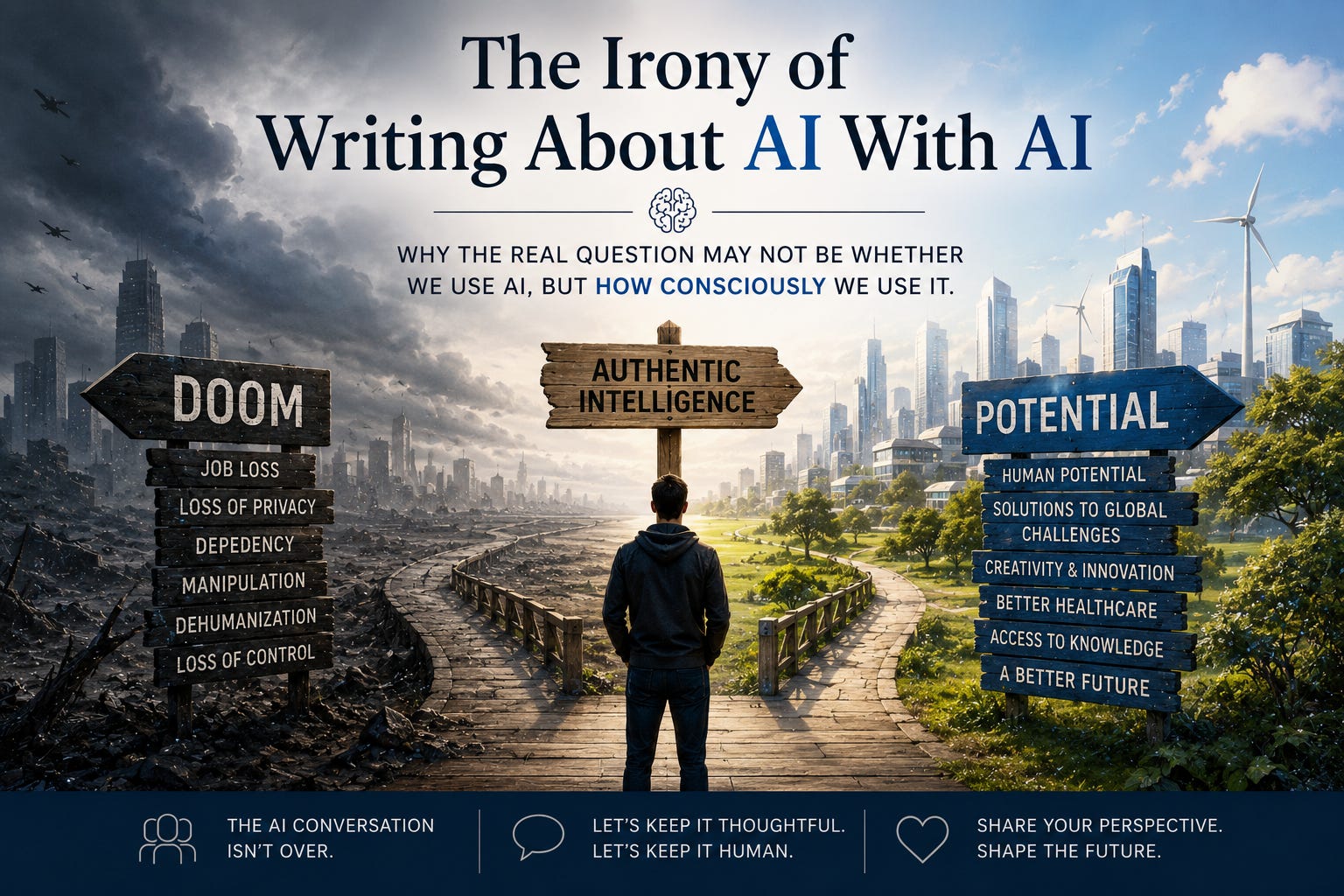
Because the truth is, the current AI conversation often feels emotionally polarized. One camp speaks as though artificial intelligence will save humanity. The other speaks as though it will destroy it.
And somewhere in between are millions of ordinary people simply trying to figure out:
how to adapt
how to work
how to learn
how to parent
how to stay emotionally grounded
how to preserve relationships
and how to remain deeply human in a world changing faster than most nervous systems can comfortably process
That middle ground is where I think the real conversation lives.
The Two Camps
At the risk of oversimplifying, much of the public AI discussion currently falls into two broad emotional camps.
Camp One: The Utopians
This group tends to emphasize:
innovation
productivity
creativity
economic growth
scientific breakthroughs
medical advances
education access
automation
optimization
To this camp, AI represents one of the greatest tools humanity has ever created. And to be fair, there is truth in that perspective.
Artificial intelligence already has extraordinary potential to:
expand knowledge access
reduce certain forms of labor
support education
assist overwhelmed clinicians
organize information
increase accessibility
and augment creativity in remarkable ways
Many people using AI tools today are not becoming less capable. They are becoming more productive, more informed, and in some cases more empowered. Ignoring those realities would be intellectually dishonest.
Camp Two: The Doom Perspective
The second camp tends to focus on:
dependency
manipulation
workforce disruption
emotional isolation
misinformation
algorithmic control
dehumanization
synthetic relationships
surveillance
and the erosion of authentic human capacities
This camp worries that increasingly intelligent systems may gradually weaken:
attention
memory
emotional resilience
social competence
relational depth
critical thinking
and perhaps even human agency itself
And to be fair, there is truth in this perspective, too. Because every major technology changes human behavior. Often in ways we do not fully understand until years later.
Social media itself offers a sobering example. At first it appeared overwhelmingly positive:
connection
accessibility
democratized communication
community
global reach
Only later did many people begin recognizing some of the unintended consequences:
comparison anxiety
attention fragmentation
outrage algorithms
loneliness
identity performance
emotional dependency
and nervous-system overstimulation
It is entirely reasonable to ask whether emotionally responsive AI systems may eventually create similarly complicated outcomes.
The Problem With Certainty
Personally, I think both camps often become too certain. And certainty can become psychologically dangerous during periods of rapid societal change.
Why?
Because certainty tends to reduce curiosity. It narrows exploration. It encourages ideological rigidity. And increasingly, it can prevent thoughtful conversation altogether.
Human beings are often uncomfortable with ambiguity. We want simple answers:
“AI is amazing.”
“AI is terrifying.”
“AI will save us.”
“AI will destroy us.”
But reality is usually more complicated than that. Most powerful technologies throughout history have carried both:
tremendous promise
andtremendous risk
The internet itself transformed:
education
communication
business
medicine
creativity
and access to knowledge
At the same time, it also amplified:
distraction
misinformation
polarization
addiction
and emotional overload
Artificial intelligence may follow a similar pattern: not purely utopian, not purely catastrophic, but profoundly transformative in ways that include both gain and loss.
And perhaps one of the greatest dangers is not artificial intelligence itself. Perhaps the greater danger is unconsciousness.
We Have Been Adapting To Intelligent Systems For Decades
One of the ideas I keep returning to is this:
Artificial intelligence did not suddenly appear. We have been gradually adapting to increasingly intelligent technological environments for decades.
Calculators changed mental arithmetic. GPS changed navigation. Search engines changed memory. Social media changed attention. Recommendation algorithms changed discovery. Smartphones changed accessibility, nervous-system stimulation, and fundamentally how we connect.
Now, generative AI is changing interaction itself. What is happening now is not the beginning. It is the acceleration. And human nervous systems are trying to adapt in real time. That adaptation process matters psychologically.
Humans adapt not only behaviorally but also emotionally. We internalize environments. We normalize technologies. We reorganize expectations around them.
Children growing up today are entering a world where:
Intelligent systems respond conversationally
algorithms predict preferences
AI generates language instantly
and emotional interaction with machines increasingly feels normal
That reality is neither entirely good nor entirely bad. But it is historically significant.
The Irony Is The Point
So yes. There is irony in using AI collaboratively while writing about the psychological and relational implications of AI.
But perhaps the irony is the point.
I am not attempting to examine this transition from outside it. None of us is outside it anymore. The goal is not technological purity. The goal is conscious participation.
To me, that distinction matters enormously. Because there is a major difference between:
consciously using a tool, and
unconsciously surrendering to it
A calculator can support learning. Or replace it. Social media can facilitate connection. Or replace it. AI can augment reflection. Or slowly replace independent thought.
The issue is not merely whether a technology exists.
The issue is:
What kind of relationship are we developing with it?
That is a psychological question as much as a technological one.
Authentic Intelligence
Recently, I introduced a phrase that I suspect will become increasingly important within Internet-of-the-Mind:
Authentic Intelligence
Artificial Intelligence may continue advancing rapidly in areas like:
prediction
simulation
pattern recognition
language generation
personalization
and optimization
But Authentic Intelligence includes human capacities that emerge through lived experience itself.
Authentic Intelligence involves:
empathy
discernment
ethical reflection
relational mutuality
emotional integration
embodied awareness
accountability
wisdom
sacrifice
and the ability to remain connected through imperfection
Artificial Intelligence may simulate aspects of emotional connection. Authentic Intelligence develops through living one.
That distinction matters. Because if intelligent systems continue becoming increasingly persuasive, emotionally responsive, and frictionless, then preserving and strengthening Authentic Intelligence may become one of the most important developmental tasks of the modern era.
The Real Risk May Be Unconscious Dependency
Personally, I do not think the greatest danger is that AI suddenly becomes “evil.” I think the greater danger may be far quieter. Gradual dependency. Gradual outsourcing. Gradual erosion of human capacities through disuse.
Not because humans are weak. But because humans adapt to environments.
Always.
The more frictionless a technology becomes, the easier it becomes to unconsciously surrender capacities to it.
And modern AI systems are becoming extraordinarily good at:
reducing friction
reducing effort
reducing uncertainty
reducing loneliness temporarily
reducing the discomfort of not knowing
But some forms of human development emerge precisely through:
uncertainty
effort
struggle
relational friction
compromise
ambiguity
reflection
and repair
Those things are not design flaws in human life. They are developmental experiences. And if we gradually remove too many of them, we may eventually weaken some of the very capacities that make deep human maturity possible.
So Where Do We Go From Here?
I do not believe the healthiest path forward is to reject technology. Nor do I believe it is blind surrender. Perhaps the future belongs neither to people who reject artificial intelligence nor to those who merge with it unconsciously.
Perhaps the future belongs to people who learn to collaborate with intelligent systems consciously while strengthening Authentic Intelligence.
That means:
using technology intentionally
preserving human relationships
protecting attention
maintaining reflective capacity
strengthening emotional resilience
practicing real-world connection
and remaining aware that convenience always shapes development
The issue is not simply whether AI changes society. It already is. The issue is whether human beings remain conscious participants in the process.
The Conversation Matters
One of my hopes for Internet-of-the-Mind is that it becomes a place for thoughtful exploration during this strange and rapidly accelerating period of human history.
Not a place for ideological conformity.
Not a place for certainty theater.
Not a place for panic or technological worship.
But a place where thoughtful people can wrestle honestly with difficult questions involving:
artificial intelligence
Authentic Intelligence
psychology
relationships
nervous systems
ethics
identity
loneliness
adaptation
education
work
creativity
and what it means to remain deeply human in an increasingly intelligent technological environment
Strong disagreement is welcome. Thoughtlessness is not. Because these conversations are too important for simplistic tribalism. And perhaps one of the healthiest things we can do right now is continue thinking together consciously before increasingly intelligent systems begin doing too much of our thinking for us.
Invitation To The Conversation
In addition to thoughtful comments and discussion, Internet-of-the-Mind is now open to occasional guest contributions from readers who would like to participate in this evolving conversation.
If you have a thoughtful perspective, personal experience, concern, question, counterpoint, or reflection related to:
artificial intelligence
Authentic Intelligence
mental health
relationships
ethics
education
human development
technology
or the future of human adaptation
…you are welcome to submit a guest article for consideration. The goal is not ideological agreement. The goal is thoughtful human dialogue during one of the most significant technological transitions in modern history.
Submissions can be sent to: support@serenitycreationsonline.com