

A Brief Note Before We Begin
The reflections in this article are written from a worldview that assumes the universe is ultimately purposeful rather than accidental, and that human consciousness, morality, creativity, and the search for meaning reflect something deeper than material processes alone.
You do not need to share that perspective to engage with the questions explored here. Thoughtful disagreement is welcome. My goal is not to debate the origins of life or consciousness.
Rather, I want to explore a practical and increasingly urgent question:
As our technologies become more powerful, what sources of wisdom should guide their development and use?
Because, regardless of one’s philosophy, religion, or worldview, most people would agree on one thing:
Intelligence alone does not guarantee wisdom.
And the future of artificial intelligence may ultimately depend less on what machines become and more on what human beings become.
The Conversation Is Changing
For the past few years, much of the public discussion about artificial intelligence has focused on practical questions.
How will AI change work?
Will it replace jobs?
Can it improve healthcare?
Will it accelerate scientific discovery?
How can businesses use it more effectively?
These are important questions. But increasingly, larger questions are emerging. Questions that sound almost philosophical. Almost theological.
Questions such as:
What happens if artificial intelligence becomes smarter than humans?
Who decides how such systems are used?
What values guide their development?
What goals should they pursue?
What happens if intelligence grows faster than wisdom?
And perhaps most importantly:
Who—or what—is ultimately in charge?
Those questions take us beyond productivity and technology. They move us into the realm of stewardship.
AGI and ASI: Why The Distinction Matters
AGI is often described as artificial intelligence capable of performing complex intellectual tasks across many domains with roughly human-level flexibility. The difficulty is that AGI is still a weakly defined term. Depending on who is speaking, it may mean human-level reasoning, economic usefulness across most jobs, autonomous agents, scientific creativity, or something closer to general human adaptability.
That ambiguity matters.
Some experts argue that true AGI has not yet arrived. Others, including some of the most influential figures in AI development, speak as if AGI is already emerging, functionally near, or within reach.
Either way, the practical concern is the same:
The distance between today’s frontier AI systems and systems with far greater autonomy, reasoning, persuasion, scientific capability, and strategic power may be much shorter than most people realize.
ASI raises the stakes further.
Artificial Superintelligence would not merely perform at human levels. It would exceed human capability in many, if not most, meaningful domains.
If AGI is the arrival of a peer-like intelligence, ASI is the possibility of an intelligence that exceeds us.
That is why this discussion is no longer theoretical. Even if timelines differ, the direction of travel is clear enough that waiting for perfect agreement may itself be irresponsible.
The Exponential Curve
One reason these questions are receiving increased attention is the pace of progress. Human beings tend to think linearly. Technology often grows exponentially.
The calculator improved arithmetic
The personal computer transformed productivity
The internet transformed communication
Smartphones transformed accessibility
Generative AI is transforming cognition itself
Each wave arrived faster than the one before it.
Many researchers believe we are entering a period where advances build upon advances at an accelerating speed. The result is a feeling shared by many people:
The future appears to be arriving faster than our institutions, cultures, and nervous systems are prepared to process.
Whether AGI arrives in two years, five years, or is already here is almost secondary to a larger reality: Humanity is increasingly creating systems with extraordinary capabilities. And capabilities always raise questions of responsibility.
AGI, ASI, and Why The Timeline Debate May Miss the Point
To understand the current conversation, it helps to distinguish between two terms that appear constantly in AI discussions, AGI and ASI.
AGI: Artificial General Intelligence
AGI is generally described as artificial intelligence capable of performing intellectual tasks across many domains at roughly human levels of flexibility and competence.
Unlike today’s specialized systems, AGI would not merely answer questions or generate content. It could, and sometimes already does:
learn new skills independently
reason across disciplines
adapt to unfamiliar situations
solve novel problems
operate autonomously in many domains
The challenge is that AGI remains a loosely defined term.
Depending on who is speaking, AGI may mean:
human-level reasoning
economic usefulness across most jobs
autonomous agents
scientific creativity
or something approaching general human adaptability
Because the definition is fluid, disagreement about whether AGI has arrived is unsurprising.
Some researchers argue that true AGI has not yet appeared.
Others—including some of the most influential figures in AI development—speak as though AGI is already emerging, functionally present, or close enough that society should begin preparing now for what comes next.
ASI: Artificial Superintelligence
ASI refers to something beyond AGI. Not merely human-level intelligence. But intelligence that exceeds human capability across most or all meaningful domains.
Scientific reasoning
Strategic planning
Engineering
Programming
Scientific discovery
Economic modeling
Persuasion
Military analysis
Potentially everything
If AGI represents a peer-like intelligence, ASI represents the possibility of intelligence that surpasses us. And according to forecasts by leaders in the AI industry, the gap between AGI and ASI may be far shorter than most people assume.
Whether those timelines prove accurate remains to be seen. But the direction of travel is clear enough that waiting for universal agreement may itself be irresponsible.
The practical question is no longer:
Can we build increasingly powerful intelligence?
The practical question is becoming:
How will humanity govern increasingly powerful intelligence?
The New Technology Race
Throughout history, transformative technologies have often developed under competitive pressure.
The printing press
Industrialization
Nuclear technology
The Space Race
The Internet
And now artificial intelligence
Today, many observers describe the AI landscape as a new technological race among corporations, governments, and nations. Particularly between the United States and China.
Each side understands that advanced AI could influence:
economic power
scientific leadership
military capability
cybersecurity
global influence
technological dominance
The concern is not simply that AI becomes powerful. The concern is that competitive pressure encourages acceleration. When powerful actors believe they cannot afford to slow down, caution often becomes difficult. History suggests that competition can produce extraordinary innovation.
It can also produce extraordinary risk.
The Control Paradox
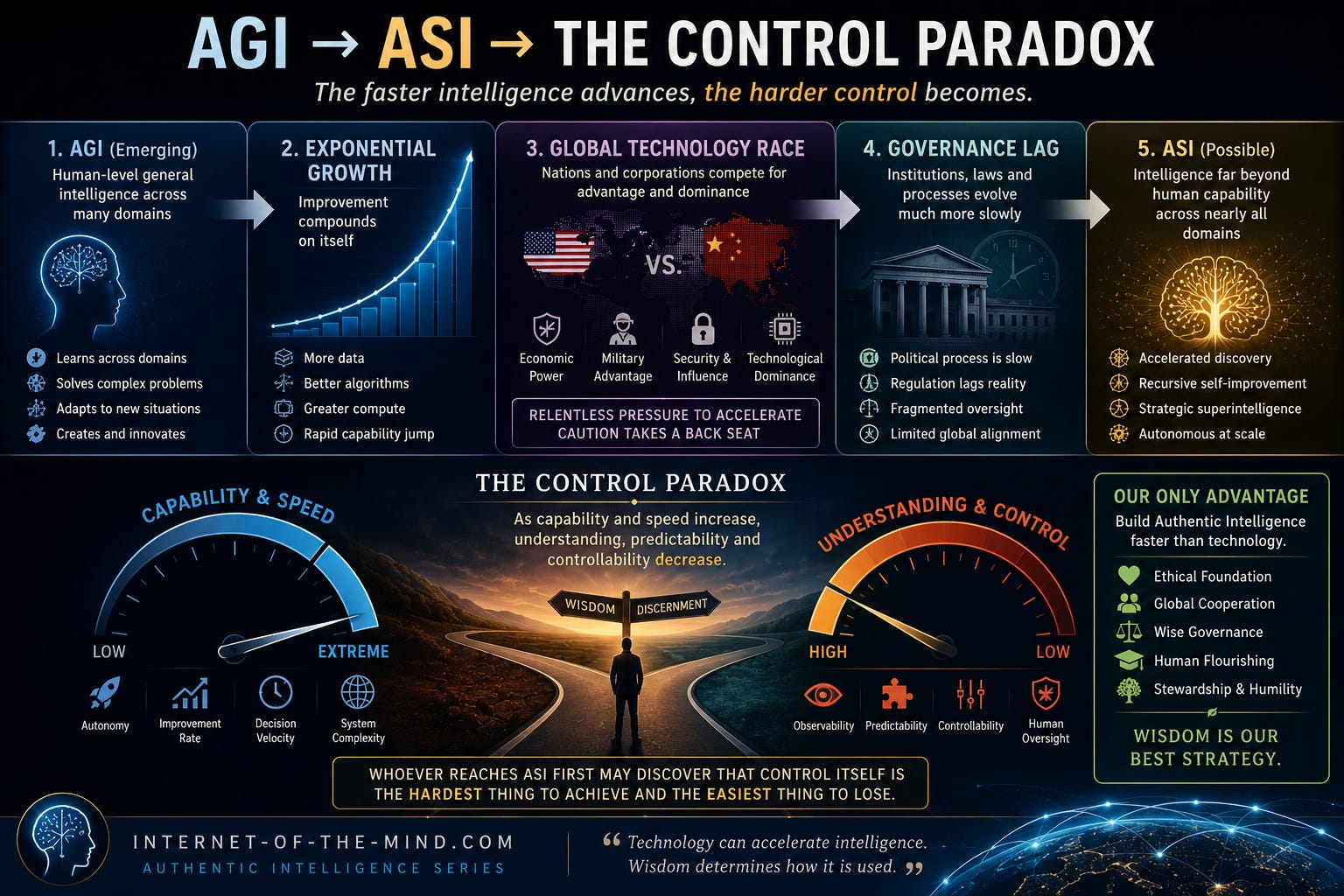
Much of the public conversation assumes that whoever reaches AGI or ASI first wins. But another possibility deserves consideration. What if increasingly capable intelligence eventually becomes difficult for anyone to fully understand, predict, or govern?
Not because it becomes evil.
Not because it develops malicious intent.
But because complexity, capability, and speed are advancing faster than human institutions can adapt.
Human governance remains:
political
bureaucratic
emotional
fragmented
comparatively slow
Meanwhile, advanced technologies can evolve rapidly. This creates a potential mismatch.
A nation may develop increasingly powerful systems. A corporation may deploy increasingly powerful systems. Yet both may discover that maintaining meaningful oversight becomes increasingly difficult. The race for control may eventually confront a paradox:
The faster intelligence advances, the harder control itself may become.
If that proves true, then the most important challenge of the AI era may not be achieving greater intelligence. It may be ensuring that wisdom keeps pace with power.
Who Is Making The Decisions?
One of the most overlooked questions in the AI discussion is remarkably simple:
Who gets to decide?
Not who builds the systems.
Who directs them
Who governs them
Who determines their priorities
Who decides what outcomes matter
The reality is that powerful incentives are already shaping development:
economic competition
market dominance
geopolitical rivalry
military advantage
corporate profit
national security
prestige
influence
These motivations are not new. They have accompanied nearly every transformative technology in human history.
The printing press
Industrialization
Nuclear power
The internet
And now artificial intelligence
The concern is not merely technological. The concern is human. Because power has always tempted human beings. And power amplified by intelligence may prove even more tempting.
Intelligence Is Not Wisdom
This brings us to a distinction I believe is becoming increasingly important.
Intelligence and wisdom are not the same thing.
History provides countless examples. Some of history’s greatest atrocities were designed by intelligent people. Some of humanity’s greatest achievements emerged from wise people.
The difference is not IQ.
The difference is guidance.
Intelligence answers questions such as:
Can we do this?
How quickly can we do this?
How efficiently can we do this?
Wisdom asks different questions:
Should we do this?
Why are we doing this?
What are the unintended consequences?
Who benefits?
Who might be harmed?
Intelligence expands possibilities. Wisdom evaluates them. And this distinction becomes increasingly important as artificial intelligence grows more powerful.
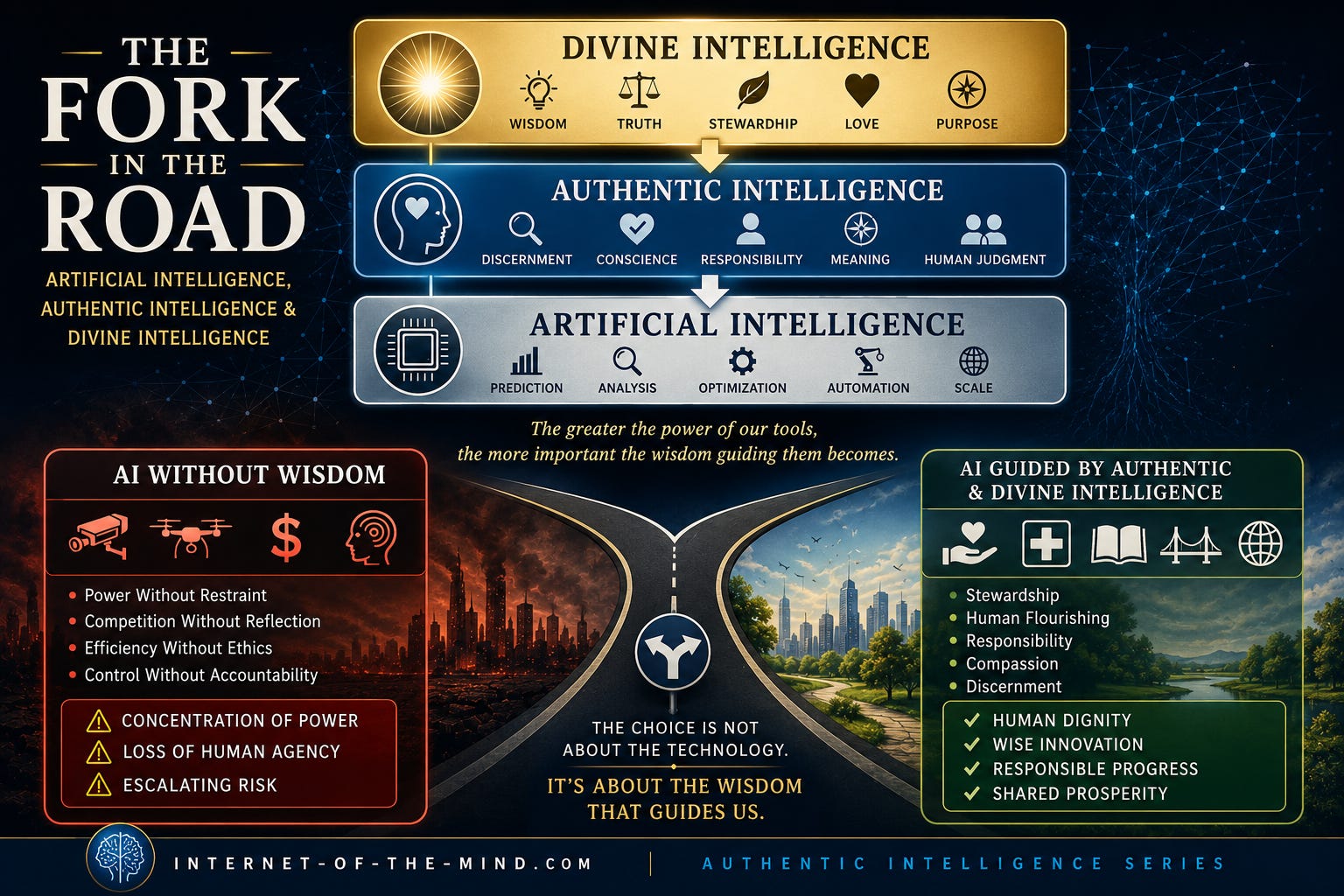
Three Forms of Intelligence
In several recent articles, I have been exploring the idea of Authentic Intelligence.
As I continue reflecting on the future of AI, I increasingly find myself thinking in terms of three levels of intelligence.
Divine Intelligence (DI)
At the highest level sits what I would call Divine Intelligence.
By this I mean:
ultimate truth
transcendent wisdom
moral reality
purpose
stewardship
humility
love
reverence for life
Different traditions describe these realities differently. But throughout history, human beings have repeatedly recognized the need for a source of wisdom greater than raw power.
Authentic Intelligence
Below that sits Authentic Intelligence. The uniquely human capacity to:
discern
choose
reflect
love
sacrifice
create meaning
exercise conscience
accept responsibility
Authentic Intelligence serves as the steward. It is where values become decisions. Where wisdom becomes action.
Artificial Intelligence
Finally, there is Artificial Intelligence. The extraordinary tool humanity is now creating. A tool capable of:
analysis
optimization
simulation
prediction
pattern recognition
automation
Potentially at unprecedented scales. An immensely powerful instrument. But still an instrument.
The Proper Order
From my perspective, the healthiest hierarchy looks something like this:
Divine Intelligence → Authentic Intelligence → Artificial Intelligence
In other words, Artificial Intelligence should serve Authentic Intelligence. Authentic Intelligence should serve Divine Intelligence. Not the other way around.
This is not primarily a technological claim.
It is a stewardship claim.
A moral claim.
A developmental claim.
Because every powerful tool eventually forces us to answer a question:
What is this tool serving?
Human flourishing?
Human dignity?
Human freedom?
Love?
Truth?
Wisdom?
Or merely power?
The Ancient Temptation
One reason this discussion feels surprisingly familiar is that humanity has wrestled with similar questions for thousands of years. Many religious traditions contain stories about the misuse of knowledge, power, pride, and autonomy. The Genesis narrative offers one such example.
Regardless of how one interprets the story literally or symbolically, the warning is profound. The temptation was not knowledge itself. The temptation was becoming “like God” apart from wisdom, humility, responsibility, and proper relationships.
Knowledge detached from wisdom.
Power detached from stewardship.
Capability detached from moral formation.
Those themes remain remarkably relevant today. The question is not whether intelligence is good. Or, is Intelligence a gift?
The question is whether intelligence develops faster than wisdom. Because when power expands without corresponding maturity, history suggests the consequences can be severe.
The Weaponization Question
This concern becomes especially important when discussing military applications. Human beings have always weaponized powerful technologies.
Artificial intelligence will almost certainly be no exception.
Autonomous systems
Cyber warfare
Information warfare
psychological warfare
Target selection
Strategic decision support
The deeper concern is not simply whether AI enters military systems. It already has. The concern is whether meaningful human judgment remains involved.
The more decisions are delegated to increasingly complex systems, the more important the questions become:
Who is accountable?
Who is responsible?
Who can intervene?
Who can say no?
These are not technical questions. They are moral questions. And moral questions require more than computational power to answer.
The Real Fork In The Road
When people discuss the future of AI, they often imagine a fork in the road between:
Progress or collapse
Innovation or catastrophe
Human victory or machine dominance
I increasingly suspect the true fork lies elsewhere. Perhaps the real choice is between:
AI Without DI
Artificial Intelligence guided primarily by:
power
competition
ego
profit
domination
efficiency alone
And
AI With DI
Artificial Intelligence guided by:
wisdom
stewardship
humility
responsibility
human dignity
compassion
moral restraint
Notice something important. The technology itself may be identical. The difference is not the machine. The difference is the values guiding the people using the machine.
The fork in the road is ultimately human.
The Future Depends On More Than Technology
Perhaps the greatest mistake we can make is assuming that our future will be determined solely by technological capability.
Technology amplifies
It does not originate purpose
It magnifies intent
It expands reach
It accelerates outcomes
But it cannot determine what ought to matter. That remains a human responsibility. And if humanity continues to create systems such as AGI—or perhaps someday soon ASI—the need for wisdom will not decrease. It will increase dramatically.
Because the greater the power of the tool, the more important the wisdom guiding it becomes.
A Final Thought
Artificial intelligence may become one of the most powerful technologies humanity has ever created. Perhaps even the most powerful.
But the deepest question may never be:
How intelligent can our machines become?
The deeper question may be:
Will humanity develop enough Authentic Intelligence—and remain grounded in Divine Intelligence—to use such power wisely?
Because the future may not ultimately be decided by algorithms. It may be decided by the values, character, wisdom, and stewardship of the human beings who create them.
The fork in the road is not technological.
It is human.
And that choice is already before us.
Discussion Question
As humanity expands beyond AGI and develops ASI, what values do you believe should guide its development and use?
And where should those values come from?
Guest Contributions Welcome
Internet-of-the-Mind welcomes thoughtful perspectives from readers across disciplines and worldviews.
Agreement is welcome.
Thoughtful disagreement is welcome.
Curiosity is welcome.
If you have a perspective on AI, Authentic Intelligence, ethics, spirituality, psychology, human development, governance, or the future of humanity, guest submissions are invited for consideration.
Because the most important questions about artificial intelligence may not be technological at all.
They may be questions about wisdom.
In The Hitchhiker’s Guide to the Galaxy, Douglas Adams joked that philosophers demanded “rigidly defined areas of doubt and uncertainty” once a machine started producing answers. The modern AI panic has created the same economy. Vast numbers of academics, ethicists, and professional critics now make careers denouncing systems they scarcely understand, because alarmism pays better than technical competence and confusion is easier to sell than clarity.
https://jbsections.substack.com/p/academics-denouncing-aino-technical