

By the time Daniel reaches his car, he is furious.
Not furious enough to yell. Daniel almost never yells.
He is the kind of man who goes quiet.
His wife is walking several steps behind him through the grocery store parking lot, and he can feel himself shutting the doors inside.
She had embarrassed him.
At least that is what it felt like.
Five minutes earlier, at the checkout, she had reminded him that he had forgotten something she asked him to pick up. She was not cruel about it. She had not raised her voice. She had simply sighed and said:
“Daniel, I asked you twice.”
That was all. But something inside him had detonated. Now his jaw is tight. His hands are gripping the steering wheel. And before she has even closed the passenger door, Daniel has already built the case against her.
Nothing is ever good enough for her.
She always finds something wrong.
People are exhausting.
Marriage is exhausting.
Life is exhausting.
And beneath all of that is another verdict, one he would never say aloud:
“There must be something wrong with me.”
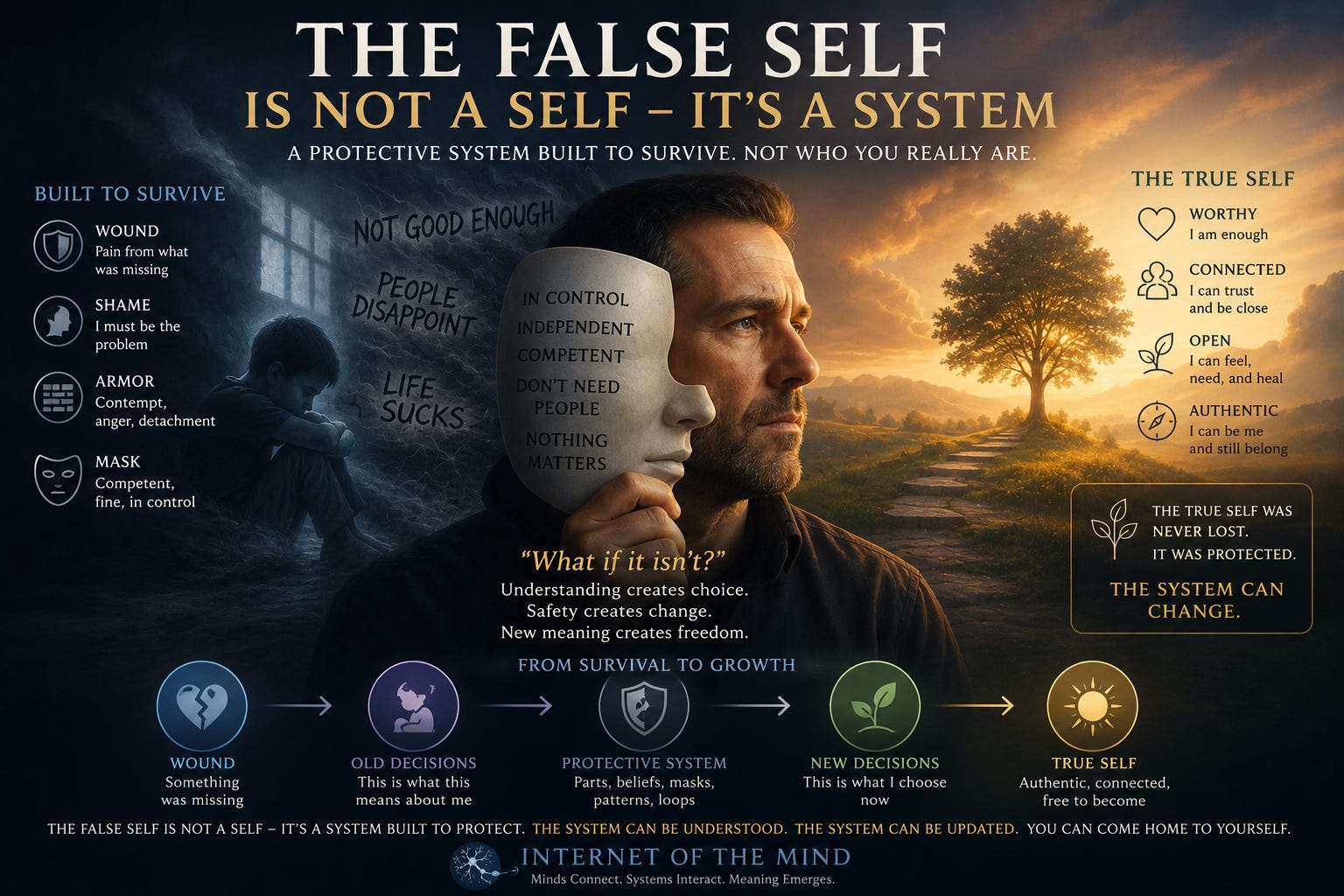
Daniel does not experience any of these thoughts as a childhood wound. He experiences them as Daniel. He has been this way for as long as he can remember: independent, guarded, easily irritated, uncomfortable with need, suspicious of criticism.
He calls it personality. Other people have called him difficult. Neither description is quite right. Because Daniel was not born sitting in a grocery store parking lot resenting the people he loves.
Long before he learned contempt, he learned something else. He learned abandonment. Not necessarily the abandonment of a child left on a doorstep. His was quieter than that.
He learned that certain feelings were too much.
That needing comfort made people impatient.
That tears brought embarrassment instead of tenderness.
That mistakes disappointed the people whose approval he depended on.
So Daniel did what children do when they cannot change the people around them. He changed himself.
First came the pain:
“No one is coming for what I need.”
Then shame attached itself to the pain:
“If no one is coming, there must be something wrong with me for needing anything in the first place.”
And eventually shame needed armor. So contempt arrived.
“I don’t need anybody.”
“People are idiots.”
“Nothing matters.”
“Life sucks.”
Contempt felt stronger than shame. Anger felt safer than longing. Detachment felt safer than disappointment.
And because Daniel still had to live in the world, another layer developed over all of it.
He became competent.
Funny when he needed to be.
Successful.
Helpful.
Low-maintenance.
The guy who had everything under control.
That was the Mask.
People liked the Mask. Daniel depended on it. But the Mask was not Daniel any more than the contempt was Daniel. They were parts of a system. A remarkably intelligent survival system built around an old wound.
And one afternoon, sitting across from me, Daniel says something he has said many times before:
“This is just who I am.”
But this time he stops. His face changes. For several seconds he says nothing. Then, much more quietly, he says:
“What if it isn’t?”
That question changes everything. Because healing does not require Daniel to destroy some dark, defective self hiding inside him.
There is no evil twin to kill.
There is a wound to understand.
There is shame to disinfect.
There is contempt whose protective job can finally be recognized.
There is a Mask that can gradually become unnecessary.
And behind all of it is something Daniel did not manufacture in therapy and does not have to invent now. Himself.
The False Self was never really a self. It was a system built to protect one.
The Problem With the Phrase “False Self”
The phrase False Self can be useful. But it can also be misleading. It may sound like there is a fake person inside us.
A counterfeit self.
A liar.
A mask.
A defective version of us that needs to be exposed, rejected, defeated, or destroyed.
That misunderstanding can create even more shame. A person may begin to wonder:
Have I been fake my whole life?
Is my personality false?
Are my accomplishments meaningless?
Are my relationships built on a lie?
Do I even know who I am?
But that is not the way I understand it.
The False Self is not a second self.
It is not an evil twin.
It is not proof that a person is fake.
It is a protective system.
It is the way a person’s inner world organizes when the True Self does not feel safe, seen, protected, welcomed, or loved.
That distinction matters. Because if we misunderstand the False Self, healing can become another form of self-rejection. And many people have already had more than enough of that.
What Was Missing?
In the previous article, we explored a question that often matters as much as “What happened to you?”
That question was: What was missing that should have been there?
Protection.
Comfort.
Guidance.
Attunement.
Delight.
Validation.
Safe correction.
Healthy boundaries.
A sense of being wanted.
A sense of being enjoyed.
A sense of being held emotionally, not just managed physically.
A child does not only react to what was present.
A child also reacts to what was absent.
And when something essential is missing long enough, the child’s system begins to adapt.
If comfort is missing, the child may decide: “My feelings are too much.”
If protection is missing, the child may decide: “I have to stay alert.”
If delight is missing, the child may decide: “I am not worth enjoying.”
If guidance is missing, the child may decide: “I have to figure everything out alone.”
If tenderness is missing, the child may decide: “Need is dangerous.”
If safe correction is missing, the child may decide: “Mistakes mean shame.”
If love feels conditional, the child may decide: “I must perform, please, perfect, help, hide, or disappear.”
These are not usually adult, conscious, rational conclusions. They are meaning-making decisions made by a developing mind inside a relational environment it cannot control.
The child cannot change the parent.
The child cannot rewrite the family system.
The child cannot create safety where there is none.
So the child adapts.
And over time, those adaptations can begin to feel like identity.
The False Self Forms Around Old Decisions
A child usually does not say:
“I am now forming a life script.”
“I am developing a schema.”
“I am creating a protective part.”
“I am organizing a false-self system.”
The child simply concludes:
This is what this means about me.
This is what this means about people.
This is what this means about love.
This is what this means about safety.
This is what I must do from now on.
Those decisions matter.
Because the brain predicts.
The nervous system protects.
And the mind makes meaning.
The meaning becomes a decision.
The decision becomes a belief.
The belief becomes a filter.
The filter shapes perception.
Perception shapes reaction.
Reaction shapes behavior.
Behavior shapes relationships.
Relationships reinforce the original story.
And eventually the person may begin living inside a world built from decisions they do not remember making.
Daniel was not born contemptuous.
He was not born guarded.
He was not born resentful.
He was not born allergic to need.
He learned that need led to disappointment.
He learned that mistakes led to shame.
He learned that tenderness was not dependable.
He learned that needing people was dangerous.
So his system made a decision:
I will not need.
Then another: “If I do need, something is wrong with me.”
Then another: “If something is wrong with me, I must cover it.”
Then another: “If I can stay competent, funny, useful, and low-maintenance, maybe no one will see how much I hurt.”
That is not a fake self. That is an organized survival system.
Wound, Shame, Armor, Mask
Daniel’s pattern can be understood in layers.
First, there was a wound. “No one is coming for what I need.”
Then shame formed around the wound. “If no one is coming, maybe needing is the problem. Maybe I am the problem.”
Then armor developed to protect the shame. “I do not need anybody. People are ridiculous. Nothing matters. Life is exhausting.”
Then the Mask formed so he could function in the world. “I am competent. I am fine. I am helpful. I am in control. I do not need much. Do not look too closely.”
That sequence matters. Because if we only focus on the outer behavior, we may misread the person.
We may see Daniel’s irritation and call him angry.
We may see his distance and call him cold.
We may see his sarcasm and call him arrogant.
We may see his independence and call him avoidant.
We may see his competence and assume he is fine.
But underneath the visible pattern is an inner system that formed around a wound. That does not excuse hurtful behavior. But it helps explain it.
And what we can understand, we can begin to work with.
The Mask Is Not the Person
Many people become identified with the Mask because the Mask worked.
It got them through.
It helped them belong.
It prevented rejection.
It earned approval.
It kept conflict down.
It protected vulnerability.
It allowed life to continue.
Some Masks are impressive.
The Responsible One.
The Funny One.
The Strong One.
The Spiritual One.
The Successful One.
The Helpful One.
The Easygoing One.
The One Who Needs Nothing.
The One Who Has It All Together.
Other Masks are harder to like.
The Cynic.
The Controller.
The Rebel.
The Critic.
The Avoider.
The One Who Does Not Care.
The One Who Pushes People Away Before They Can Leave.
But whether the Mask is admired or criticized, it is still not the whole person. It is a role. A strategy. A layer. A protective presentation. Sometimes the world rewards the Mask so strongly that the person becomes afraid to take it off.
A child who becomes responsible too early may be praised as mature.
A child who suppresses emotion may be praised as strong.
A child who performs may be praised as successful.
A child who pleases may be praised as sweet.
A child who rescues may be praised as caring.
A child who disappears may be praised as no trouble.
But praise does not always mean the pattern is healthy. Sometimes the world rewards the very strategies that disconnect us from ourselves.
By adulthood, a person may say:
“This is just who I am.”
But sometimes “who I am” really means:
“This is who I had to become.”
That difference can change everything.
The False Self Is Not the Enemy
This is where healing can go wrong. Some approaches talk as if the False Self needs to be destroyed.
Kill the ego.
Crush the old identity.
Defeat the inner critic.
Eliminate the fear.
Break the false self.
But most protective systems do not soften through attack. They tighten.
If a part of you learned to protect you by pleasing, shaming it will not help.
If a part of you learned to protect you by controlling, attacking it will only make it more controlling.
If a part of you learned to protect you by shutting down, demanding that it open immediately may feel like danger.
If a part of you learned to protect you through contempt, treating it with contempt may only prove its point.
The False Self is not healed by becoming another persecutor toward yourself. It is healed by bringing enough truth, compassion, regulation, and wisdom to understand why the system formed. We can say to the protective system:
I see what you have been trying to do.
I understand why you became necessary.
Thank you for helping me survive.
And now we are going to learn a new way.
That is not self-rejection. That is transformation.
The True Self Does Not Disappear
One of the most hopeful truths is this:
The True Self does not disappear.
It may become hidden.
Covered.
Buried.
Protected.
Exiled.
Numbed.
Silenced.
Outvoted by fear.
But it is not destroyed.
I often think of the True Self like the sun shining behind clouds.
The clouds may be thick.
The storm may be real.
The sky may feel dark for a long time.
But the sun is not gone.
In the same way, the True Self may still be present beneath the protective system.
Beneath pleasing.
Beneath performance.
Beneath perfectionism.
Beneath control.
Beneath withdrawal.
Beneath sarcasm.
Beneath numbness.
Beneath anger.
Beneath shame.
Beneath the life script.
Beneath the old decision.
The work of healing is not to manufacture a brand-new self from scratch. It is to uncover, discover, and recover what has been hidden.
The False Self system says:
“I must become whatever keeps me safe.”
The True Self says:
“I am already someone worth protecting, knowing, loving, and becoming.”
That is a very different foundation.
From Survival System to Growth System
The False Self system is organized around survival. That does not make it bad. Survival matters. Protection matters. There are seasons when the nervous system must organize around safety. But when survival becomes the default operating system, life gets smaller. Survival asks:
How do I avoid rejection?
How do I prevent shame?
How do I stay in control?
How do I keep people from leaving?
How do I prove I am enough?
How do I avoid needing too much?
How do I stay safe?
Growth asks different questions:
What is true?
What is wise?
What do I actually feel?
What do I actually need?
What is mine to carry?
What can I release?
What can I learn?
What can I create?
Who am I becoming?
The goal is not to shame survival. The goal is to recognize when survival is still running a life that is now asking for growth.
Daniel’s contempt protected him from shame.
His Mask protected him from exposure.
His independence protected him from disappointment.
But those protections also kept him from intimacy.
They kept him from repair.
They kept him from receiving love.
They kept him from knowing that the forgotten item at the grocery store was not really the problem.
The old wound was the problem. The shame around the wound was the problem. The protective system was doing its job. But the job needed to be updated.
How This Fits With LSPM
In LSPM — the Life Scripts and Parts Matrix — we do not look at the False Self as one simple thing.
We look at the system.
Life scripts.
Parts.
Core beliefs.
Mental filters.
Nervous-system states.
Attachment wounds.
Developmental absences.
Relational loops.
Spiritual assumptions.
Old decisions.
Growth resources.
The question is not simply:
“What is wrong with me?”
The better questions are:
What was missing?”
What happened?
What did I decide it meant?
What part of me stepped forward to protect me?
What belief began organizing my inner world?
What nervous-system state became familiar?
What relational patterns reinforced the old story?
What resources are available now?
What new decision is possible?
That is why the False Self is not really a self. It is a protective system organized around old meanings. And when the system begins to feel safe enough, supported enough, and resourced enough, it can begin to update.
The LSPM Guided Intensive
This is part of the larger purpose behind the upcoming LSPM Guided Intensive. The Guided Intensive is being designed to help people understand the inner patterns that have shaped their lives.
Not with shame.
Not with blame.
Not by forcing change from the outside.
But by helping people recognize their life scripts, protective parts, core beliefs, nervous-system responses, old decisions, and available resources.
The goal is not to destroy the False Self system. The goal is to understand the protective system, strengthen the True Self, and begin creating a healthier inner pathway.
That means learning how to notice old loops.
How to identify the parts involved.
How to understand what was missing.
How to recognize the decisions that formed around those absences.
How to build inner resources.
How to practice new meaning.
How to move from survival patterns toward growth.
More will be coming soon on the LSPM Guided Intensive and how this framework can help people prepare for deeper healing and transformation.
For now, the main point is this:
You are not fake because you adapted.
You are not broken because you protected yourself.
You are not hopeless because old patterns still repeat.
The False Self is not a self. It is the survival-shaped system that formed around what hurt, what was missing, and what you decided it meant.
And the True Self is still there.
Waiting to be uncovered.
Discovered.
Recovered.
A Final Thought
A starving dog does not need to be punished for guarding food. A numb child does not need to be shamed for not feeling. A protective adult does not need to be condemned for surviving.
What we need is understanding.
Safety.
Truth.
Compassion.
Practice.
New meaning.
And enough courage to ask:
Who did I become to survive?
What did I decide when something essential was missing?
What part of me has been trying to protect the wound?
What Mask have I mistaken for myself?
And who might I become now that a new decision is possible?
That is where the journey continues.
Join the Conversation
Internet-of-the-Mind was created to explore the intersection of psychology, human development, technology, artificial intelligence, relationships, meaning, and the future of being human.
The goal is not to create an echo chamber.
The goal is to create thoughtful conversation.
Agreement is welcome.
Thoughtful disagreement is welcome.
Curiosity is welcome.
If this article sparked a question, challenged an assumption, or inspired a different perspective, please share your thoughts in the comments.
Guest contributions are also welcome from readers, clinicians, educators, technologists, researchers, students, creators, and thoughtful observers of the human condition.
You do not have to agree with me.
You do have to think.
Because the most important questions of our time are probably too important to be explored from only one perspective.