

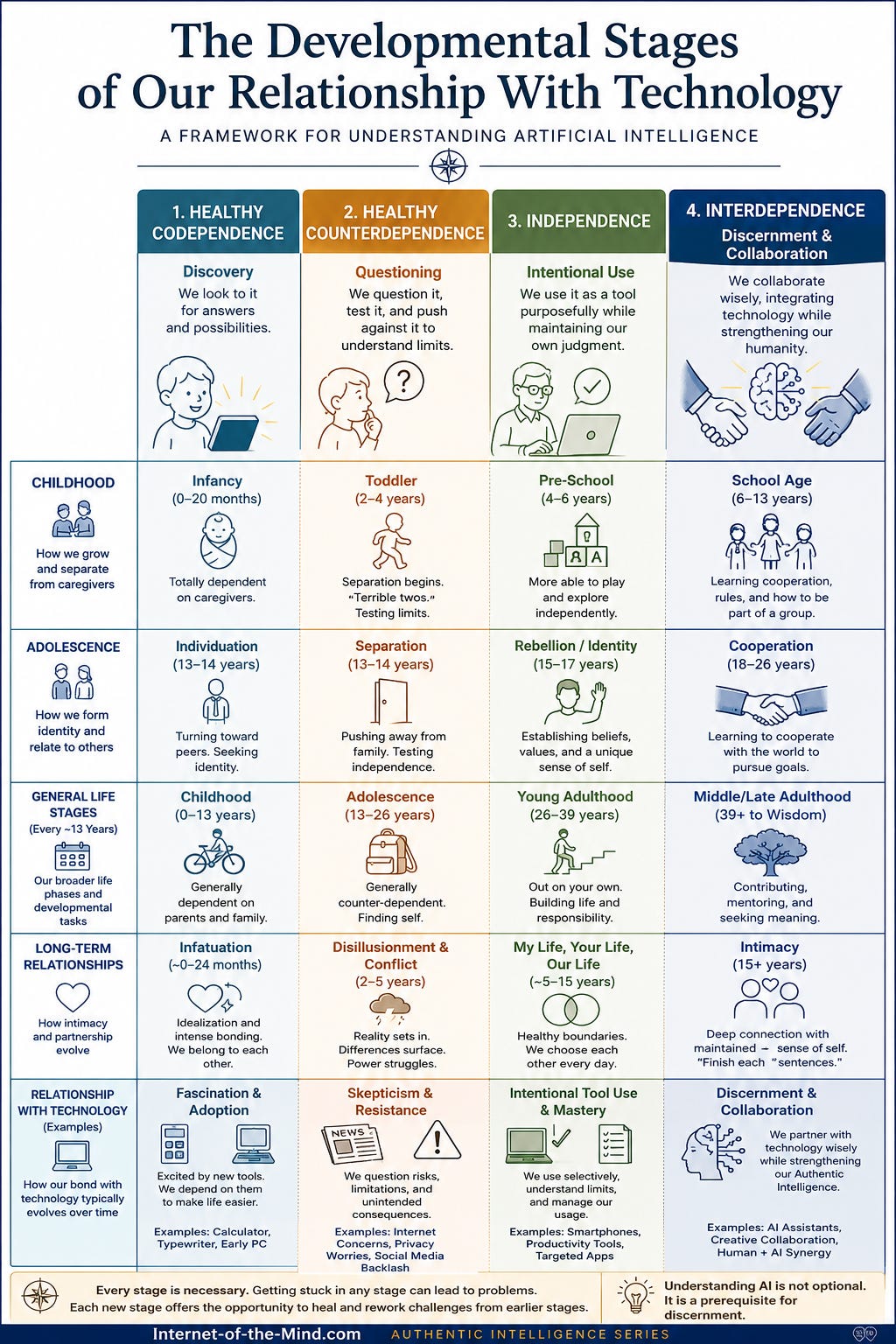
Human growth and development occur in predictable stages. Psychologists, educators, and developmental theorists have been mapping those stages for generations.
There are developmental stages of childhood.
Developmental stages of adolescence.
Developmental stages of adulthood.
Even long-term romantic relationships tend to progress through recognizable stages of growth.
These stages serve an important purpose. They function like a compass. They help us understand where we are in the process. They help us understand what challenges are normal for a particular stage. And perhaps most importantly, they help us anticipate what developmental tasks must be completed before healthy growth can continue.
What many people do not realize is that these seemingly different developmental processes often follow a similar underlying pattern.
Whether we are talking about:
children separating from parents,
adolescents finding their identity,
adults establishing healthy boundaries,
or couples learning intimacy,
The same recurring developmental sequence often appears:
Healthy Codependence → Healthy Counterdependence → Independence → Interdependence
Over the years I have come to view these as developmental stages within developmental stages — a recurring pattern woven throughout many aspects of human growth.
Recently I began wondering:
What if our relationship with technology follows developmental stages too?
And more specifically:
What if our relationship with artificial intelligence is progressing through these same developmental stages right now?
If so, understanding those stages may help us navigate the AI revolution far more wisely.
The Original Developmental Pattern
Let’s start with human development.
During infancy, healthy codependence is normal. An infant is completely dependent upon caregivers.
Food.
Protection.
Comfort.
Regulation.
Connection.
Without healthy dependence, survival is impossible.
Then comes toddlerhood. The famous “terrible twos.” Suddenly, the child discovers a powerful new word: “No.”
This is healthy counterdependence.
The child begins pushing against dependency.
Testing limits.
Establishing individuality.
Learning separation.
Without this stage, independence never develops.
Then comes increasing independence.
The child learns:
self-regulation
self-direction
competence
personal responsibility
Eventually, healthy development culminates in interdependence.
The ability to:
cooperate
connect
contribute
remain close to others
while maintaining a healthy sense of self
This same pattern appears repeatedly throughout life.
Adolescents separate from family before establishing adult identity.
Young adults move from dependence toward self-sufficiency.
Healthy marriages move from infatuation through conflict into genuine intimacy.
The pattern repeats.
Dependence.
Counterdependence.
Independence.
Interdependence.
Each stage serves a purpose. Problems emerge when people become stuck.
We Bring Attachment Patterns Into Everything
Another important reality is that we do not approach relationships as blank slates. We bring our attachment histories with us.
How we attach to:
parents
partners
friends
communities
institutions
often influences how we attach to new experiences and technologies as well.
Someone with a secure attachment style may approach AI with curiosity while maintaining healthy boundaries.
Someone with anxious attachment may become highly dependent on reassurance, validation, or constant information seeking.
Someone with avoidant tendencies may dismiss AI entirely without fully exploring its potential.
Someone with disorganized attachment may swing between fascination and fear, dependence and rejection.
In other words: The AI conversation is not only about technology. It is also about psychology. We are bringing our attachment systems into the relationship. Whether we realize it or not.
Stage One: Healthy Codependence
Every significant technology begins with fascination.
The calculator.
The personal computer.
The internet.
The smartphone.
Social media.
Artificial intelligence.
Initially, we are captivated by the possibility. We discover new capabilities. We become excited, curious, maybe even dependent.
This is not necessarily unhealthy. Healthy codependence is part of learning.
The infant depends upon the parent.
The student depends upon the teacher.
The beginner depends upon the tool.
Many people today are in this stage with AI.
The questions sound like:
What can it do?
How can it help me?
How much faster can I work?
What problems can it solve?
These are healthy questions. This stage encourages exploration and learning. Without it, innovation never occurs. The danger is not codependence itself. The danger is never progressing beyond it.
Stage Two: Healthy Counterdependence
Eventually, a developmental shift occurs.
The honeymoon fades.
Questions emerge.
Concerns surface.
Skepticism develops.
This is healthy counterdependence.
The toddler says no.
The adolescent rebels.
The young adult questions authority.
And society begins questioning new technologies.
We are witnessing this stage with AI right now.
People are asking:
Is AI dangerous?
Can it be trusted?
Will it replace jobs?
Is it manipulating us?
What happens to privacy?
What happens to relationships?
What happens to human creativity?
These are not signs of irrational fear. They are developmental questions. Counterdependence serves a vital purpose.
It prevents blind dependence.
It encourages critical thinking.
It creates boundaries.
It exposes risks.
Without counterdependence, people become vulnerable to exploitation. But this stage has its own trap. Some people become stuck here.
When Counterdependence Becomes Anti-Dependence
Not everyone moves through counterdependence. Some remain trapped in it. Instead of healthy skepticism, they develop rigid opposition.
This is anti-dependence. The difference matters.
Healthy counterdependence says:
“I need to evaluate this carefully.”
Anti-dependence says:
“I reject it completely.”
The same pattern appears everywhere. Some people become
permanently rebellious.
Permanently oppositional.
Permanently suspicious.
The issue is no longer discernment. The issue becomes identity. We can already see this emerging in portions of the AI conversation. For some people, opposition to AI has become a worldview rather than an evaluation.
Yet anti-dependence is no more mature than blind dependence. Both represent developmental arrest. Neither leads to wisdom.
Stage Three: Independence
Eventually healthy development produces independence. This is where tools become tools. Not saviors. Not threats — Tools.
The individual begins making conscious choices.
Understanding strengths.
Understanding limitations.
Understanding consequences.
In the AI world, independence sounds like:
I know when to use it.
I know when not to use it.
I verify important information.
I understand its limitations.
I maintain my own thinking process.
I use it intentionally.
At this stage, AI becomes neither master nor enemy. It becomes a resource. One among many. This is a significant developmental achievement.
But it is not the final stage.
Stage Four: Interdependence
Interdependence is where maturity emerges.
Not dependence.
Not rejection.
Collaboration.
Discernment.
Integration.
Healthy adults understand that life requires both autonomy and connection. Likewise, healthy technological adaptation may ultimately require both human intelligence and artificial intelligence. This is where I believe the future conversation becomes most interesting.
The question shifts from:
Should I use AI?
to
How can I collaborate with AI while strengthening my own Authentic Intelligence?
This is a fundamentally different conversation. It acknowledges:
benefits
limitations
opportunities
risks
simultaneously. It neither worships nor fears technology. It engages it consciously.
Authentic Intelligence
In previous articles, I introduced a phrase that continues to feel increasingly relevant:
Authentic Intelligence.
Artificial Intelligence excels at:
prediction
simulation
pattern recognition
information retrieval
optimization
Authentic Intelligence includes uniquely human capacities such as:
empathy
wisdom
ethical reasoning
emotional integration
discernment
accountability
meaning-making
sacrifice
relational depth
Artificial Intelligence may generate information. Authentic Intelligence determines what to do with it.
Artificial Intelligence may simulate understanding. Authentic Intelligence develops through lived experience.
Artificial Intelligence may predict patterns. Authentic Intelligence determines which patterns deserve our attention.
The future will likely require both. The challenge is ensuring that one strengthens rather than replaces the other.
Not All AI Is Created Equal
Another important reality is that not all AI systems share the same goals. Some are designed primarily to educate. Some are designed to assist. Some are designed to increase productivity.
Others are designed primarily to:
capture attention
maximize engagement
generate advertising revenue
influence behavior
increase retention
Mental health is no exception. The coming years will likely bring an explosion of:
AI therapy tools
coaching bots
self-help applications
emotional support platforms
Some will be thoughtful. Some will be helpful. Some may be remarkably innovative. Others may be little more than automated worksheets wrapped in sophisticated marketing.
Discernment becomes critical. And discernment requires knowledge. You cannot critically evaluate what you refuse to understand.
Discernment Is A Developmental Achievement
Perhaps this is the most important idea in this article. Discernment is not a personality trait. It is not intelligence alone. It is not education alone. Discernment is a developmental achievement.
It emerges through:
experience
reflection
skepticism
curiosity
boundaries
knowledge
integration
People who understand AI are better positioned to evaluate AI. People who understand attachment are better positioned to recognize unhealthy dependency. People who understand development are better positioned to recognize developmental traps. And people who understand themselves are generally better positioned to navigate it all.
The Next Developmental Challenge
We cannot stop the technological tsunami. Nor should we blindly surrender to it. Every generation must learn how to relate to the tools it creates. Perhaps the challenge of our generation is not learning how to build Artificial Intelligence. Perhaps it is learning how to develop enough Authentic Intelligence to use it wisely.
The future may not belong to those who adopt AI uncritically. Nor to those who reject it reflexively.
It may belong to those who progress through the developmental stages consciously.
From dependence.
Through skepticism.
Into independence.
And ultimately toward wise interdependence.
That journey may become one of the most important developmental tasks of the AI age.
Discussion Question
Looking at these four developmental stages:
Healthy Codependence → Healthy Counterdependence → Independence → Interdependence
Where would you place your current relationship with AI? And what helped you arrive there?
Guest Contributions Welcome
Internet-of-the-Mind is becoming a place for thoughtful exploration of how artificial intelligence is reshaping psychology, relationships, mental health, education, work, identity, and human development.
Thoughtful disagreement is welcome. Thoughtlessness is not.
If you would like to contribute a guest article or thoughtful counterpoint, submissions are welcome at:
support@serenitycreationsonline.com
Because the most important conversation about AI may not be technological at all. It may be developmental.