

For years, most people have viewed artificial intelligence primarily as a technology story. Faster computers. Smarter software. Better automation. More efficient businesses. But something much larger is happening beneath the surface.
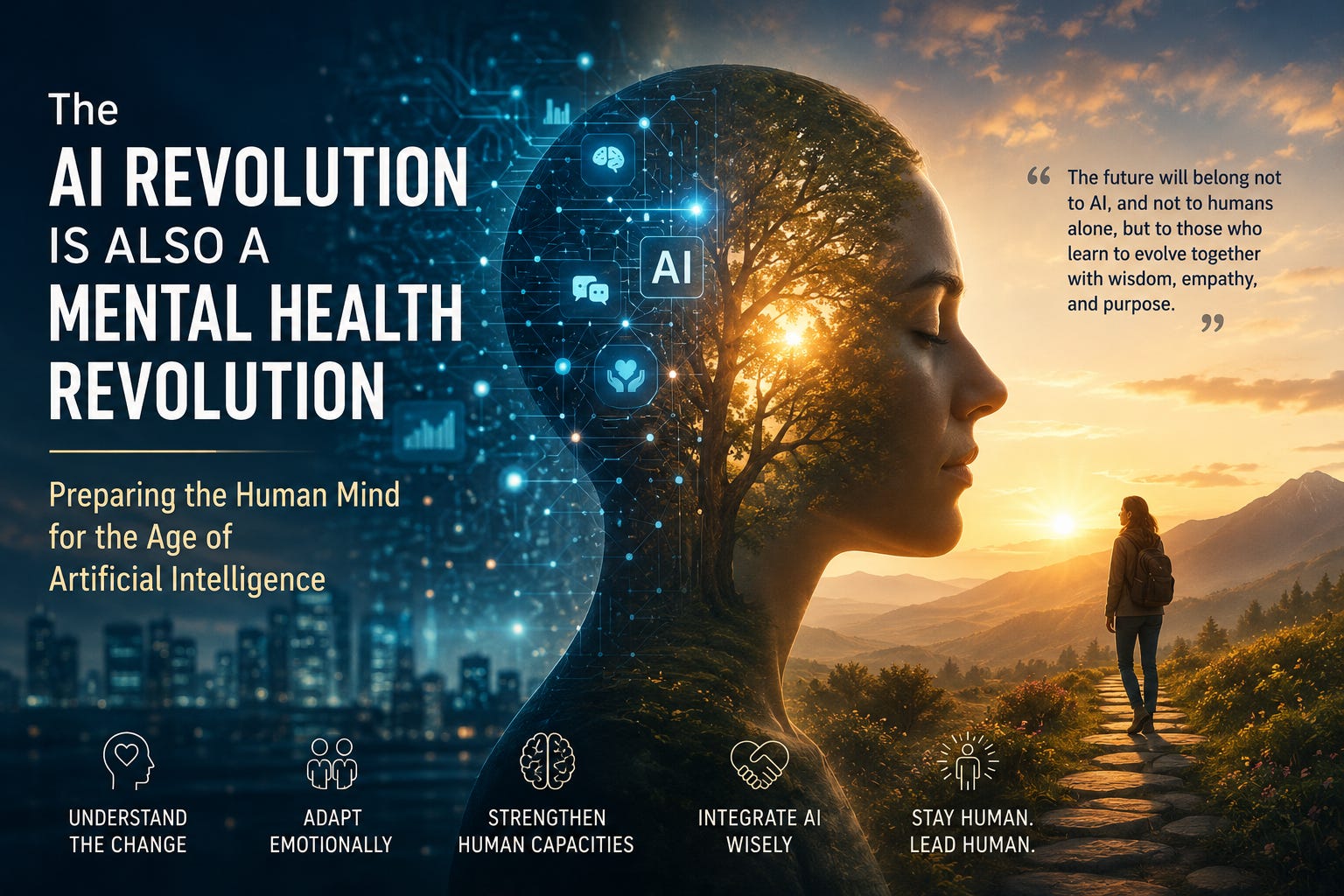
The AI revolution is not merely changing tools. It is changing the way human beings think, work, learn, relate, create, organize information, solve problems, and even understand themselves. It is beginning to affect not only industries and economies, but identity, emotional stability, relationships, education, attention, meaning, and psychological adaptation itself.
In many ways, this moment may ultimately prove to be even more disruptive than the birth of the internet.
The internet changed how we accessed information.
Artificial intelligence is changing what it means to interact with intelligence itself.
And the speed of this transition is unlike anything most of us have experienced before.
Some people are excited. Some are overwhelmed. Some are fascinated. Others are frightened, resistant, skeptical, or quietly exhausted by the pace of change.
All of those reactions make sense.
Human nervous systems adapt far more slowly than technology evolves.
That gap matters.
Because while technology is accelerating exponentially, emotional adaptation is not.
And that may become one of the defining mental health challenges of the next decade.
The Pace of Change Is Becoming Difficult to Process
Many people still think of AI as something “coming in the future.”
But for millions of people, the future has already arrived.
Students are using AI to learn, organize, and study.
Businesses are using AI for customer support, writing, coding, marketing, scheduling, and data analysis.
Medical professionals are using AI-assisted tools for documentation and diagnostics.
Writers, artists, educators, coaches, therapists, and consultants are all beginning to encounter a profound question:
“What happens when intelligent systems can perform portions of what I do?”
That question can evoke excitement and possibility.
It can also evoke fear.
Not because people are weak or unwilling to adapt, but because change at this scale activates something deeply human.
When our environments shift rapidly, our nervous systems begin scanning for danger.
Uncertainty increases.
Identity becomes less stable.
Old assumptions stop feeling reliable.
Protective parts of the self begin asking questions like:
“Will I still matter?”
“Will my skills still be valuable?”
“Can I keep up?”
“What if I fall behind?”
“What if the world changes faster than I can adapt?”
Those questions are not irrational.
They are adaptive human responses to uncertainty.
Historically, major technological revolutions unfolded slowly enough that generations had time to adjust.
The industrial revolution transformed labor, but it unfolded across decades.
The internet reshaped communication and business, but adoption still took years to normalize.
Artificial intelligence is moving differently.
New tools appear weekly.
Entire workflows change in months.
Capabilities that seemed impossible a year ago are now commonplace.
Many people are quietly experiencing cognitive and emotional overload while trying to function as though everything is normal.
And perhaps the most important point is this:
Most people have not yet realized that this is not only a technological transition.
It is also a psychological transition.
The Helping Professions Are Not Exempt
For a long time, many people assumed the helping professions would remain relatively untouched by AI.
After all, therapy, coaching, mentoring, teaching, and emotional support are deeply human activities.
And in many ways, they still are.
But something important is already happening.
Increasing numbers of people are turning to AI before they turn to another human being.
Not necessarily because they prefer machines over people.
But because AI offers something psychologically powerful:
Immediate access without fear of judgment.
People who would hesitate to tell another person:
“I think something is wrong with me”
“Why do I sabotage relationships?”
“Why can’t I stop overthinking?”
“Why do I feel numb?”
“Why do I keep repeating the same patterns?”
…may feel surprisingly willing to ask an AI system those questions.
Why?
Because shame often decreases when the perceived social risk decreases.
Many people feel emotionally safer exploring painful questions privately before exposing themselves relationally.
This matters enormously for the future of mental health.
AI is rapidly becoming:
a first-stop reflection tool
a journaling companion
a brainstorming partner
an educational guide
a language-organizing system
a psychological mirror
And this trend will likely continue.
But there is another side to this conversation.
While AI can help people organize thoughts, identify patterns, generate language, and reflect on experiences, there are critical areas where human relationship remains irreplaceable.
AI may help someone recognize a protective pattern.
A human relationship helps that protector feel safe enough to soften.
AI may help identify attachment wounds.
A healing relationship helps create corrective emotional experiences.
AI may help generate insight.
But insight alone rarely reorganizes the nervous system.
That distinction is important.
Because many people are going to discover something in the coming years:
Understanding a problem intellectually and transforming it emotionally are not the same thing.
And this is precisely where thoughtful clinicians, coaches, educators, and helpers may become even more valuable—not less.
People May Not Be Replaced by AI
There is a phrase I have heard occasionally that continues to resonate with me:
“People are not going to be replaced by AI. People are going to be replaced by people who know how to use AI.”
I believe there is considerable truth in that statement.
Especially in the helping professions.
The future may not belong to those who blindly embrace AI.
Nor to those who reject it entirely.
It may belong to people who learn how to integrate technological tools while remaining deeply human.
That requires a different mindset than fear-based resistance.
It requires adaptability.
Curiosity.
Discernment.
Ethical reflection.
Emotional regulation.
And perhaps most importantly:
The ability to continue learning.
The people most likely to struggle with this transition may not necessarily be those with the least intelligence or talent.
They may be those whose nervous systems become overwhelmed by change itself.
Because rapid change often activates older survival patterns.
Some people respond to uncertainty by becoming hypervigilant and overworking.
Others shut down, avoid, numb out, or disengage.
Some become angry and polarized.
Others become dependent on external certainty.
Still others become frozen between fascination and exhaustion.
From a psychological perspective, these responses make sense.
Different parts of the self attempt to maintain safety in different ways.
One protective part may want to learn every new AI tool immediately.
Another may want to avoid the entire subject altogether.
One part may feel inspired.
Another may feel threatened.
One part may see opportunity.
Another may fear becoming obsolete.
These inner conflicts are becoming increasingly common—not only among clients, but among professionals themselves.
And I suspect we are still in the very early stages of this process.
The Real Challenge Is Human Adaptation
I increasingly believe that the greatest challenge of the AI era may not be technological.
It may be psychological adaptation.
Human beings are remarkably adaptable, but adaptation becomes more difficult when change occurs too quickly, too continuously, and without sufficient emotional integration.
Many people are already experiencing:
information overload
chronic attention fragmentation
comparison fatigue
nervous system dysregulation
uncertainty exhaustion
fear of irrelevance
pressure to constantly optimize
identity instability
And these experiences do not remain confined to work.
They spill into:
relationships
parenting
education
self-esteem
purpose
spirituality
attention span
emotional resilience
In some ways, AI is amplifying existing human vulnerabilities.
But it is also amplifying existing human strengths.
This is why emotional adaptation matters so much.
Because technology does not remove human psychology.
It magnifies it.
People who already struggle with perfectionism may feel overwhelmed trying to keep up with constant innovation.
People with abandonment wounds may fear being left behind socially or professionally.
People with shame-based beliefs may interpret difficulty adapting as personal failure.
People with chronic nervous-system activation may become increasingly dysregulated in a world of accelerating stimulation and uncertainty.
And many individuals will likely need new frameworks for understanding these internal experiences.
This is part of why I have become increasingly interested in integrative approaches that combine:
nervous-system awareness
parts-oriented work
emotional regulation
belief systems
attachment understanding
cognitive flexibility
and adaptive learning
Because the future will likely require not only technological literacy, but psychological flexibility.
The ability to learn, unlearn, reorganize, and adapt emotionally may become one of the most valuable human capacities of all.
Ironically, AI May Increase the Value of Human Qualities
One of the great paradoxes of the AI revolution is that it may ultimately increase the value of distinctly human qualities.
As automation expands, the rarest and most meaningful capacities may become:
emotional presence
wisdom
discernment
ethical judgment
empathy
creativity
relational safety
psychological integration
self-awareness
nervous-system regulation
In other words:
The future may reward not only intelligence, but integration.
This is particularly important in the helping professions.
Clients are unlikely to stop needing:
attunement
safety
compassion
relational repair
emotional containment
co-regulation
human understanding
If anything, these needs may intensify as technological life accelerates.
The more digital the world becomes, the more emotionally hungry many people may feel.
The more overwhelmed nervous systems become, the more valuable grounded human presence becomes.
And this may create an important opportunity.
Not merely to survive the AI revolution.
But to evolve alongside it in healthy ways.
This Is Why I’m Beginning This Series
Over the coming months and years, I want to explore these questions more deeply.
Not only:
what AI is changing
but what it means for the human mind
the nervous system
relationships
emotional health
identity
learning
creativity
and the future of the helping professions
This series will likely evolve over time.
Some articles may focus on practical adaptation strategies.
Some may explore the psychology of technological change.
Some may examine how clinicians, coaches, educators, and helpers can use AI ethically and intelligently without losing the deeply human aspects of their work.
Others may explore emotional regulation, attention, overwhelm, inner conflict, protective patterns, or the challenge of maintaining humanity in an increasingly automated world.
I also suspect we will eventually need entirely new conversations about:
AI and attachment
AI and loneliness
AI and meaning
AI and identity formation
AI and nervous-system conditioning
AI and emotional dependency
AI-assisted healing
and the future relationship between human consciousness and intelligent systems
These are not merely technical questions.
They are human questions.
And perhaps most importantly, they are adaptation questions.
The Goal Is Not Fear
I do not believe fear is the answer.
Nor do I believe blind optimism is sufficient.
Every major technological transition creates both opportunities and risks.
Artificial intelligence is no exception.
There are legitimate concerns involving:
ethics
misinformation
manipulation
dependency
workforce disruption
concentration of power
emotional isolation
and misuse of highly persuasive systems
Those concerns deserve thoughtful discussion.
At the same time, there is also extraordinary potential.
AI may help democratize education.
It may help people organize thoughts more effectively.
It may support accessibility.
It may augment creativity.
It may help overwhelmed individuals find language for emotional experiences they could never previously articulate.
It may help clinicians organize information, reduce burnout, and expand access to psychoeducation and support tools.
The question may not ultimately be whether AI becomes integrated into society.
That process is already underway.
The deeper question may be:
“How do we remain psychologically grounded, relationally connected, ethically thoughtful, and deeply human while adapting to profound technological change?”
That is the conversation I want to explore.
A Final Thought
The internet transformed the external world.
Artificial intelligence may transform the internal world as well.
Not because machines are becoming human.
But because humans are increasingly interacting with systems that shape thought, attention, identity, learning, creativity, and emotional experience itself.
That means the next great frontier may not simply be technological advancement.
It may be inner adaptation.
And perhaps the future will belong neither to people who reject AI nor to those who surrender blindly to it.
Perhaps it will belong to people who learn how to integrate technology wisely while remaining connected to the deeper qualities that make us human in the first place.
Curiosity.
Compassion.
Discernment.
Creativity.
Wisdom.
Connection.
Presence.
In a rapidly changing world, those qualities may become more valuable than ever. Let’s begin the conversation. Enter your comments below.