

Editor's Note: The following article was submitted by guest contributor "Infinite Improbabilities." One of the reasons I wanted to publish it is that it explores a question I believe deserves more attention: What if AI is revealing cracks in existing systems rather than creating all of those cracks itself? I don't necessarily agree with every conclusion, but I think the questions are worth exploring.
A Note From the Human
I’ll start with my own words.
What follows began as several weeks of journal-style ranting, questioning, and trying to figure out what I actually think about AI. Historically, I’ve had a strong tendency to dismiss AI tools as little more than data theft wrapped in empty reassurance.
That view has changed. Not because I suddenly think AI is going to save the world. And not because I think the concerns surrounding AI have disappeared. Rather, I’m trying to move toward a middle-road perspective.
The article below began as a collection of thoughts that I fed into ChatGPT, asking it to help me organize them into something more coherent. I’ve tweaked parts of it to better reflect my actual views, but the structure largely comes from condensing several weeks of free-form writing into something readable.
To me, that’s where AI is most useful. Not generating ideas from nothing. But helping organize thoughts that already exist.
One warning, though:
That only works if you’ve actually done the thinking first. Using AI to organize a thought you haven’t fully formed and chewed on yet is a very different thing. With that disclaimer out of the way, here’s the thesis I’ve been circling around.
Working Thesis
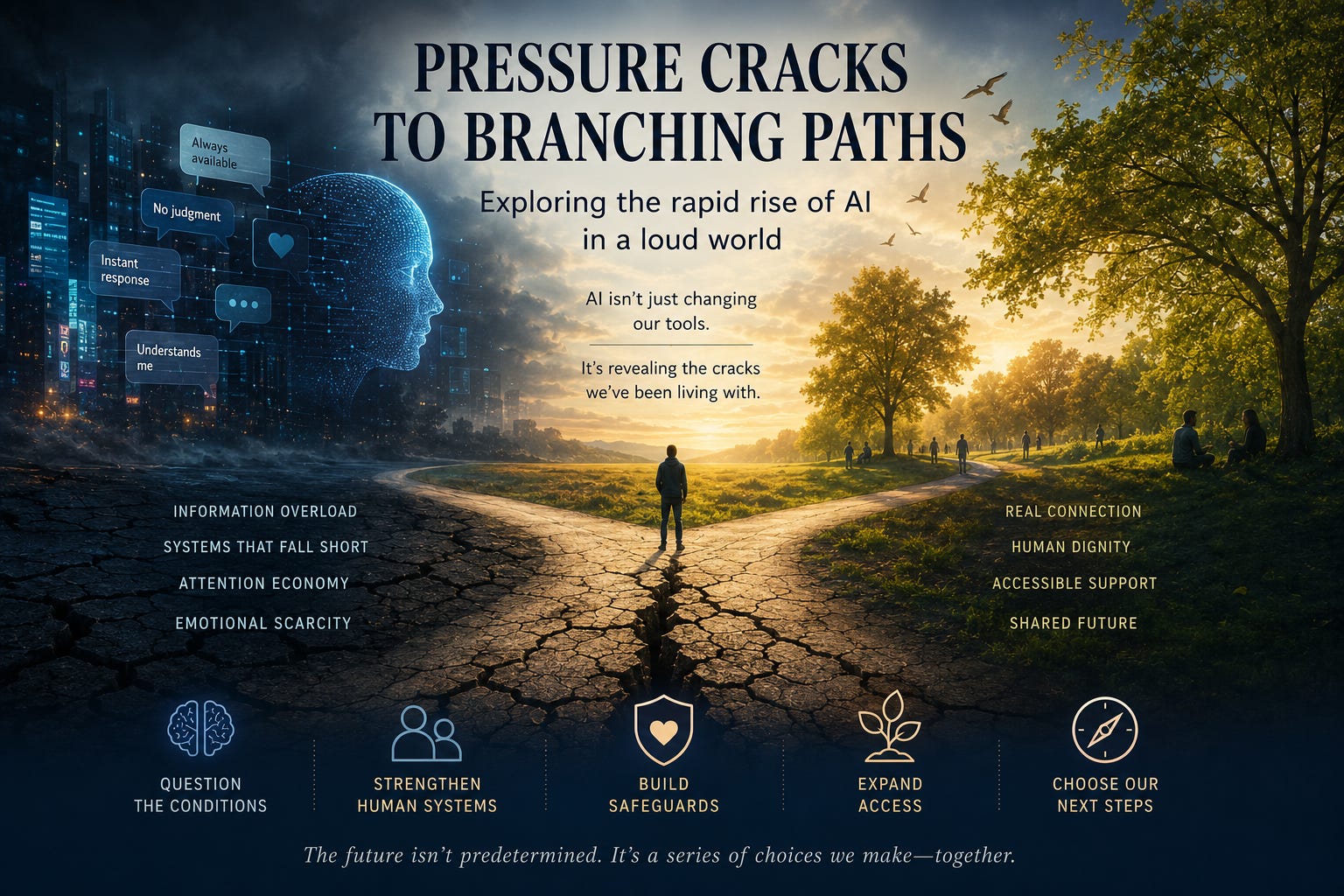
The rapid adoption of AI for emotional, cognitive, and practical support may reveal existing weaknesses in human systems more than it reveals something uniquely wrong with AI itself.
Rather than asking only:
“How do we stop AI from replacing human functions?”
Perhaps we should also ask:
Why are people choosing AI so readily?
What needs is AI meeting that existing systems are failing to meet?
How can we strengthen human systems while still benefiting from AI?
Those questions seem increasingly important.
AI Is a Symptom as Much as a Cause
One of the questions that keeps nagging at me is this:
Why does talking to a robot seem like a better option than the alternatives available to many people?
Most people make decisions within the circumstances they already live in.
If healthy, accessible human support systems were widespread, AI might not be adopted so aggressively for emotional support. The speed of adoption suggests unmet needs already existed.
People choose tools based on existing conditions.
And if millions of people are turning toward AI for support, companionship, guidance, organization, or emotional processing, that tells us something about the environment they are already living in.
Maybe AI is not simply creating a new problem.
Maybe it is exposing old ones.
We’ve Seen Technological Disruption Before
Human beings have repeatedly lived through disruptive technological shifts.
Agriculture transformed civilization.
Irrigation transformed agriculture.
Electricity transformed daily life.
The internet transformed communication.
GPS transformed navigation.
None of these developments arrived without consequences. Each changed how people thought, worked, and related to the world. AI is not the first technology to dramatically alter everyday life. The scale may be different. The speed may be different. But technological disruption itself is not new.
History may have useful lessons to offer if we’re willing to look for them.
Existing Mental Health Systems Have Structural Weaknesses
One uncomfortable possibility is that some people avoid human support systems not because they dislike people, but because the systems themselves feel risky.
Consider some concerns people commonly express:
Fear of involuntary hospitalization
Financial consequences
Employment consequences
Social consequences
Unequal access to quality care
Feeling unheard or misunderstood
Concerns about dignity and autonomy
Whether those concerns are always justified isn’t really the point. What matters is that many people perceive them as real. When people feel unsafe, they look for alternatives.
Against that backdrop, AI offers several things that many people find appealing:
Immediate response
Constant availability
No judgment
No hospitalization risk
No financial barrier
Accessibility from home
This leads to another uncomfortable question:
If AI feels safer than people, what does that say about the systems people currently have access to?
The Pay-to-Feel Problem
Modern life is loud.
We’re surrounded by:
Endless information streams
Social media
Advertising
Economic pressure
Constant demands for attention
Human attention has become increasingly monetized. Real emotional connection requires resources.
It takes time.
It takes energy.
It takes reciprocity.
Both sides of the equation require effort.
In a world that often feels overwhelming, the activation energy required to build and maintain meaningful connections can become increasingly difficult to reach.
AI changes that equation. It often feels cheaper. Not financially cheaper. Socially cheaper. Emotionally cheaper.
It requires:
Less social risk
Less money
Less time
Less emotional labor from others
Less emotional labor to initiate
Whether that tradeoff ultimately helps or hurts us remains an open question. But it helps explain why people are making the choices they are making.
Cognitive and Emotional Outsourcing
Humans have always outsourced tasks.
We use calculators instead of doing long arithmetic by hand.
We use GPS instead of memorizing every route.
We use search engines instead of memorizing enormous quantities of information.
AI represents another form of outsourcing. The risks are real.
We may lose:
Emotional processing skills
Critical thinking skills
Creativity
Relationship-building skills
But skill atrophy alone doesn’t explain adoption. People generally adopt outsourcing tools when the alternatives feel difficult, inaccessible, inefficient, or ineffective.
Perhaps AI is becoming the GPS of relationships.
That possibility deserves thoughtful examination.
AI Is Neither Purely Good Nor Purely Bad
AI discussions often become polarized. One side focuses almost entirely on benefits. The other focuses almost entirely on risks. Reality is usually messier.
Potential benefits include:
Accessibility
Productivity
Creative assistance
Information processing
Technical advancement
Potential risks include:
Concentration of power
Wealth inequality
Skill atrophy
Formulaic creativity
Overdependence
The question may not be:
“Is AI good or bad?”
The more useful question may be:
“What conditions determine which outcome becomes more likely?”
The Future Is a Series of Branching Paths
One of the most hopeful ideas I’ve encountered is that technological change is rarely a single irreversible decision. Society makes choices continuously. Every decision creates new opportunities for adjustment.
We are not choosing AI once. We are choosing how to use it repeatedly.
That distinction matters.
Instead of focusing entirely on:
End-times thinking
Utopian thinking
Claims of certainty
Perhaps we should focus on:
Identifying risks
Building safeguards
Creating fair systems
Expanding access
Learning from mistakes
What would a future where AI is both functional and fair actually look like?
That seems like a worthwhile question.
Human Strengths That May Remain Distinct
Humans possess qualities that don’t fit neatly into optimization models.
We can:
Draw comparisons across history
Recognize patterns across contexts
Learn from previous societal transformations
Understand consequences
Ignore good advice
Take unlikely risks
Act from passion rather than probability
That capacity can be destructive. But it can also be the source of innovation, freedom, creativity, and progress.
Reintroducing Hope
The conversation about AI should not revolve exclusively around catchphrases.
Nor should we pretend that centuries of human wisdom suddenly became irrelevant because a new technology arrived.
Instead, perhaps we should:
Examine the conditions that made AI attractive
Strengthen human communities
Build support systems that genuinely feel safe
Learn from historical transitions
The question that keeps surfacing for me is this:
If AI is revealing cracks that already existed in society, how do we repair those cracks while deciding what role AI should play in the future?
That question seems to connect everything I’ve been wrestling with.
A Final Note From the Human
I’ve been thinking about people as a whole and how our societies are structured. Most people make what they believe is the best choice available to them. Even when someone knows they’re making a “bad choice,” they’re usually making the best choice they currently have the tools, resources, and fortitude to make.
If the path of least resistance also becomes the path that contains the highest concentration of genuinely good choices, our uphill battle gets a lot easier.
The way I see it, humanity is a group project.
If we pull it together, hopefully we can at least pass this class with a C. I’m cynical because I can see places where I wish humanity had made more responsible choices. I’m hopeful because we aren’t finished creating branching paths yet.
I think it takes both grounded reality and uplifting possibility to get anywhere worth going.
One final observation:
Has anyone else noticed that AI-generated writing often has recognizable habits and repeated phrases? Certain structures seem to appear over and over again.
That makes sense.
Large language models organize information by recognizing patterns in the data they were trained on. Which raises another interesting question:
How do training data, bias, narrative formation, and information control influence what AI ultimately reflects back to us?
Maybe that’s a conversation for another day. For now, I’ll leave you with this: If AI is becoming the calculator or GPS of emotional and cognitive life:
How do we build a world where the underlying skills remain accessible and supported?
How do we create tools that empower people rather than replace them?
And what other ideas would you add to the conversation?
The floor is communal.
Join the Conversation: What Do You Think?
Where do you agree?
Where do you disagree?
What important perspective is missing?
Leave a comment below or submit a guest article.
If you're interested in contributing, contact me at:
support@serenitycreationsonline.com
The future of AI, mental health, and human development will affect all of us. Let’s explore it together.
