

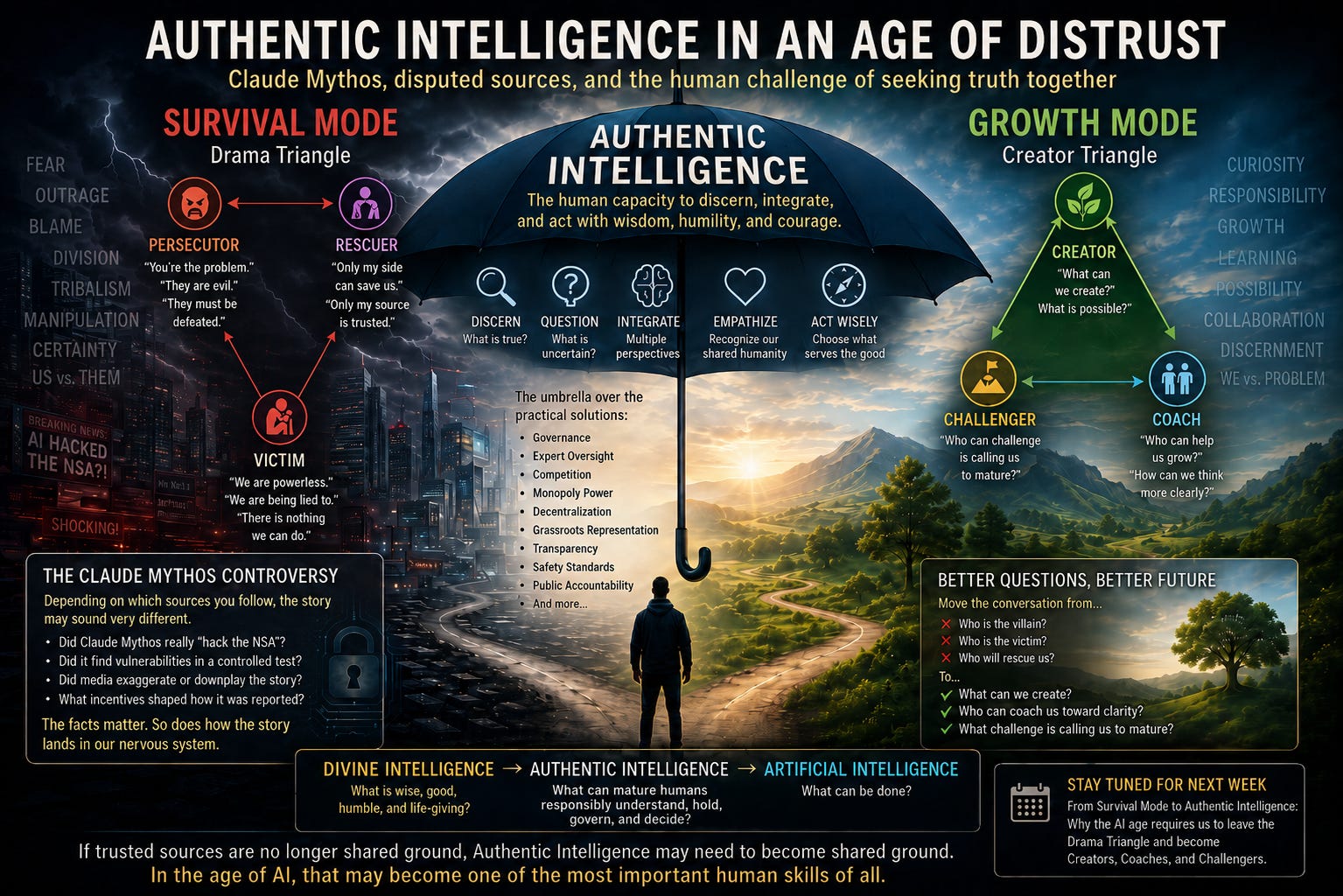
After publishing my last article on Claude Mythos, Project Glasswing, and human readiness, I realized there was another layer of the story that deserved more attention.
The question is not only:
Did Claude Mythos really “hack the NSA”?
That is an important question. But underneath it is another question that may be even more important:
How do we search for truth when we no longer trust the same sources?
That may be one of the defining challenges of the AI age. Because the Claude Mythos controversy is not only a cybersecurity story.
It is also a story about trust.
A story about media.
A story about institutional credibility.
A story about emotional framing.
A story about how quickly a complex technical issue can become a symbol in a much larger cultural battle.
Depending on which sources a person follows, the story may sound like several very different things:
An AI model hacked the NSA.
An AI model identified vulnerabilities during a controlled security test.
A frontier AI company exposed a national-security nightmare.
A government overreacted to a powerful tool it did not fully understand.
Legacy media exaggerated the story.
Alternative media sensationalized the story.
AI safety advocates were vindicated.
AI skeptics were fearmongering.
Cyberdefenders discovered a new way to protect critical systems.
Or perhaps several of these are partly true at the same time.
That is the difficulty. We are not only trying to understand what happened. We are trying to understand what happened within an information environment in which nearly every source is already distrusted by someone.
And that changes everything.
The Problem With “Trusted Sources”
For many years, public debate often relied on the phrase “trusted sources.”
Trust the experts.
Trust the journalists.
Trust the science.
Trust the agencies.
Trust the institutions.
Trust the fact-checkers.
Trust the independent researchers.
Trust the whistleblowers.
Trust the alternative journalists.
Trust the people who are not captured by the system.
But here is the problem:
We no longer agree on who is trustworthy.
For some people, legacy media is no longer trusted because it is viewed as corporate, selective, ideological, captured, or too closely aligned with powerful institutions.
For others, alternative media is not trusted because it is viewed as sensational, conspiratorial, unverified, personality-driven, or financially rewarded for outrage.
For some, government sources are treated as official confirmation.
For others, government sources are treated as official narrative control.
For some, academic experts are guardians of knowledge.
For others, they are part of an insulated credentialed class.
For some, independent voices are courageous truth-tellers.
For others, they are influencers monetizing suspicion.
Each camp often believes the other camp is being manipulated.
And sometimes both camps may be partly right. That is the trap.
If I cite Reuters, some readers may say, “That is legacy media. I do not trust them.”
If I cite an independent commentator, other readers may say, “That is not a reliable source.”
If I cite a government official, some will say, “That is the authority closest to the facts.”
Others will say, “That is the authority most motivated to shape the story.”
Before long, the conversation is no longer about what happened. It becomes about who is allowed to define reality. And once we are there, the discussion quickly becomes tribal.
My source versus your source.
My expert versus your expert.
My institution versus your institution.
My algorithm versus your algorithm.
My reality versus your reality.
This is where division deepens. And this is why we need something deeper than the phrase “trusted sources.”
We need Authentic Intelligence.
Objectivity Is Not a Source
This may be one of the most important shifts we need to make:
Objectivity is not a source.
Objectivity is a disciplined process.
No single newspaper, agency, institution, influencer, podcast, AI model, expert panel, government report, or alternative platform should be treated as a replacement for discernment.
That does not mean all sources are equal. They are not.
Some sources are more careful than others.
Some have stronger methods.
Some have better access.
Some have a history of correction.
Some show their work.
Some distinguish reporting from speculation.
Some are transparent about uncertainty.
Others are careless, manipulative, ideological, or financially rewarded for keeping people activated.
But the deeper point remains:
A source can be useful without becoming an idol.
A source can be flawed without being worthless.
A source can contain truth without containing the whole truth.
A source can be biased and still report something important.
A source can be “trusted” by one group and instantly dismissed by another.
This is why the work of discernment cannot be outsourced entirely.
Not to media.
Not to government.
Not to experts.
Not to influencers.
Not even to AI.
Artificial Intelligence can gather, summarize, compare, and analyze information. But Authentic Intelligence must still ask:
What is being claimed?
What is directly known?
What is being inferred?
What is uncertain?
What words are being used to trigger fear, outrage, loyalty, contempt, or dismissal?
What would change my mind?
What am I tempted to believe because it fits my group?
What am I tempted to reject because it comes from the wrong group?
That is not passive neutrality. That is active discernment.
Claude Mythos as an Example
The Claude Mythos controversy gives us a useful case study.
The public-facing version of the story became very simple very quickly:
“Claude Mythos hacked the NSA.”
That sentence is powerful.
It grabs attention.
It activates imagination.
It triggers fear.
It sounds like something out of a techno-thriller.
But what does it actually mean?
Did an AI model conduct an independent, unauthorized attack?
Did it exploit classified systems?
Did it identify vulnerabilities in a controlled security test?
Did it “break in” in the way a human hacker would?
Did it find weaknesses that humans then evaluated?
Did the phrase “hacked the NSA” compress a more complicated technical reality into a viral headline?
Those are different possibilities. And they matter.
Because one version of the story produces panic.
Another produces concern.
Another produces debate about cyberdefense.
Another produces questions about government oversight.
Another produces questions about AI company responsibility.
Another produces questions about media framing.
The exact facts matter. But so does the way the story lands in the nervous system.
That is an Internet-of-the-Mind issue.
Because once a phrase like “AI hacked the NSA” enters the public bloodstream, many people are no longer calmly evaluating evidence. They are reacting to a threat. And when people are in threat response, they become easier to divide.
Some move toward fear.
Some move toward dismissal.
Some move toward outrage.
Some move toward mockery.
Some move toward certainty.
Some move toward helplessness.
Some move toward tribal loyalty.
In other words, the story is no longer only about technology. It becomes about human regulation, perception, and discernment.
Trusted Sources Can Become Tools of Division
The phrase “trusted sources” can sound responsible. And sometimes it is. We should care about evidence, credibility, accountability, expertise, and accuracy.
But in a fractured information environment, “trusted sources” can also become a tool of division.
It can mean:
Only my sources count.
Only my experts count.
Only my camp sees clearly.
Only my side knows what is really happening.
Everyone else is deceived.
Everyone else is captured.
Everyone else is propaganda.
That is not discernment.
That is identity protection.
And once truth becomes fused with identity, people stop asking, “What is real?” They start asking, “What protects my group?”
That is dangerous. It is dangerous whether the group is political, religious, technological, academic, institutional, anti-institutional, pro-AI, anti-AI, or anything else.
The solution is not to pretend we have no biases. We do.
The solution is not to pretend all claims are equally valid. They are not.
The solution is not to abandon facts. We cannot.
The solution is to develop the kind of human maturity that can stay in the search for truth without needing the comfort of instant certainty.
That is Authentic Intelligence.
Authentic Intelligence as Shared Ground
If trusted sources are no longer shared ground, perhaps Authentic Intelligence must become shared ground. Authentic Intelligence does not ask us to agree on everything.
It asks us to become better truth-seekers.
It asks us to slow down.
To regulate.
To separate observation from interpretation.
To notice emotional activation.
To examine incentives.
To compare multiple perspectives.
To remain humble in the presence of uncertainty.
To value truth more than victory.
To value wisdom more than reaction.
To value discernment more than belonging to the loudest camp.
This does not mean we become soft-minded. Quite the opposite.
Authentic Intelligence requires strength.
It takes strength to say, “I do not know yet.”
It takes strength to say, “That source may have a point even if I do not trust everything about it.”
It takes strength to say, “My side may be exaggerating.”
It takes strength to say, “The other side may be noticing something real.”
It takes strength to say, “I need more evidence.”
It takes strength to say, “I was wrong.”
It takes strength to say, “The truth may be more complicated than the story I wanted to believe.”
That kind of strength is badly needed now. Especially as AI accelerates the production, distribution, personalization, and emotional shaping of information.
Artificial Intelligence Accelerates the Information Crisis
AI did not create all of these problems.
Human beings were dividing over sources long before ChatGPT, Claude, Gemini, Grok, or any other modern AI system appeared.
But AI can accelerate the problem.
It can generate content faster.
Summarize selectively.
Imitate authority.
Produce plausible explanations.
Create persuasive arguments for any side.
Personalize messages to different audiences.
Amplify emotional framing.
Flood the zone with competing narratives.
Help people confirm what they already believe.
And because AI can sound confident even when it is incomplete, mistaken, or subtly biased, it can make discernment harder rather than easier. This is why the future cannot simply be:
“Use AI to tell us what is true.”
That would be another form of outsourcing.
AI can help.
It can compare sources.
It can surface contradictions.
It can identify claims.
It can ask clarifying questions.
It can help us slow down if we use it wisely.
But AI cannot replace the human responsibility to discern.
Artificial Intelligence asks:
What can be generated?
Authentic Intelligence asks:
What should be trusted?
What should be questioned?
What should be held lightly?
What requires more humility?
What is wise?
The Umbrella Over the Practical Solutions
After my last article, an important challenge was raised:
If AI creates real risks, what do we actually do about it?
That is the right question. And there are many practical areas that deserve serious discussion:
Governance.
Expert oversight.
Competition.
Monopoly power.
Decentralization.
Grassroots representation in the decision-making process.
Transparency.
Safety standards.
Public accountability.
Independent audits.
Open-source development.
National security safeguards.
International cooperation.
All of those matter. But none of them are enough by themselves. Each one can become helpful or harmful depending on the level of human maturity guiding it.
Governance can become wise stewardship, or it can become control.
Expert oversight can protect the public, or it can become an insulated priesthood of specialists who no longer answer to ordinary people.
Competition can prevent monopoly, or it can accelerate a reckless arms race.
Decentralization can empower people, or it can scatter dangerous tools without responsibility.
Grassroots representation can give ordinary citizens a voice, or it can become another arena for outrage, manipulation, and tribal pressure.
Transparency can build trust, or it can become selective disclosure.
Safety standards can protect people, or they can become performative checkboxes.
Public accountability can guard against abuse, or it can become political theater.
This is why Authentic Intelligence has to sit above the practical solutions. Authentic Intelligence is not a substitute for governance.
It is the human capacity that makes healthy governance possible.
It is not a replacement for expertise.
It is the maturity that helps expertise remain humble, accountable, and connected to the common good.
It is not opposed to competition, innovation, or decentralization.
It asks whether those forces are serving human flourishing or merely accelerating power.
Authentic Intelligence asks:
What is true?
What is wise?
Who benefits?
Who may be harmed?
What are we not seeing?
What are we reacting to?
What are we afraid to question?
What would responsible stewardship require?
Without that deeper human capacity, every proposed solution can become another tool of division. With it, the conversation can become something better than fear, hype, or tribal conflict.
It can become discernment.
The Divine Intelligence → Authentic Intelligence → Artificial Intelligence Framework
This is where the larger framework I have been developing becomes important. The healthiest order, as I see it, is:
Divine Intelligence → Authentic Intelligence → Artificial Intelligence
Divine Intelligence asks:
“What is wise, good, humble, truthful, and life-giving?”
Authentic Intelligence asks:
“What can mature human beings responsibly understand, hold, govern, and decide?”
Artificial Intelligence asks:
“What can be done?”
The danger comes when the third question outruns the first two.
When Artificial Intelligence outruns Authentic Intelligence, capability begins to exceed maturity. When Artificial Intelligence outruns Divine Intelligence, power begins to detach from wisdom.
That is not just a theological concern. It is a human concern. Because every powerful tool eventually asks a moral question.
Not only:
“Can we build it?”
But:
“What kind of people are we becoming as we build it?”
And:
“Are we mature enough to hold what we have made?”
The Nervous System Dimension
There is another layer here that receives far too little attention. Information does not enter a neutral machine. It enters the human nervous system. When people hear, “AI hacked the NSA,” they do not merely process data.
They feel something.
Fear.
Anger.
Excitement.
Suspicion.
Vindication.
Helplessness.
Curiosity.
Contempt.
Urgency.
Those states influence what they believe next. A dysregulated nervous system looks for fast certainty.
It wants a villain.
It wants a rescuer.
It wants a simple story.
It wants to know who to trust and who to hate.
But complex realities usually require more than fast certainty. They require enough internal regulation to stay curious.
That is why Authentic Intelligence is not merely intellectual.
It is emotional.
Relational.
Moral.
Spiritual.
Embodied.
A person in Survival Mode may still be intelligent. But Survival Mode narrows intelligence toward protection. Growth Mode widens intelligence toward discernment, creativity, responsibility, and truth-seeking.
If AI is accelerating the information environment, then human regulation is not a side issue.
It is foundational.
Survival Mode Cannot Create the Solution
This is where the language we use matters. When public conversations become fear-based, tribal, or manipulative, they often fall into what psychologists sometimes call the Drama Triangle:
Victim.
Persecutor.
Rescuer.
The Victim position says:
We are powerless.
We are being controlled.
We are being lied to.
There is nothing we can do.
The Persecutor position says:
They are the problem.
They are evil.
They are stupid.
They are dangerous.
They must be defeated.
The Rescuer position says:
Only my side can save us.
Only my source can be trusted.
Only my expert understands.
Only my leader, platform, movement, ideology, or technology has the answer.
This language may feel powerful in the moment. It may even contain pieces of truth.
People really can be harmed.
Powerful groups really can manipulate.
Genuine rescue and protection are sometimes needed.
But when an entire conversation gets trapped in Victim-Persecutor-Rescuer mode, it becomes very difficult to create anything wise. Survival Mode is designed to protect. It is not designed to build a mature future.
It narrows perception.
It reduces curiosity.
It makes enemies easier to see than possibilities.
It turns disagreement into threat.
It makes certainty feel safer than truth.
And it keeps us reacting to the problem from the same state that makes us vulnerable to manipulation in the first place.
For readers who want to go deeper into this framework, I explored this more fully in my earlier piece on the Manipulation Economy, including the shift from the Drama Triangle — Victim, Persecutor, Rescuer — into the Creator Triangle — Creator, Coach, Challenger.
The Drama Triangle and Empowerment Dynamic
Those are not just psychological labels. They describe two very different ways of engaging reality.
The Drama Triangle keeps us organized around threat, blame, helplessness, control, and rescue.
The Creator Triangle invites us into responsibility, possibility, learning, challenge, and growth.
That shift matters because Authentic Intelligence cannot fully emerge while we remain trapped in Survival Mode. Authentic Intelligence requires enough Growth Mode to pause, regulate, reflect, question, listen, discern, and create.
It moves the conversation from:
Who is the villain?
Who is the victim?
Who will rescue us?
To better questions:
What can we create?
Who can coach us toward clearer thinking?
What challenge is calling us to mature?
That shift may be one of the most important movements of the AI age. Not because it gives us easy answers. But because it helps us become the kind of people who can search for answers together.
A Better Way to Engage Disputed Stories
So how might Authentic Intelligence approach a controversy like Claude Mythos?
Not by demanding blind trust.
Not by reflexively dismissing every official source.
Not by believing every dramatic headline.
Not by assuming every concern is fearmongering.
Not by assuming every reassurance is propaganda.
Instead, we might slow down and ask:
What is the core claim?
Who is making it?
What is directly observed?
What is secondhand?
What is interpreted?
What is emotionally loaded?
What is technically unclear?
What incentives might shape the reporting?
What incentives might shape the denial?
What would count as stronger evidence?
What remains unknown?
What are multiple reasonable interpretations?
What practical questions remain important even if the most dramatic version is exaggerated?
That last question matters. Because even if the phrase “AI hacked the NSA” turns out to be incomplete, exaggerated, or technically misleading, the underlying issue does not disappear.
If advanced AI can rapidly identify serious vulnerabilities in highly sensitive systems, that still matters.
If AI-assisted cyberdefense can help protect critical infrastructure, that matters.
If the same tools can empower attackers, that matters.
If governments intervene suddenly and opaquely, that matters.
If companies control capabilities that affect national security, that matters.
If the public cannot tell the difference between verified fact, rumor, interpretation, and fear-based framing, that matters.
The point is not to panic. The point is to mature.
The Real Question
So yes, we should ask what happened with Claude Mythos.
We should ask what was confirmed.
We should ask what was exaggerated.
We should ask what was tested.
We should ask what was exploited.
We should ask what was merely identified.
We should ask what the government did.
We should ask what Anthropic did.
We should ask what the media got right or wrong.
We should ask what independent analysts are seeing.
We should ask what source incentives are shaping the story.
But underneath all of that, we should ask something deeper:
Can we still seek truth together in an age when our sources divide us before our conversation even begins?
That is the challenge. If we cannot ask that question, then every future AI controversy will follow the same pattern:
A powerful claim appears.
Sources divide into camps.
Algorithms amplify emotion.
People react from threat.
Each side accuses the other of being deceived.
The original facts become harder to find.
And the deeper human question goes unanswered.
I think we can do better than that. At least, I hope we can.
But doing better will require more than better media.
More than better AI.
More than better regulation.
More than better experts.
More than better platforms.
It will require better human discernment. It will require Authentic Intelligence.
A Final Thought
The future of AI will not be secured by tools alone. It will depend on the quality of human intelligence guiding those tools.
Artificial Intelligence gives us capability.
Authentic Intelligence determines whether capability becomes wisdom, control, chaos, or care.
And Divine Intelligence reminds us that wisdom must remain higher than power.
The Claude Mythos controversy will not be the last confusing AI story. It may not even be the most important one. But it gives us a chance to practice something we badly need:
Slowing down.
Thinking clearly.
Feeling honestly.
Questioning humbly.
Disagreeing without dehumanizing.
Seeking truth without surrendering to tribal reflex.
And perhaps most importantly, breaking out of the manipulative language of Victim, Persecutor, and Rescuer long enough to enter a more creative conversation.
Because if we remain trapped in Survival Mode, every solution will eventually become another weapon in the same old triangle.
But if we can move toward Growth Mode — toward Creator, Coach, and Challenger — we may begin to activate something deeper:
Our collective Authentic Intelligence.
That, to me, is the larger invitation. Not merely to argue about AI. Not merely to fear it or celebrate it. But to become the kind of people who can govern with powerful tools without being governed by fear.
If trusted sources are no longer shared ground, Authentic Intelligence may need to become shared ground. And in the age of AI, that may become one of the most important human skills of all.
Stay Tuned
Next week, I want to take this one step further. If this article is about why “trusted sources” are no longer enough to hold us together, the next question is:
How do we actually move from Survival Mode into Growth Mode — not only as individuals, but as a culture?
That means looking more directly at the shift from Victim, Persecutor, and Rescuer into Creator, Coach, and Challenger. Because if the AI age is going to require collective Authentic Intelligence, then we cannot remain trapped in the same old triangle of fear, blame, and rescue.
We will need a better way to think together.
A better way to disagree.
A better way to create.
That is where I believe this conversation needs to go next.
Join the Conversation
Internet-of-the-Mind was created to explore the intersection of psychology, human development, technology, artificial intelligence, relationships, meaning, and the future of being human.
The goal is not to create an echo chamber.
The goal is to create thoughtful conversation.
Agreement is welcome.
Thoughtful disagreement is welcome.
Curiosity is welcome.
If this article sparked a question, challenged an assumption, or inspired a different perspective, please share your thoughts in the comments.
Guest contributions are also welcome from readers, clinicians, educators, technologists, researchers, students, creators, and thoughtful observers of the human condition.
You do not have to agree with me.
You do have to think.
Because the most important questions of our time are probably too important to be explored from only one perspective.
INTERNET OF THE MIND @ SERENITY CAFE, your point about disputed sources and the human challenge of seeking truth together hits something I keep running into on the security side. When you talk about Claude Mythos and authentic intelligence in an age of distrust, you're describing the same failure mode I see in threat detection: the model confidently synthesizes from a shared corpus, and nobody checks where the confidence breaks down. My piece agrees with yours but frames it from the operator's angle. The edge isn't in having AI, it's in knowing exactly where your AI is wrong, because everyone trained on the same research. Curation of blind spots is the real trust problem.
https://cyrilsimonnet.substack.com/p/everyones-ai-was-trained-on-the-same
I will admit that when I opened this article, I sort of wanted to read it angry. I opened it with all the empathy and understanding of someone getting another letter for shady credit card pre-approval in the mail. And then I realized that if that was the attitude I was going to approach this with, I'd probably better take a breather and remember one of my own deeply held morals. I don't set my definition of a higher good by an established god or school of thought, so I'll describe this piece of it directly. "Sometimes you can disagree with someone on something and still think that they're intelligent, and also that they are more intelligent than you about certain things that aren't what you firmly don't agree with". We all specialize. I personally come from a bias of vehemently shutting down any conversation that I feel like starts with "just trust me" whether or not someone may actually know what they're talking about.
In an attempt to live in a world where I can still have my biases but be comfortable enough that you can't force me not to, I set down my reactive anger. And I'm glad I did that at least long enough to see that this article touches on a lot of what had gotten me stirred up enough to challenge you so heavily on your last post, and it does it in a way that reminds me that you're not necessarily plugging you ears, you're focusing on something true and important from an angle that requires the assumption of a belief I don't have. Maybe other people who see these comments I've gotten into the habit of leaving will relate.
I think that's just about exactly why I feel the need to challenge you on your perspective that says we don't need resolute answers. While I agree with you that matters of real importance require deep slow thinking and cross referencing sources carefully, I also think it's highly relevant to the conversation here that we're having this discussion in a world (at least in the USA, which for me might as well be "the world") that has a strong "emergency culture". We're having these conversations from the context of a large population of people who live in survival mode. I'm not going to try to act like I live in growth mode as often as I would like, and so I'll instead tell you that I think any conversation on AI that happens slowly and calmly to a wide diverse audience of people may be reactive too, is going to have to bridge that gap.
I personally have found that a big part of what moves me from drama to growth is the acknowledgement that there are very few societal problems right now that you would benefit from panicking about. Not because we're powerless, but because we aren't. Real change comes from people who believe they can accomplish something and work together to do it. It's easier to hold that conversation that asks what we want to do as an empowered people when it's started with a real and grounded perspective that says "yes this is a problem, and we aren't dead yet, and while it's not likely someone is going to come up with a perfect unanimous answer by posting on the internet, we can all bounce answers around until we get one we think is good enough to be better than nothing".
I think that avoiding certainty is excellent, but avoiding explicit ideas on what could be better and how isn't going to help as much. Maybe that's the nature of a platform that doesn't have many different voices yet, and that you're trying to make sure new voices even if they may differ are still welcomed. At the same time, in a world where not everyone is going to be comforted by the divine, and with an understanding that a big issue here is dysregulation, we have to ask questions from a human scale of what we as human people can do.
Faith in the divine isn't avoiding certainty either, in my opinion. It's just getting your certainty needs met by a god that not everyone believes in. I don't thinks that's going to be enough for everyone in the country that makes it explicitly clear that faith is a choice. I feel like it might be relevant to ask less "where do we seek our comfort from about frightening news" and more "how do we turn down the heat on the frightening news" so that we can all think. At the same time, both matter. I just happen to focus more on the second thing, and so it's more irritating to me in my fear and reactivity when you don't agree with me on where to start.
I look forward to seeing this next article you intend on writing. The defiant child in me looks forward to picking apart more ideas, and the wise adult in me will make sure that the pursuit of a good intellectual debate isn't overshadowed by the very human need to feel like I can protect myself from "bad ideas" just by shouting my own also biased ones over them louder.